Dynamic Clock Speed Management and Advanced Firmware Redefine Bitcoin Mining Profitability Amid Fluctuating Energy Markets
In the contemporary landscape of industrial Bitcoin mining, the era of the "set-and-forget" operational strategy has officially drawn to a close. As electricity markets grow increasingly volatile and the hardware fleet deployed across global data centers diversifies, mining operators are being forced to adopt sophisticated optimization techniques. At the heart of this operational evolution is clock speed management—the precise adjustment of operating frequencies on mining Application-Specific Integrated Circuits (ASICs) to strike a delicate, dynamic balance between raw performance and energy consumption. With current market conditions dictating a hashprice of $0.055 per terahash per day, mining efficiency has transitioned from a background metric to the primary determinant of financial survival.
Understanding Clock Speed Management
Clock speed management is fundamentally about adaptation. Operating in an industry where energy prices can swing dramatically from hour to hour requires mining infrastructure to be equally fluid. The foundational physics of semiconductor chips dictate a strict economic trade-off: higher clock speeds increase performance but degrade energy efficiency, while lower clock speeds conserve power at the expense of total hashrate output. Smart miners leverage this dynamic not as a rigid setting, but as a continuous knob to fine-tune their operations against real-time market conditions.
This operational reality means that not all hashrate is created equal. The hardware ecosystem currently supporting the Bitcoin network spans a wide technological spectrum, ranging from aging legacy machines like the Antminer S19 to cutting-edge deployments such as the Antminer S21 Pro and the S21 XP. These different generations possess distinct optimal operating ranges. Depending on a facility’s specific electricity rate, running every machine at factory default settings is often a sub-optimal strategy. Instead, operators frequently find that profitability is best unlocked by downclocking older generation hardware to squeeze out extra efficiency or by overclocking newer models when local power costs drop low enough to justify the aggressive energy draw.
Historical deployment strategies generally grouped miners by purchase date and left them running identical profiles indefinitely. Today, however, hardware strategy must be segmented by model capabilities. Older models like the Antminer S19j Pro and the MicroBT Whatsminer M30s face high energy costs relative to their output, making downclocking essential to avoid unprofitable hashrate and keep them viable. Mid-generation units such as the S19 XP and M50s occupy a nuanced middle ground where profitability is heavily dictated by custom firmware capabilities and local energy tariffs. Conversely, modern flagship hardware like the S21 Pro and M60s can be aggressively overclocked to maximize return on investment whenever cheap power is abundantly available.
Breakeven Efficiency and the Cost of Power
The financial margin in Bitcoin mining is defined by breakeven efficiency—how effectively a machine converts a kilowatt-hour of electricity into valid hashes. With the hashprice resting at $0.055 per terahash per day, every single Joule matters. This makes the choice of firmware a critical lever for modern operators.
Standard stock firmware provided by manufacturers generally offers rudimentary power modes, usually limited to a single high or low speed preset. In contrast, advanced third-party solutions like Braiins OS utilize sophisticated autotuning engines to calibrate voltage and frequency settings on a chip-by-chip basis. Because power consumption scales with the square of voltage, minor reductions in operating voltage—achieved through controlled downclocking—can yield massive improvements in Joules per terahash performance.

For legacy machines, the efficiency gains can be substantial. An older Antminer S9 operating on stock firmware typically consumes around 98 Joules per terahash, but with Braiins OS optimization, that figure can drop to 70 J/TH, representing a significant 29 percent improvement in efficiency. Similarly, the Antminer S17 sees efficiency drop from 45 down to 31 J/TH, a 31 percent enhancement. Even modern architectures benefit; the Antminer S21 improves from 17.5 to 15.4 J/TH, while the high-end S21 XP moves from 13.5 down to 11.9 J/TH. These granular efficiency gains shift the needle on what electricity prices a facility can endure.
When mapping these efficiencies directly against electricity costs, the economic boundaries become stark. At very low power rates near zero, nearly any functioning hardware remains profitable under both stock firmware and advanced alternatives. However, as electricity prices climb toward $0.04 to $0.06 per kilowatt-hour, legacy machines on stock firmware quickly slip into negative margins. Advanced firmware extends the operational lifespan of these older units by maintaining profitability slightly further up the pricing curve. Yet, as power prices escalate toward $0.10 or higher, even mid-generation hardware begins to falter unless managed with extreme precision, leaving only the newest generation of hardware capable of weathering high tariffs.
This dynamic is further complicated by the rise of index-priced energy contracts, where a miner’s electricity rate is tied directly to real-time or day-ahead wholesale power markets. During periods of extreme grid stress or peak demand, electricity prices can spike to levels that render entire fleets unprofitable instantaneously. To combat this, advanced operations are increasingly turning to strike price curtailment. By integrating management platforms like Braiins Manager, operators can establish automated safety nets. When wholesale power prices breach a predefined profitability threshold, the software automatically pauses the mining fleet and brings the hardware back online only after market prices normalize, protecting profit margins from unexpected volatility.
Intelligent Efficiency Through Autotuning and Centralized Control
The technological backbone enabling these advanced strategies is automated chip-level tuning. When operators input specific power or hashrate targets into Braiins OS, the software deploys a proprietary autotuning algorithm designed to find the absolute physical limit of the silicon. Rather than applying a blanket setting across an entire hash board, the algorithm evaluates individual chips, calibrating voltage and frequency precisely to ensure the machine operates on the bleeding edge of efficiency for the chosen target. This eliminates the tedious process of manual trial-and-error and ensures hardware consistently performs at its highest economic potential.
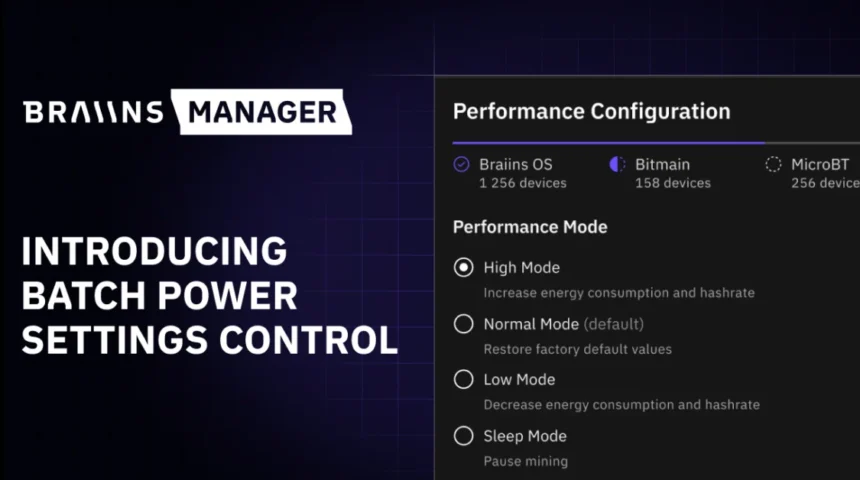
To manage these capabilities at scale, operators require centralized control centers. Modern management suites allow data center administrators to implement dynamic performance scaling and batch configurations across thousands of machines simultaneously. Instead of treating miners as static appliances, facility managers can adjust operational parameters on the fly, responding dynamically to minute-by-minute shifts in energy pricing and network difficulty.
Ultimately, the confluence of fluctuating energy markets, widening hardware efficiency gaps, and sophisticated firmware engineering has transformed Bitcoin mining into an exercise in high-frequency operational management. By moving away from rigid factory settings and embracing granular, automated control over clock speeds and power consumption, modern mining operations are securing the operational resilience necessary to navigate an increasingly competitive global landscape.

Related News