Global Human Rights Coalitions Urge Bangladesh Government to Overhaul Deeply Entrenched State Surveillance Frameworks
July 28, 2026
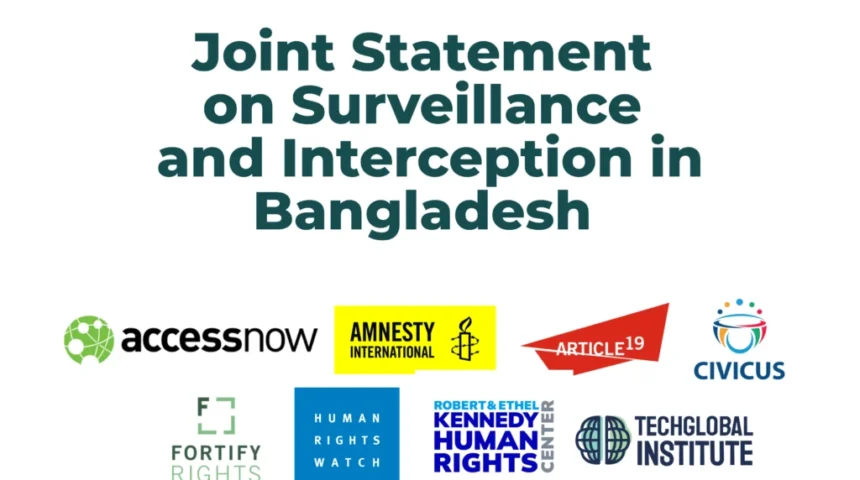
A coalition of eight prominent international human rights and digital rights organizations—including Access Now, Amnesty International, ARTICLE 19, CIVICUS: World Alliance for Citizen Participation, Fortify Rights, Human Rights Watch, the Robert & Ethel Kennedy Human Rights Center, and the Tech Global Institute—has issued an urgent appeal to the Government of the People’s Republic of Bangladesh. The coalition is calling on the administration to implement sweeping legal, institutional, and governance reforms to dismantle the unchecked expansion of state surveillance and interception capabilities inherited from the past sixteen years.
While welcoming the government’s broader stated commitments to advance legal, institutional, and political reforms during the nation’s ongoing transition, the civil society groups emphasized that addressing the legacy of unrestrained digital monitoring is paramount. During the previous administration, sweeping surveillance powers and sophisticated technologies were aggressively deployed across military, intelligence, and civilian law-enforcement structures. Operating largely in the shadows, these mechanisms functioned without meaningful transparency, independent oversight, or effective accountability structures.
The targets of this expansive apparatus were not limited to opposition political figures—ironically including members of the ruling Bangladesh Nationalist Party (BNP)—but also encompassed human rights defenders, civil society actors, independent journalists, and grassroots activists. The coalition highlighted that in its election manifesto, "Bangladesh Before All," the BNP explicitly pledged to strengthen accountability, uphold the rule of law across all levels of the state, restore professionalism and discipline within security and intelligence agencies, and enact vital legislative safeguards to permanently prevent any re-emergence of authoritarian governance. Fulfilling these pledges, the organizations argue, is critical to rebuilding public trust, reinforcing democratic state institutions, and safeguarding fundamental human rights.
Evidence of the Scale and Impact of Surveillance and Interception Practices in Bangladesh Warrants Urgent Attention
The scale of the institutionalized surveillance apparatus has only recently come to light through extensive investigative reporting and official findings published since 2024. A comprehensive report by the Tech Global Institute detailed the aggressive procurement and deployment of deep interception, monitoring, and data-analysis tools across military, intelligence, and civilian agencies, revealing public expenditures of at least US$ 190 million between 2015 and 2025. Concurrently, investigative reports by The Daily Star indicated that the former government poured at least US$ 120 million into parallel surveillance infrastructure between 2016 and 2024.
Following the public exposure of these procurement sprees in August 2025, the interim government reportedly established a high-powered review committee to investigate the acquisition and operational deployment of surveillance technologies. That committee formally submitted its findings to Chief Adviser Professor Muhammad Yunus on February 10, 2026. However, the report has remained confidential. Alarmingly, an amendment to the nation’s telecommunications laws was rushed through and published in the official gazette before the committee could formally release its recommendations, heavily implying that expert findings were sidelined during the legislative process.
These concerns are further substantiated by the United Nations Office of the High Commissioner for Human Rights in its comprehensive Fact-Finding Report concerning human rights violations tied to the mass protests of July and August 2024. The UN report revealed an expansive surveillance architecture that had long transcended traditional national security boundaries, becoming deeply integrated into the systematic repression of civil and political dissent by police and military forces. Security agencies routinely shared intercepted communications to track critics, identify dissidents, and orchestrate arbitrary arrests, enforced disappearances, physical intimidation, medical interference during treatment, and the violent suppression of public demonstrations—all operating under the direct authority of senior executive branch officials without any institutionalized parliamentary checks or independent judicial oversight.
Despite these revelations, the expansion of the state’s digital monitoring apparatus continues unabated. Reports indicate that as recently as May 2026, the government greenlit a procurement valued at approximately BDT 94.95 crore for the National Telecommunication Monitoring Centre (NTMC). The contract includes advanced technologies capable of filtering, blocking, and actively monitoring online content while managing massive network traffic volumes across national data centers. Furthermore, the 2026–27 national budget allocated a staggering BDT 73,640 crore collectively to the Ministry of Home Affairs, the Ministry of Defence, and the Armed Forces Division—accounting for 7.85 percent of the total national budget.
While civil society groups acknowledge that budgetary allocations for national security are necessary, they stress that a severe lack of public transparency surrounds how funds dedicated to surveillance and interception technologies are managed, procured, and supervised. Without clear public disclosures, these financial streams risk perpetuating and expanding systems that fundamentally undermine civil liberties.
Legal and Institutional Safeguards Necessary to Prevent Misuse Have Not Evolved at the Same Pace
The coalition expressed profound concern that Bangladesh’s overarching surveillance architecture remains technologically sophisticated, institutionally entrenched, and dangerously broad, lacking the necessary legal and procedural safeguards to prevent administrative abuse.
During the interim administration, the adoption of the Bangladesh Telecommunication Regulation (Amendment) Ordinance, 2026 represented an initial, albeit incomplete, step toward meaningful reform. It attempted to move away from legacy models of unchecked surveillance by introducing structured procedural safeguards. However, the subsequent enactment of the Bangladesh Telecommunication Regulation (Amendment) Act, 2026 by the current government stripped away many of these crucial protections, instead expanding discretionary powers for authorities wielding intrusive surveillance tools.
Specifically, while Section 97A retained broad interception powers, it diluted rights-oriented terminology, eliminated specific accountability architectures, and weakened transparency provisions introduced in the earlier ordinance. Furthermore, the amended statute preserves the role of the NTMC despite the ongoing absence of a clear public-facing statutory mandate, independent oversight mechanisms, or regulatory frameworks governing its operations. Consequently, the current legal environment empowers regulatory, intelligence, and law-enforcement bodies to conduct sweeping surveillance and issue binding directives to telecommunications service providers, leaving citizens virtually powerless to challenge the legality, necessity, or proportionality of such measures before an independent judicial body.
Compounding these issues, the newly enacted Personal Data Protection Act, 2026 grants extensive exemptions to state authorities under overbroad definitions of national security, defense, public order, public interest, and criminal investigations. When combined with the National Data Management Act, 2026—which introduces centralized database integration frameworks, interoperability initiatives, and potential data localization requirements—these statutes create profound legal uncertainty regarding personal data governance. Rather than protecting citizens, the cumulative effect of these laws facilitates the large-scale aggregation, sharing, and retention of personal data across government databases, opening the door to unchecked state surveillance without independent scrutiny or effective legal redress.
While the coalition acknowledges that legitimate public interests—such as counter-terrorism, serious crime investigations, and national security—may necessitate targeted intelligence-gathering capabilities, they emphasize that effective security and fundamental rights are mutually reinforcing rather than competing objectives. The current domestic framework falls woefully short of international standards concerning legality, transparency, due process, and protection against arbitrary interference with privacy and freedom of expression.
Recommendations
More than five months have elapsed since the new government assumed office in February 2026. While steps have been taken in various policy areas, the absence of a comprehensive, transparent review of Bangladesh’s surveillance and intelligence governance framework remains deeply troubling.
In light of the BNP’s stated commitments to institutional accountability and the rule of law, the human rights coalition has urged the government to adopt a series of fundamental reforms:
First, the government should establish an independent legislative reform commission tasked with conducting a thorough, transparent review of all existing laws, regulations, and executive instruments enabling surveillance. Operating in close consultation with civil society and technical experts, the commission should identify provisions requiring amendment or repeal to ensure compliance with constitutional precedents and international human rights obligations. This body should also publish its comprehensive findings and make public the long-suppressed report of the high-powered committee established by the interim administration.
Second, authorities must enact a clear, narrowly tailored, and publicly accessible legal framework governing all investigative and surveillance powers. Rather than patching up legacy telecommunication regimes, a dedicated primary statute should regulate the entire lifecycle of surveillance technologies—from deployment and data access to retention, sharing, oversight, and redress—grounded strictly in the international legal principles of legality, necessity, and proportionality. Overbroad legal immunities shielding officials from accountability for surveillance abuses must be repealed.
Third, the legal framework must explicitly regulate the import, transfer, and procurement of intrusive dual-use surveillance technologies. Given Bangladesh’s reliance on foreign technology imports, all acquisition proposals should be subjected to rigorous prior scrutiny by civilian authorities, guided by human rights impact assessments, end-use declarations, and strict necessity standards. Public disclosure of vendors and procurement capabilities should be mandated, along with the exclusion of tools carrying a substantial risk of human rights violations.
Fourth, all surveillance and interception operations must be subjected to prior authorization by an independent judicial authority, except in narrowly defined emergencies subject to rapid ex post review. Independent judicial oversight must extend beyond initial approvals, granting affected individuals access to post-surveillance remedies, judicial review, the suppression of unlawfully obtained evidence, and financial compensation for rights violations.
Fifth, the government should establish an adequately resourced parliamentary oversight committee to periodically monitor the surveillance activities of civilian and military agencies. This committee must possess the authority to summon officials, compel document production, review procurement contracts, investigate abuses, and publish public audit reports to ensure sustained democratic accountability.
Finally, exemptions to data privacy under the Personal Data Protection Act, 2026 must be narrowly defined and subjected to robust administrative and judicial safeguards. Blanket carve-outs granting unrestricted state access to personal data must be reformed to protect citizens from arbitrary digital intrusion, device searches, and unauthorized extractions of cloud backups.
The coalition concluded by expressing its readiness to engage constructively with policymakers, regulators, civil society organizations, and technical experts to foster a rights-respecting framework that balances national security with fundamental human freedoms.

Related News