Growth vs. Value Extremes Hit Big Tech as the Massive AI Spending Bill Finally Comes Due
By Lance Roberts
October 31, 2026
Value stocks have decisively crushed growth for four straight weeks, and the monumental bill for artificial intelligence infrastructure has finally come due. For months, market participants cheered massive corporate outlays directed toward the artificial intelligence revolution, viewing heavy data center buildouts and accelerated chip acquisition as necessary investments in the future. However, the risk facing investors now is the dangerous assumption that the recent defensive rotation and flight to safety still have plenty of room to run.

Market Brief: The AI Bill Comes Due
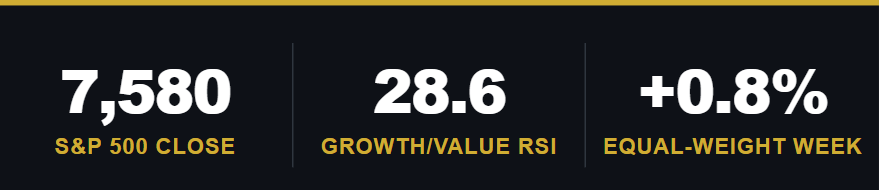
Last week’s market analysis warned that a sudden "Meta-style reaction" to corporate mega-cap earnings reports could easily drive the S&P 500 below its 100-day moving average and back toward the lows seen in September. Alphabet delivered precisely that kind of reaction on Thursday, and Intel finished the job on Friday. The S&P 500 tumbled 1.8% on Friday to close at 7,580, marking its lowest settlement since September 16 and bringing its weekly loss to 0.6%. On Friday alone, the tech-heavy Nasdaq Composite dropped 2.9%, while the Dow Jones Industrial Average lost 1.1%.
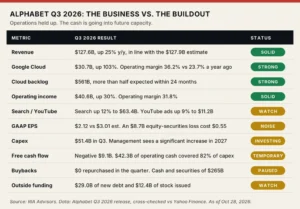
The sharp change in market sentiment stemmed from cash flow realities rather than a drop in end-user demand. Google Cloud revenue more than doubled during the quarter, yet Alphabet reported a staggering negative free cash flow of $9.1 billion, driven by quarterly capital spending of $51.4 billion. That financial disclosure sent Alphabet shares down 12.6% on Thursday. Similarly, Amazon reported that its AWS cloud division grew by 39%, but overall earnings missed expectations as capital expenditures hovered near $77 billion for the quarter. Intel collapsed 28.6% on Friday following a weak fourth-quarter outlook, while industrial bellwether Caterpillar dropped 9.3% on Thursday.
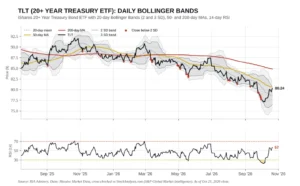
Microsoft stood out as the lone exception among the mega-caps, reporting that Azure grew 48% while giving up less than 2% over a two-day trading stretch. Financial markets are no longer questioning whether artificial intelligence technology works; instead, investors are aggressively asking who ultimately pays for the massive infrastructure buildout. With Treasury yields hovering near the critical 5% threshold, that fundamental question carries a heavy price tag.
Macroeconomic headwinds compounded the market’s unease. The Federal Reserve held benchmark interest rates steady at a range of 3.75% to 4.00% during its Wednesday meeting, resulting in a 10-2 vote. Governor Lisa Cook and Cleveland Fed President Beth Hammack dissented from the decision, favoring an immediate rate hike. Thursday brought the release of September personal consumption expenditures (PCE) inflation data showing an annualized rate of 3.6%, with core inflation at 3.1%, alongside third-quarter gross domestic product (GDP) growth of 3.4%. Futures markets quickly priced in roughly an 85% probability of a rate hike at the December FOMC meeting.
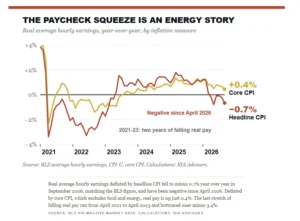
The one bright spot in the economic data emerged on the wage front. The employment cost index revealed that wage growth slowed to an annualized 3.1%, providing strong evidence that energy-driven inflation is not feeding into a broader wage-price spiral. Meanwhile, the benchmark 10-year Treasury yield slipped to 4.93% from 5.00% a week earlier, while Brent crude oil maintained its footing near $118 per barrel.
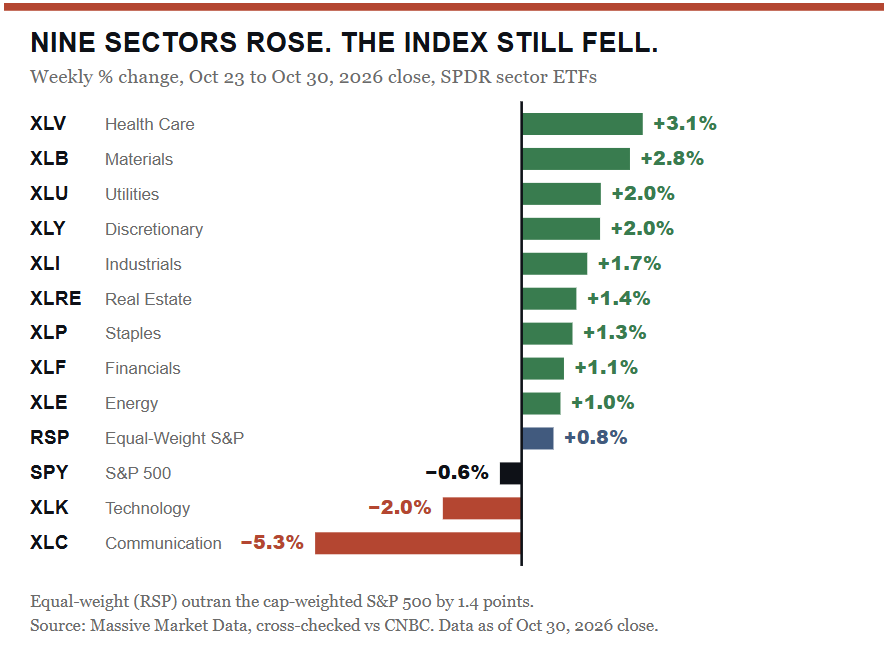
Beneath the headline indices, market breadth revealed a surprising internal resilience. Nine out of the eleven primary market sectors advanced during the week. The equal-weight S&P 500 gained 0.8%, outperforming the traditional cap-weighted index by 1.4 percentage points, as 500 out of 849 actively traded stocks finished higher. Nearly all the downward pressure was concentrated in the technology and communication services sectors, which directly carry the weight of the heavy AI capital expenditure trade.
While the mainstream financial narrative frames market broadening as a sign of underlying health, seasoned market observers recall veteran investor Howard Marks’ timeless warning that the single riskiest belief in finance is the conviction that risk no longer exists. Right now, that complacent belief is heavily concentrated in the defensive sectors where investors have recently rushed for cover.
Technical Backdrop: MACD Turns Up Just Below the Record
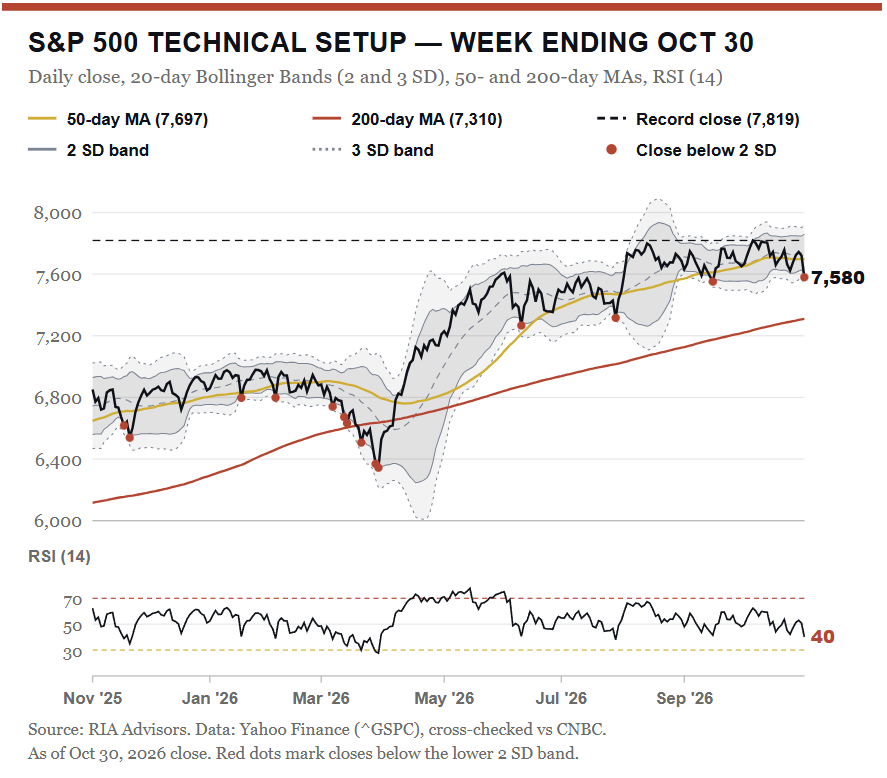
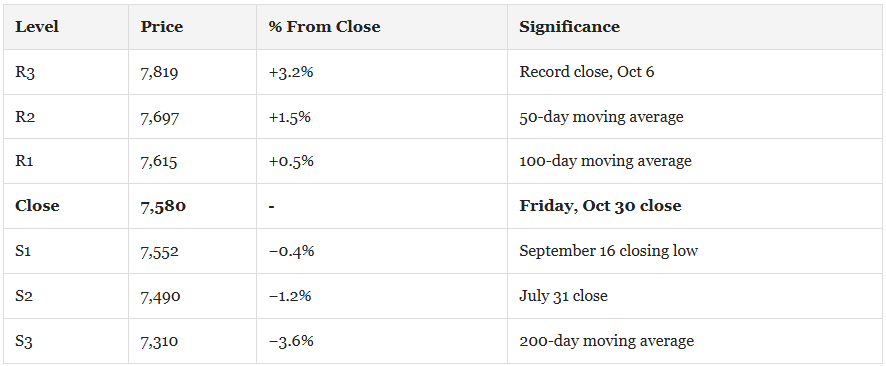
Friday’s sharp decline inflicted genuine technical damage across major indices. The S&P 500 closed at 7,580.07, marking its first daily settlement below its 100-day moving average since early April. The index now sits 0.5% below that average at 7,615 and 1.5% below its 50-day moving average at 7,697. Measured from its record close of 7,819 on October 6, the index is down 3.1%.
While this pullback does not signal the end of the broader bull market—the index remains 3.7% above its rising 200-day moving average at 7,310—the short-term trend has clearly deteriorated. Momentum indicators confirm this technical break. The relative strength index (RSI) fell rapidly from 50.8 to 40.1 in a single trading session. The Moving Average Convergence Divergence (MACD) indicator, which had been approaching a bullish crossover, turned sharply back down below the zero line, widening its histogram from negative 3.7 to negative 11.5 index points. Furthermore, Friday’s close landed below the lower Bollinger Band at 7,600, representing a move of 2.3 standard deviations below the 20-day mean. Similar closes below this band marked short-term market bottoms on September 16 and July 29, though such readings do not guarantee an immediate reversal.
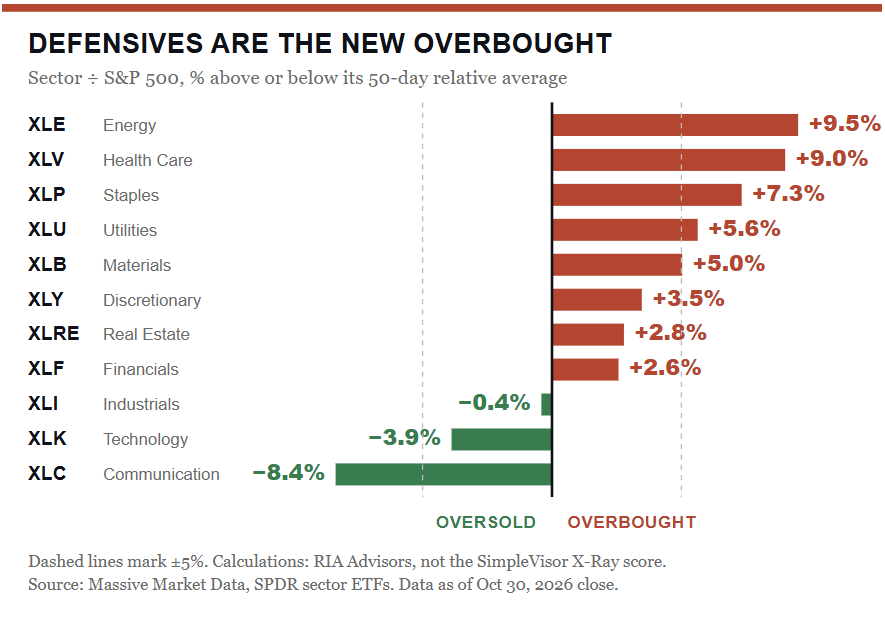
Sector breadth data explains why the headline index fell while the majority of individual stocks advanced. Measured against the S&P 500, eight of the eleven sectors trade more than 2.5% above their 50-day relative averages. Energy leads the pack with a 9.5% premium, followed by healthcare at 9.0% and consumer staples at 7.3%. Conversely, technology at negative 3.9% and communication services at negative 8.4% sit meaningfully below their relative averages, demonstrating that the "safe" trade has rapidly become a crowded consensus.
This technical setup cuts both ways. Technology and communication services carry the heaviest market weightings, and oversold market conditions can easily persist and deepen. Because the market is trading below both its 50-day and 100-day moving averages, algorithmic and discretionary sellers are likely to use subsequent rallies as opportunities to trim exposure until those levels are successfully reclaimed as support. Consequently, treating Friday’s selloff as an automatic, unconditional buying opportunity carries substantial risk.
Key Catalysts Next Week
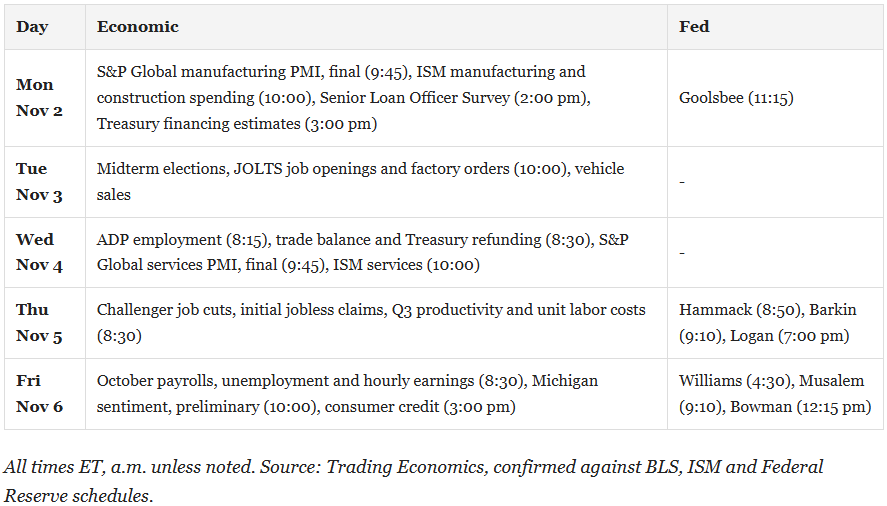
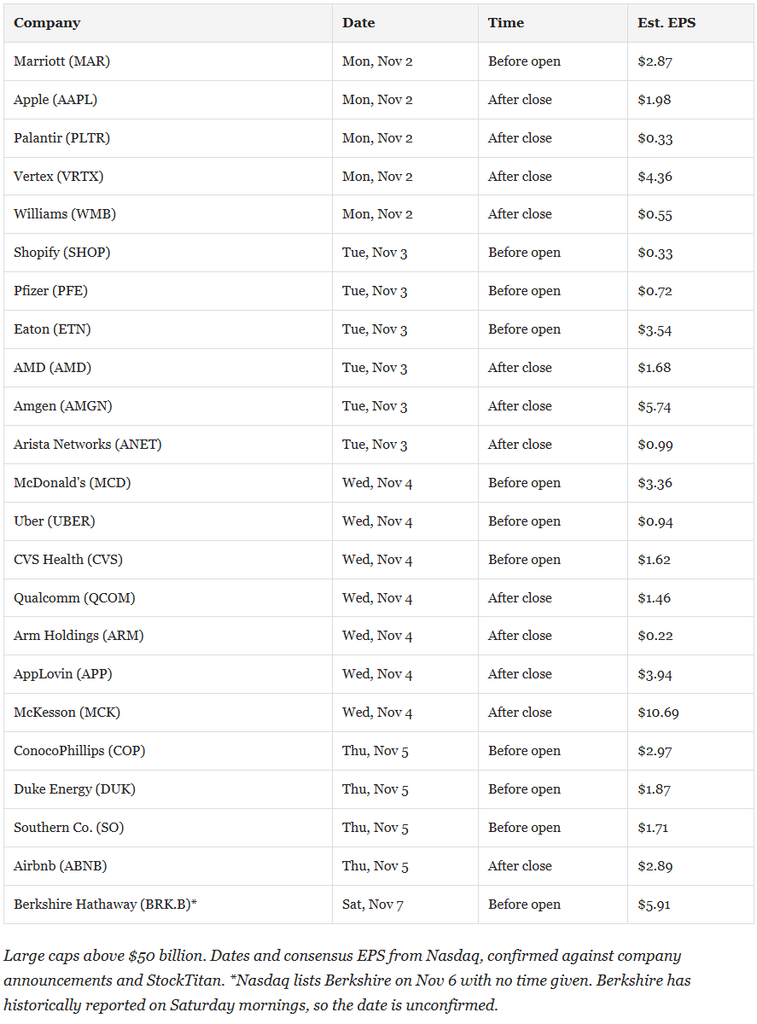
The upcoming week delivers an exceptionally heavy calendar of corporate earnings reports, economic data releases, and central bank commentary. Monday brings quarterly financial results from Apple, followed closely by the U.S. midterm elections on Tuesday and the crucial October employment report on Friday. Each major event arrives while the broader market is actively searching for technical footing.
Political polling and market prediction platforms like Polymarket suggest the midterm elections are largely priced in by investors, with Democrats heavily favored to retain control of the House and maintain a narrow edge in the Senate. A surprise outcome in a close congressional race or a protracted vote-counting process represents the primary political risk for market stability.
The economic data docket is equally packed. Monday features the Institute for Supply Management (ISM) manufacturing report, where consensus expectations point to a reading of 54.7 alongside a prices-paid index hovering near 78. A strong print would serve as a clear reminder that energy-driven inflation continues to work its way through domestic supply chains. The ISM services index follows on Wednesday, alongside the U.S. Treasury’s quarterly refunding announcement—an event taking on heightened importance with the 10-year Treasury yield anchored near 5%.
Friday’s nonfarm payrolls report stands out as the week’s premier market-moving catalyst. Consensus forecasts project job growth of 55,000 to 65,000 net new positions, with the unemployment rate holding steady at 4.2% and average hourly earnings ticking up 0.3%. A weaker-than-expected employment figure paired with sticky 3.6% inflation would cast genuine doubt on the likelihood of a December Federal Reserve rate hike.
Federal Reserve speakers will maintain a prominent public schedule throughout the week. Chicago Fed President Austan Goolsbee speaks on Monday, followed on Thursday by Cleveland Fed President Beth Hammack, who will make her first public remarks following her policy dissent in favor of a rate hike. Richmond Fed President Tom Barkin and Dallas Fed President Lorie Logan are also scheduled to speak, while Friday features commentary from New York Fed President John Williams, St. Louis Fed President Alberto Musalem, and Federal Reserve Governor Michelle Bowman.

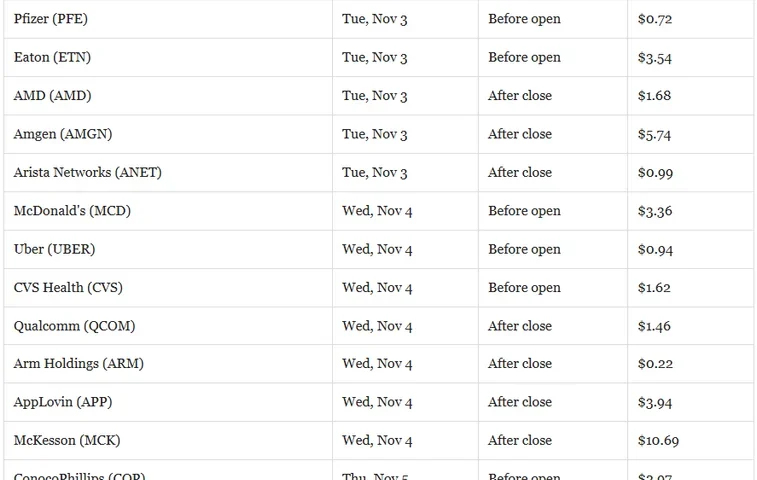
Corporate earnings releases will continue to dominate market headlines. Alongside Apple, Palantir reports earnings on Monday, offering investors another vital window into commercial artificial intelligence adoption. Tuesday features reports from Advanced Micro Devices (AMD), Amgen, and Arista Networks, with Qualcomm, Arm, and AppLovin reporting on Wednesday. Reports from AMD and Palantir carry particular significance as both companies sit at the epicenter of the capital spending debate that punished Alphabet and Amazon. Evidence that artificial intelligence demand is successfully converting into tangible cash flow rather than perpetual capital outlays could spark a powerful relief rally among oversold semiconductor and software equities.
Growth vs. Value: Value Had Its Run, But the Turn Is Setting Up
Four weeks ago, market analysis correctly anticipated that a rotation from growth to value was becoming increasingly likely heading into year-end. Action was taken promptly on October 5 by trimming mega-cap growth leaders like Apple, Nvidia, AMD, and Palantir within equity models and reallocating proceeds into value-oriented stalwarts such as Walmart, Costco, JPMorgan Chase, Goldman Sachs, Kinder Morgan, and RTX. This was followed on October 8 by exiting positions in Applied Digital and Vertiv to add shares of Berkshire Hathaway, alongside a parallel shift within ETF model portfolios.

Since that positioning adjustment, the spread between growth and value has moved decisively in favor of value. The Vanguard Value ETF (VTV) has advanced 4.6%, while the Vanguard Growth ETF (VUG) has dropped 7.6%, and the broader technology sector has retreated 10.7%. While this tactical rotation successfully protected capital, the magnitude of the move suggests it may soon be time to prepare for a counter-rotation. For the year to date, the value exchange-traded fund is up 19.4%, while the growth fund has gained just 4.6%, and the energy sector has surged 56.6%. When one investment style dominates this decisively, evaluating how much good news is already priced into the market becomes essential.
The relative dominance of value over growth throughout the year has a straightforward explanation. With Brent crude trading near $118 and the 10-year Treasury yield hovering just under 5% ahead of a Federal Reserve meeting with elevated tightening expectations, the macro environment has proven hostile to growth stocks whose equity valuations rely heavily on distant future cash flows. Conversely, this environment has provided a highly favorable backdrop for energy producers, commercial banks, and defensive market sectors.
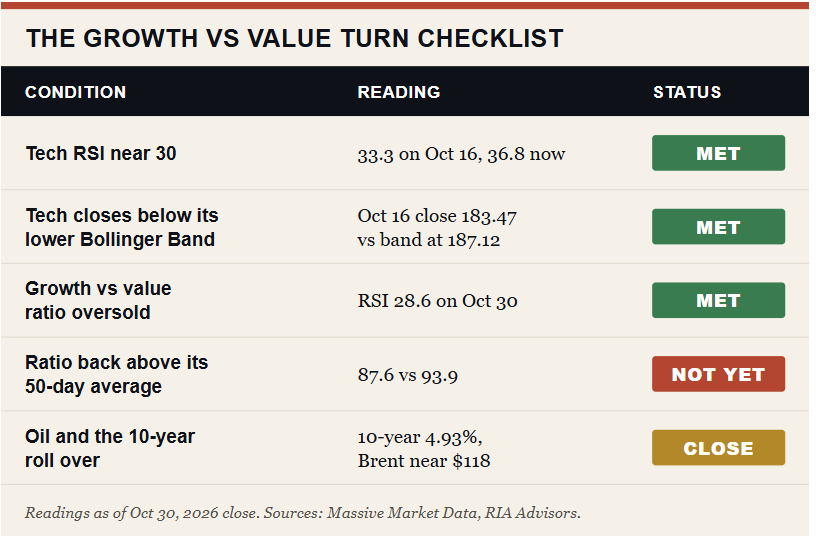
Between October 7 and the end of the month, the growth-versus-value ratio fell 11.9% over the span of 17 trading sessions, pushing the relative ratio below both its 50-day and 200-day moving averages. Despite this significant trend shift, the ratio currently sits just above its March low of 85.2, while its 14-day relative strength index dipped to 28.6 on Friday, signaling an extremely washed-out reading below the traditional oversold threshold of 30. Major market trends of this nature rarely reverse in a clean, orderly fashion; instead, they typically turn when selling becomes sufficiently lopsided that remaining sellers act out of exhaustion or fear rather than fundamental deterioration.
Energy is Stretched While Staples Bounce
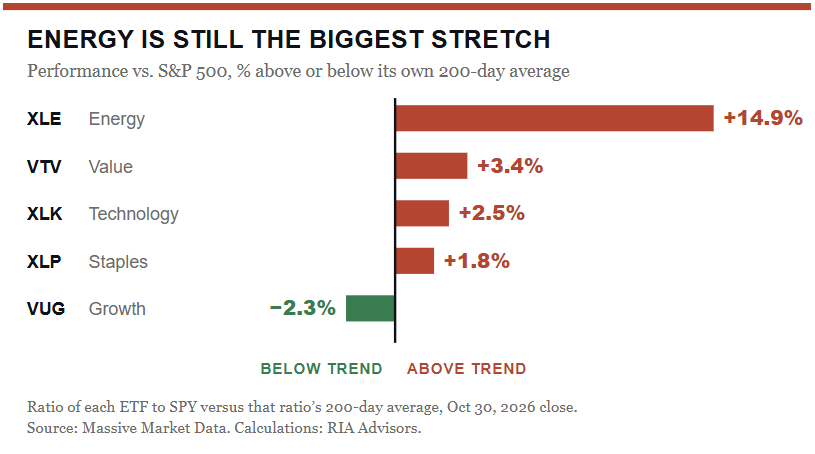
Market commentary frequently groups energy and consumer staples together under a single "rotation" umbrella, but fundamental and technical data show they are behaving very differently. The Energy Select Sector SPDR Fund (XLE) gained 10.8% over the past month. Measured relative to the broader S&P 500—the most appropriate baseline for a sector riding a sustained oil shock—the energy group trades 14.9% above its 200-day relative moving average, representing the widest positive deviation of any market sector.
According to veteran technical principles regarding market excesses, extreme deviations in one direction ultimately sow the seeds for an eventual reversion in the opposite direction. The energy sector achieved a record high on Friday, concentrating a tremendous amount of speculative excess into a single group that has outperformed the broader S&P 500 by nearly 40 percentage points over the course of the year.
Consumer staples started from a much lower valuation base but have accelerated rapidly. The Consumer Staples Select Sector SPDR Fund (XLP) rallied 11.3% over a four-week period as institutional capital sought shelter in traditional safe-haven equities. Relative to the S&P 500, the sector climbed from 2.6% below its 200-day trendline to 1.8% above it, representing a sharp bounce off a deeply oversold foundation that is increasingly showing signs of crowding.
The technology sector bore the brunt of last week’s liquidation. Since October 6, the Technology Select Sector SPDR Fund (XLK) has declined 11.1%, including a 4.9% drop on Friday alone. On October 16, its relative RSI touched 33.3, marking its lowest reading since the market trough on March 30. Even after this steep correction, the sector still sits 2.5% above its relative 200-day moving average, indicating that the recent sector rotation bruised technology’s short-term trading momentum without breaking its multi-year structural leadership.
What Must Happen Before Growth vs. Value Flips
Investors evaluating technology and growth equities must weigh the risk of catching a falling knife against the opportunity presented by washed-out valuations. A sector that has dropped 11% over a four-week period can easily experience additional downside if the underlying macroeconomic pressures that triggered the decline remain unresolved.
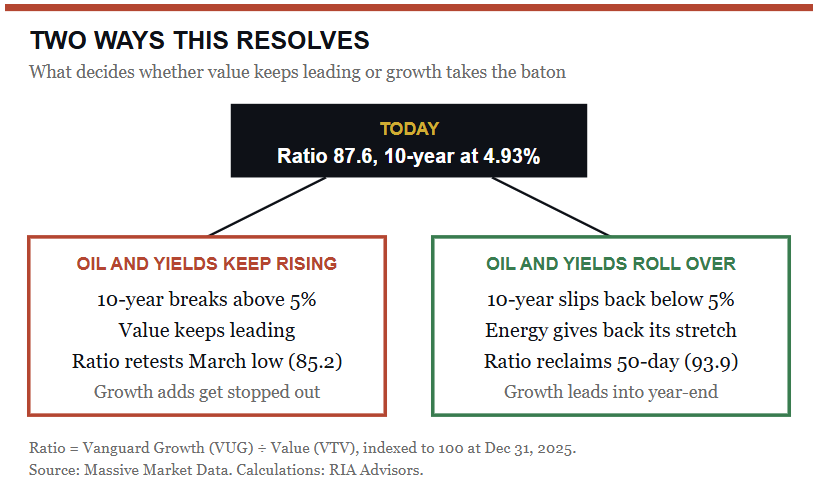
Momentum readings can remain depressed for extended periods if macroeconomic conditions do not immediately cooperate. Closes below lower Bollinger bands serve as technical symptoms of market panic, and panic episodes frequently deepen before they fully exhaust themselves. Furthermore, upcoming corporate earnings reports remain a critical variable. With hyperscaler capital expenditures running near $800 billion for the year, investors have made it clear that they are no longer willing to reward heavy spending programs that fail to generate immediate, positive free cash flow.
Nevertheless, the asymmetry of the current market setup favors patience and structured preparation. The value trade relies heavily on oil prices and Treasury yields continuing to climb from already restrictive levels, whereas a potential growth recovery only requires those macroeconomic pressures to stabilize.
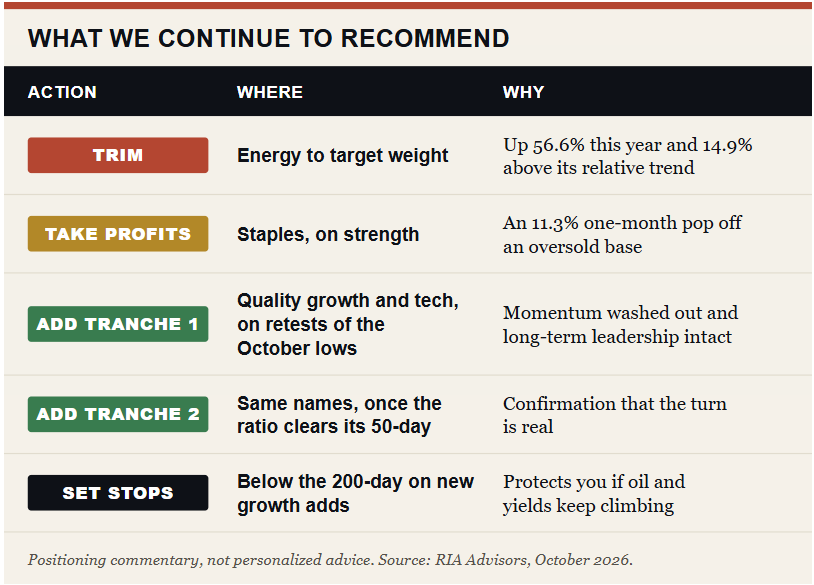
Rather than attempting to pinpoint the exact absolute bottom in technology shares, the most prudent strategy involves trimming exposure where speculative excess is most pronounced—such as recent profit-taking in energy holdings like Kinder Morgan and Williams—while systematically building exposure to growth assets in carefully staged tranches. By utilizing disciplined risk management stops and allowing technical indicators to confirm a durable market bottom, portfolios can remain balanced and resilient regardless of which investment style dominates the final weeks of the year.

Related News