‘Klara and the Sun’ Review: Jenna Ortega Fans, Respectfully Look Away
By Kristy Puchko
October 22, 2026
On paper, Klara and the Sun possessed all the ingredients for a cinematic triumph. Adapted from Kazuo Ishiguro’s acclaimed, popular science fiction novel, the film taps directly into the modern, pressing anxieties surrounding artificial intelligence. Its titular character, Klara, is an "Artificial Friend" engineered to serve as the ultimate, devoted companion for an isolated teenager. In the lead role sits rising star Jenna Ortega, an actor widely celebrated for her sharp range, looking to pivot away from her hardened screen personas and the devotedly monotone cadence of her breakout hit Wednesday to portray a smiling, relentlessly empathetic robot.
Surrounding Ortega is an enviable supporting cast featuring celebrated heavyweights like Amy Adams and Natasha Lyonne. At the helm is director Taika Waititi, a filmmaker who previously demonstrated a deft touch at literary adaptations, turning Barry Crump’s book Wild Pork and Watercress into the beloved, winsome coming-of-age comedy Hunt for the Wilderpeople.

Yet, cinema is measured by execution rather than initial potential, and Klara and the Sun arrives as a profound disaster. It has been a decade since Waititi gifted audiences with the quirky, heartfelt tale of Ricky Baker. In the years since, the director’s trajectory has grown increasingly erratic. He earned mixed responses for Jojo Rabbit, his adaptation of Christine Leunens’ novel Caging Skies in which he cast himself as Adolf Hitler. Following the vibrant, comedic success of Thor: Ragnarok, his Marvel follow-up, Thor: Love and Thunder, became a widely criticized misfire. Most recently, Waititi took the inspiring true-story sports documentary Next Goal Wins and flattened it into an uninspired sports comedy of the same name.
The steady artistic slide from the inventive charm of What We Do in the Shadows and Hunt for the Wilderpeople down to Next Goal Wins served as an ominous warning that Waititi may have lost the distinct creative spark that once made him one of Hollywood’s most exciting voices. Klara and the Sun ultimately confirms that this spark is gone, resulting in a misbegotten picture that feels aggressively tuned to please no one.
What is ‘Klara and the Sun’ About?
Set in a grim post-World War III, post-internet landscape, AI Friends have transformed into the must-have luxury accessory for affluent households. Among a row of older models awaiting adoption, Klara stands out as an eccentric oddity. She has an unusual habit of praying to the sun and maintains a peculiar posture, standing "like a flamingo" with one leg raised. Unless a buyer claims her soon, she faces the grim fate of being returned to the factory and scrapped for parts.

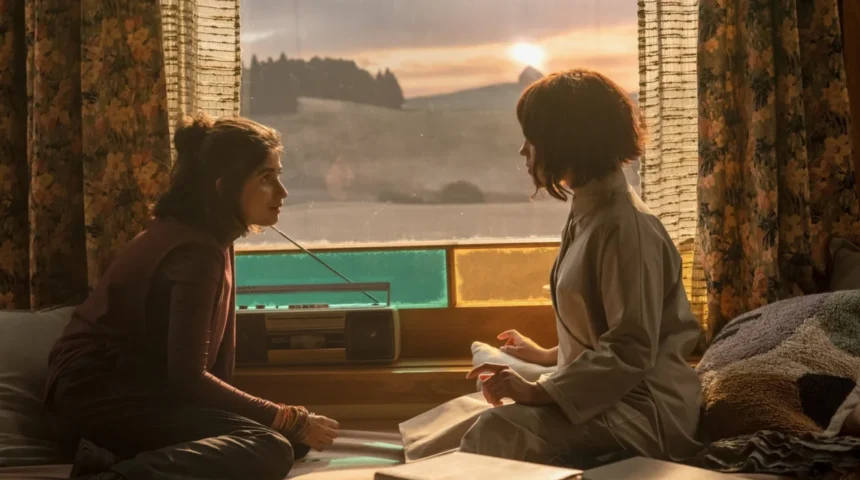
When a gloomy, fragile teenager named Josie, played by Mia Tharia, unexpectedly chooses her, Klara believes she has been rescued from certain doom. Josie lives far away from the soot-covered city where the Artificial Friends store is located, inhabiting a sprawling estate amid wheat fields. Her home is heavily overdecorated by her smothering mother, Chrissie, played by Adams, who works tirelessly as an interior designer. Despite its grand size, the house feels emotionally frozen and steeped in unspoken mourning. Years prior, Josie’s older sister, Sal, passed away, an event that drove her father away and left Josie and Chrissie trapped in a cycle of failed connection.
Thrust directly into this fractured domestic dynamic, Klara becomes an immediate lightning rod. Josie welcomes the presence of a companion dedicated entirely to listening to her, especially given that Chrissie is perpetually critical or absent for work. For Chrissie, however, Klara is viewed primarily as a high-tech baby monitor tasked with watching over her daughter. Yet, the exact nature of Josie’s vulnerability remains shrouded in secrecy. Neither Chrissie nor her fiercely protective maid, Melania, played by recurring Waititi collaborator Rachel House, will explain the situation to Klara, even as medical machinery and intravenous lines are introduced into the home alongside Josie’s sudden, violent physical fits.
As Klara attempts to calibrate her surroundings and fulfill her purpose toward Josie, she encounters other figures, including Josie’s robo-curious crush, Rick, played by Aran Murphy, and a scarecrow robot named Scarecrow, voiced by Jesse Griffin in a performance heavily reminiscent of Rhys Darby. Above all else, whenever doubt creeps in, Klara turns her gaze upward to the sun, maintaining an unwavering conviction that it is a benevolent deity capable of healing her ailing human friend.
‘Klara and the Sun’ Is a Movie for No One

The foundational premise bears the initial hallmarks of a classic children’s fable, reminiscent of Steven Spielberg’s A.I. Artificial Intelligence, where an innocent, child-like robot learns profound lessons about a deeply cruel world. However, against the backdrop of contemporary debates regarding the psychological impacts of chatbots on developing minds, Klara and the Sun feels frustratingly dated. It positions Klara as a wholesome, entirely sentient servant whose existence is solely dedicated to maximizing the happiness and health of her human owner.
Beyond this thematic miscalculation, Waititi’s tonal approach to Ishiguro’s narrative remains utterly confounding. The opening act unfolds inside the Artificial Friend store, where a kindly manager, played by Natasha Lyonne, reads bedtime stories to her robotic charges. In these scenes, Klara exhibits an endearing eccentricity reminiscent of Roald Dahl’s Matilda, driven by an earnest curiosity and plucky resilience. Dressed in simple diction and a hiking outfit that evokes memories of Dora the Explorer, Ortega’s character initially appears tailor-made for a family-friendly film.
Almost immediately, however, the screenplay—co-written by Waititi and Dahvi Waller—injects much darker, jarring elements, including violence, blood, death, arson, and suicide. While filmmakers like Tim Burton routinely weave such macabre motifs into family-friendly fare like Beetlejuice, Edward Scissorhands, or the Netflix series Wednesday, Klara and the Sun fails to capture that delicate balance of spooky charm. Instead, it feels dreadful, bland, and consistently mean-spirited.
Throughout the narrative, Klara is repeatedly berated as an "idiot," while the human characters surrounding her are sketched as thin scoundrels prone to lying, seething, shouting, and issuing selfish demands. Even the ostensibly kindly store manager subjects Klara to extreme cruelty, locking her away in a dark closet deprived of sunlight—a punishment that, given Klara’s solar-powered nature, is essentially equivalent to starvation.

While stories like Matilda balance their cruelty with beacons of hope like Miss Honey, Waititi’s film offers no such relief. Josie often reads as a caricature of angsty adolescence, fluctuating rapidly between sarcastic, cheerful, and sullen dispositions. Tharia is left to brood silently as the plot unfolds around her. Faced with such underwritten, flimsy material, the entire ensemble cast struggles to find footing. Lyonne delivers an amusing but strictly one-note performance, while six-time Academy Award nominee Amy Adams is unable to inject genuine depth into Waititi’s charmless cinematic universe.
‘Klara and the Sun’ Is a Story of Faith With No Soul
In a narrative defined by external fears and internal pain, Klara’s unwavering focus on the sun forms the emotional core of her character. She prays, undertakes pilgrimages, and offers sacrifices in the hope that her perceived god will answer her pleas to save Josie. Yet, Waititi’s direction demonstrates zero genuine belief in these convictions. Although Ortega commits fully to the role with a bright smile, she appears fundamentally unmoored within a clumsily constructed world that fails to reflect her inherent whimsy, despite the film being framed strictly from Klara’s perspective.
Visually, the film suffers from an unappealing color palette dominated by a sickly, overcast yellow-green hue, casting a drab pallor over the entire production that recalls the glum, genderless uniforms worn by the Artificial Friends upon purchase. Costume choices across the board lean toward the ghastly. Josie wears haphazard garments devoid of character, while Adams is wedged into drab dresses that actively work against her natural presence. Klara herself is eventually outfitted in a bizarre 1980s soccer-mom aesthetic, complete with high-waisted jeans and an asymmetrical jersey, while Ortega’s performance is hindered by a poorly executed bob haircut designed to mimic a clumsy pastiche of Amélie.

Curiously, the most striking wardrobe choices emerge during a second-act sequence where Josie encounters her affluent, intensely entitled schoolmates. These wealthy, vicious teenagers sport garish textures, vibrant colors, and outrageous silhouettes intended to signal their shallow nature—a bizarre stylistic choice from a director who has regularly attended the Met Gala.
Musically, Michael Giacchino’s score relies heavily on cloyingly sentimental cues, aggressively telegraphing emotional beats that fail to land even on the written page. Plot lines that hint at genuine tension, such as potential jealousy between Josie and Klara, are repeatedly sidestepped or rushed, muting moments of narrative revelation that should pack a significant emotional wallop.
Ultimately, Waititi fails to translate Ishiguro’s literary work into a compelling cinematic experience. His screenplay stumbles through plodding, childish beats, while his visual storytelling remains uninspired and baffling. Despite Jenna Ortega’s physical commitment and willingness to tackle complex material, the direction reduces her performance to something resembling a low-budget children’s television movie. For fans of the rising star, the best course of action is to politely look away and let Klara and the Sun fade quietly into memory.
Klara and the Sun opens in theaters on October 23.

Related News