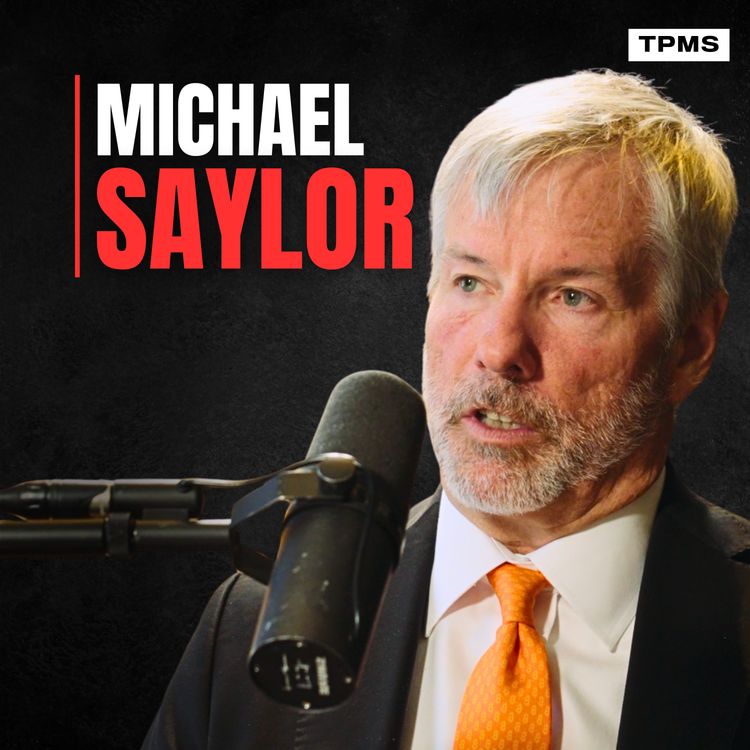
Michael Saylor Warns That AI and Currency Debasement Threaten Traditional Wealth in the Coming Decade

The traditional economic framework that generations have relied upon to build financial security is quietly drawing to a close, and the vast majority of people remain entirely unprepared for the transition. That is the stark warning delivered by MicroStrategy founder and Bitcoin pioneer Michael Saylor during a recent appearance on episode 171 of Peter McCormack’s podcast. According to Saylor, individuals have roughly a decade to fundamentally adapt their financial strategies before artificial intelligence and ongoing monetary debasement completely rewrite the rules of modern society.
Saylor, who transitioned from a traditional Wall Street outsider to one of the corporate world’s most prominent and vocal advocates for Bitcoin, has built a reputation for analyzing broad economic trends through sweeping historical frameworks. His commentary frequently explores how civilizations rise and fall, how currencies lose their purchasing power over time, and what ordinary individuals must do to protect their livelihoods amidst rapid technological disruption. During his conversation with McCormack, Saylor laid out a sobering vision of the near future, explaining why working hard is no longer a reliable path to wealth, how fiat currency systems are eroding personal savings, and why scarce digital assets like Bitcoin represent the ultimate form of capital preservation.
The Silent Erosion of Purchasing Power
At the heart of Saylor’s analysis is the fundamental flaw embedded within the global fiat currency system. For decades, average workers have trusted traditional bank accounts and steady employment as the primary vehicles for achieving financial independence. However, Saylor argues that this system is quietly making citizens poorer every single year through persistent currency debasement. Operating under a steady rate of monetary expansion, central banking policies erode the real value of labor and savings faster than most people can accumulate them.
This steady degradation creates a pervasive sense of financial anxiety among the public. People work longer hours, attain higher levels of education, and diligently save a portion of their income, only to find that their purchasing power is diminishing rather than growing. Saylor points to a persistent debasement rate that continually outpaces traditional wage growth, transforming the standard bank account into a losing proposition. Consequently, holding traditional cash or keeping wealth concentrated in standard savings vehicles is no longer a viable strategy for preserving long-term financial security. Instead, individuals are forced to navigate a tiered global currency structure where the rules heavily favor asset holders while penalizing wage earners.

The Looming Impact of Artificial Intelligence on Human Labor
Compounding the problem of monetary debasement is the rapid advancement of artificial intelligence and automation. While technological revolutions of the past primarily automated physical labor, the current wave of AI development is poised to disrupt cognitive labor, professional services, and white-collar productivity on an unprecedented scale. Saylor warns that this shift will effectively demonetize traditional human labor.
As software and machine intelligence become capable of performing complex tasks at a fraction of the cost and time required by human workers, the economic value traditionally derived from a standard paycheck will face severe downward pressure. This dynamic threatens to trigger a massive wealth divide. While the broader economy may experience an explosion in overall productivity and nominal prosperity driven by AI efficiencies, the benefits will not be distributed evenly. Saylor cautions that most people risk being left behind because their primary asset—their labor—is losing its relative scarcity and economic value in a world dominated by intelligent automation.

The Shift Toward Scarce Assets and Bitcoin
Given the dual pressures of currency debasement and AI-driven labor disruption, Saylor emphasizes that owning scarce assets is now the only reliable form of financial security. In a landscape where governments can print unlimited amounts of fiat currency and algorithms can replicate cognitive tasks instantaneously, true value can only reside in things that cannot be infinitely multiplied.
Throughout history, societies have turned to scarce commodities like gold and real estate to protect their wealth from government overreach and monetary inflation. However, Saylor argues that the digital era requires a modern, superior form of capital. This is where Bitcoin enters the equation. Having studied monetary history extensively, Saylor regards Bitcoin as the highest form of capital ever created by human civilization. Its mathematically capped supply of 21 million coins provides an absolute defense against the arbitrary monetary policies of central banks.

Unlike traditional assets that carry high storage costs, divisibility limitations, or geographic restrictions, Bitcoin combines absolute scarcity with seamless global mobility. For Saylor, the debate over Bitcoin’s viability as a premier asset class is effectively over. He contends that Bitcoin has already won the long-term monetary battle, and the coming decade will simply mark the period during which institutions, corporations, and everyday individuals finally wake up to this reality and adjust their balance sheets accordingly.
Navigating the Next Decade
The upcoming ten years will serve as a critical transition window for society. Saylor outlines a future where individuals must completely rethink their relationship with money, career planning, and asset allocation. Clinging to outdated notions of financial security—such as relying solely on a traditional pension, a standard savings account, or standard wage employment—will likely result in a permanent decline in economic standing.

The single biggest mistake that will define winners and losers in the coming decade, according to Saylor, is failing to recognize the shifting nature of value. Those who continue to measure their wealth in debased fiat units and fail to secure exposure to scarce, non-sovereign digital capital will find themselves increasingly disenfranchised by the combined forces of inflation and automation. Conversely, those who adapt early by transitioning a portion of their savings into resilient assets like Bitcoin will position themselves to thrive in the emerging economic order.
As the conversation with Peter McCormack highlights, the economic changes ahead are profound, structural, and fast-approaching. With the traditional economic model fading out, Saylor’s message serves as both a warning and a strategic roadmap for anyone looking to navigate the profound transformations shaping the modern financial landscape.

Related News