Pricing Out the Hike: How Falling Rate Expectations and Soft Economic Data Shaped Bitcoin Markets

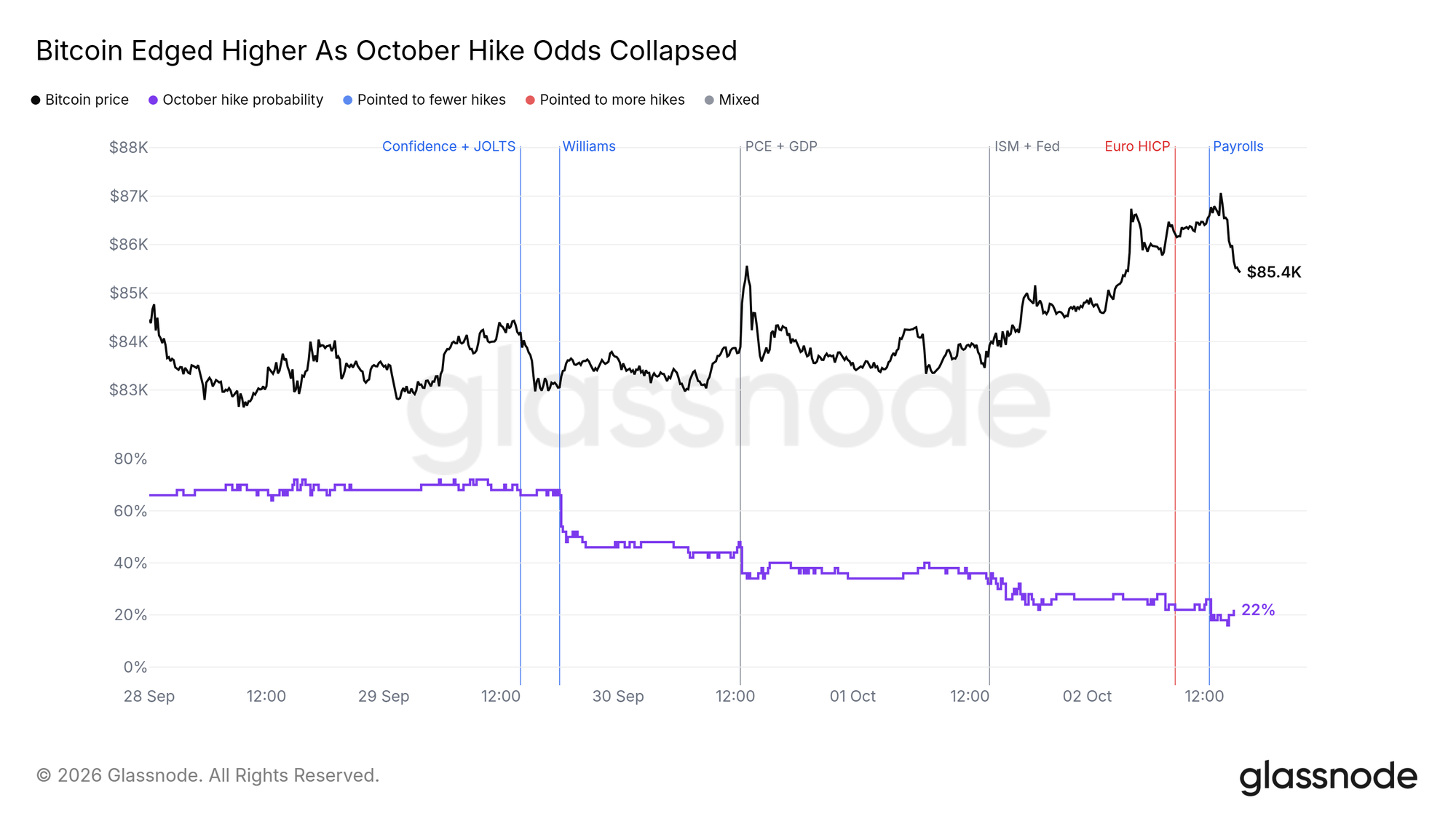
Financial markets underwent a dramatic shift regarding monetary policy expectations as traders aggressively pared back their bets on an upcoming Federal Reserve interest rate hike for October. Just two weeks after the central bank implemented a rate increase, market sentiment shifted rapidly following a series of dovish signals from Fed officials, softer-than-expected inflation metrics, and a markedly weak employment report for September. By Friday afternoon, fed funds futures drastically recalibrated, pricing the probability of an October rate hike down to a mere 22%, a steep decline from the 66% conviction recorded at the start of the week. Amid this macroeconomic recalibration, Bitcoin posted a modest gain of approximately 1% over the same stretch, though the path forward was defined by intense derivatives activity, sudden short squeezes, and shifting leverage across crypto exchanges.
The Fed Talked the Odds Down
The erosion of market expectations for a quarter-point rate increase at the October 28 Federal Open Market Committee meeting did not happen in a vacuum. Instead, it unfolded in distinct steps that closely tracked a series of high-profile central bank speeches and macroeconomic data releases. At the beginning of the week, fed funds futures indicated a robust 66% probability of a rate hike. However, a steady stream of commentary and economic data systematically dismantled that consensus.
Tuesday brought soft consumer confidence and job openings figures, though these initial prints barely moved the needle on interest rate projections. The real inflection point arrived later that afternoon when New York Fed President John Williams addressed the economic landscape. Williams remarked that following the September rate hike, there was "no need for urgency," emphasizing that the central bank possessed the luxury of time to gather more comprehensive data before making its next policy move. Within a mere two hours of his remarks, the implied probability of an October hike tumbled from 66% to 50%.

Downward pressure persisted on Wednesday when the core Personal Consumption Expenditures (PCE) price index—widely recognized as the Federal Reserve’s preferred inflation gauge—registered a softer print than anticipated by Wall Street consensus. This inflation reading shaved another 10 percentage points off the hike odds, despite simultaneous gross domestic product reports coming in stronger than expected. Thursday brought further moderation as a mixed Institute for Supply Management (ISM) factory survey crossed the wires alongside commentary from Fed Vice Chair Philip Jefferson. Jefferson reiterated that the central bank might require additional time and deeper data analysis before determining its next policy step, pushing the probability of a restrictive move even lower. By the time a hotter-than-expected euro-area inflation report hit the market on Friday morning, traders largely shrugged it off, focusing instead on domestic monetary policy trajectories.
Bitcoin’s immediate reaction to each successive drop in hike odds was generally positive, though these upside responses were frequently subdued or short-lived. The premier cryptocurrency ticked up 0.4% in the immediate half-hour following John Williams’ speech. It experienced a sharper jump immediately after the PCE inflation release, only to surrender those gains within three hours. As hike odds continued their downward slide through Thursday afternoon, Bitcoin climbed back above its Monday starting level, before rallying another 2.1% overnight into Friday during a period when headline rate expectations remained largely stagnant.
A Weak Report in a Long Slowdown
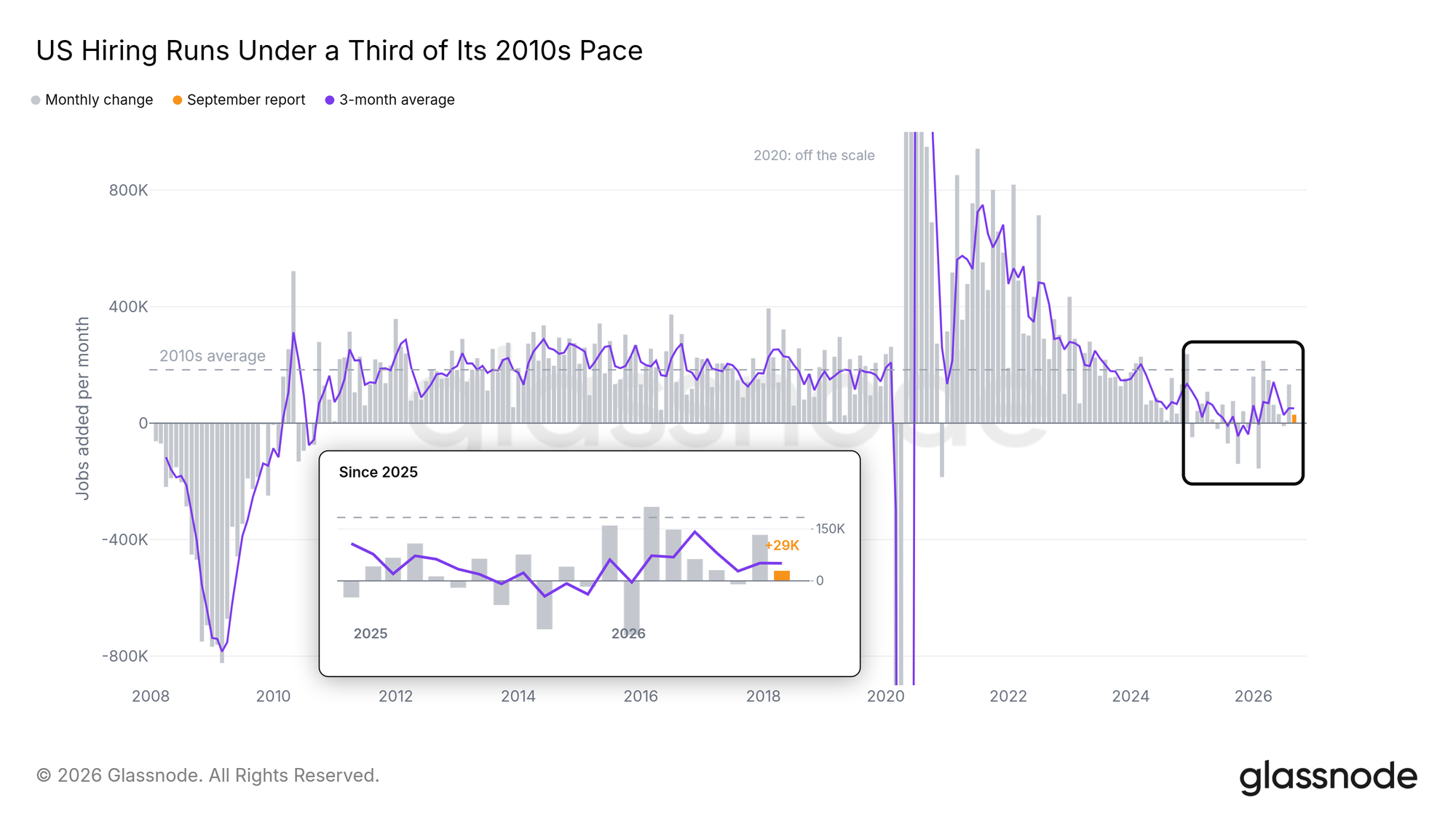
The macroeconomic narrative was further complicated by the release of the September employment report, which underscored a broader, multi-year cooling trend in the American labor market. According to the Bureau of Labor Statistics, the U.S. economy added just 29,000 nonfarm payroll jobs during the month, falling well short of the 84,000 jobs anticipated by economists surveyed by Dow Jones. Concurrently, the national unemployment rate ticked up to 4.2%, while previously reported employment figures for July and August experienced downward revisions.

Because single-month employment prints are inherently volatile and susceptible to noise, macroeconomic analysts frequently rely on the three-month moving average to gauge underlying labor market health. That metric currently stands at approximately 51,000 jobs per month, which amounts to less than a third of the robust 183,000 monthly average observed throughout the 2010s. Historical context reveals that this deceleration has been building for some time; hiring severely decelerated through 2025 to a meager pace of roughly 10,000 jobs per month, and the subsequent recovery this year has remained exceptionally sluggish.
This persistent slowdown in hiring provides the Federal Reserve with a compelling rationale to pause its tightening cycle. Imposing higher borrowing costs risks inflicting further damage on an employment sector that is already displaying clear signs of fatigue. At the same time, stubborn inflation figures point in the opposite direction, with core PCE prices up 3.0% over the trailing twelve-month period—comfortably above the central bank’s stated 2% target. Nonetheless, the prevailing weight of this week’s economic data compelled traders to reallocate their risk positions toward the assumption that the Federal Open Market Committee will stand pat and leave interest rates untouched at its upcoming October meeting.
Short Yields Fell, Long Yields Responded Differently
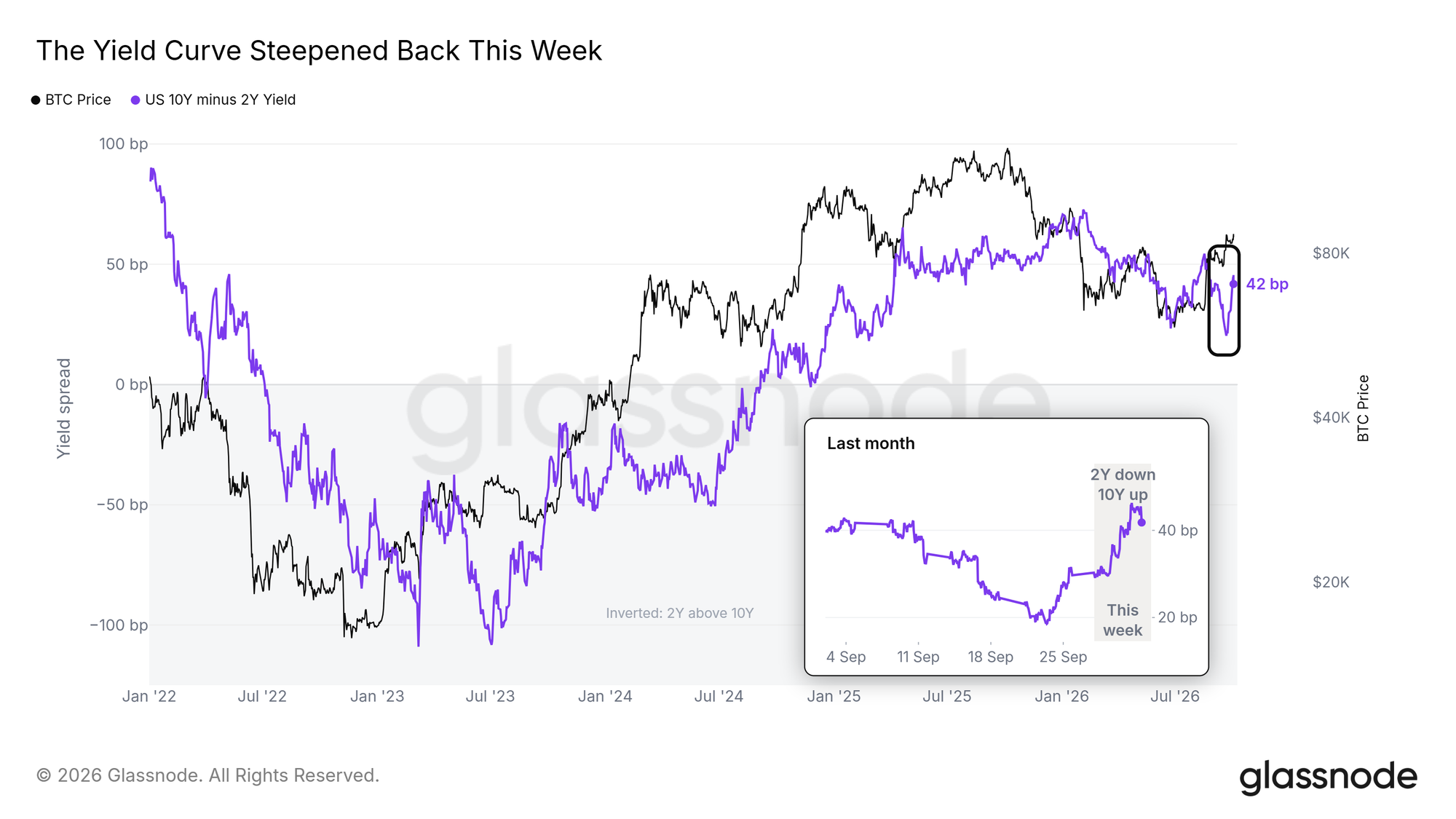
The shifting macroeconomic landscape also left a distinct footprint across the U.S. Treasury yield curve. The 2-year Treasury yield traditionally serves as a sensitive barometer for near-term monetary policy expectations, closely tracking where traders believe the Federal Reserve will direct its benchmark rate. Conversely, the 10-year Treasury yield incorporates longer-horizon risks, including structural inflation expectations and expanding federal debt issuance. The spread between these two maturities measures the slope of the yield curve—a curve that is normally upward-sloping but famously inverted from mid-2022 through late 2024 following the central bank’s aggressive tightening campaign.
Around the time of the Fed’s September rate increase, the 2-year yield climbed at a faster pace than the 10-year yield, causing the curve to flatten as the spread narrowed from approximately 40 basis points down to 20 basis points. However, this week reversed that dynamic. As fading expectations for an October hike pulled short-term yields downward, the 2-year yield dropped while the 10-year yield held firm or edged higher, steepening the curve once again and widening the spread back out to 42 basis points.
A yield curve steepening driven primarily by falling short-term yields typically signals that bond market participants anticipate a more accommodating monetary stance or fewer rate hikes on the horizon. Despite this easing at the front end of the curve, long-term borrowing costs failed to provide relief to the broader economy, with the benchmark 10-year Treasury yield hovering near 5.2% by the conclusion of the trading week.
Leverage Built Up Into the Report
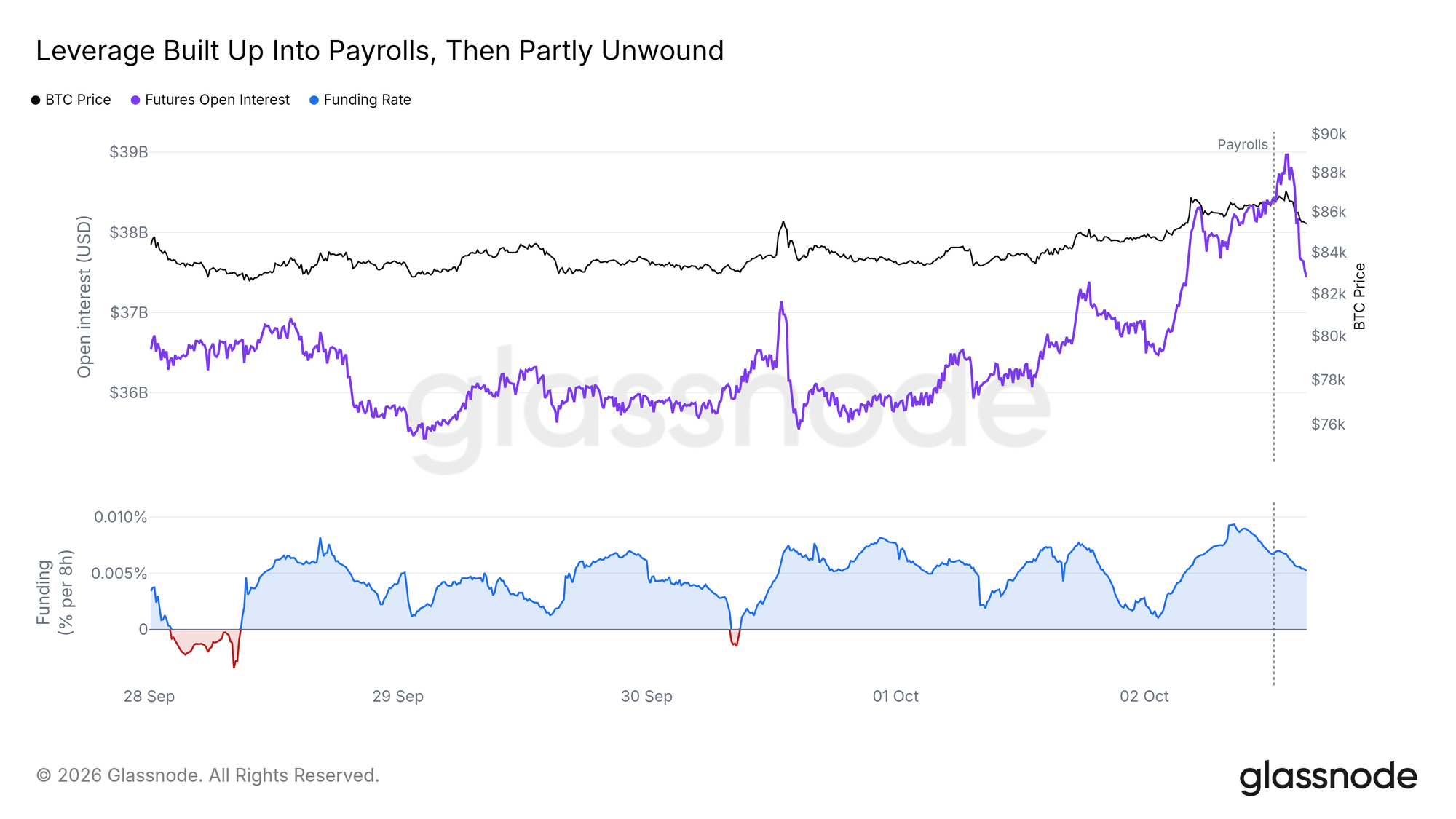
In the derivatives market, positioning ahead of the high-stakes employment report was characterized by a distinct accumulation of risk. In the 24-hour window leading up to the Bureau of Labor Statistics release, total futures open interest expanded by $2.1 billion. Even when measured strictly in coin terms rather than nominal fiat value, active positions grew by roughly 2.5%, indicating that market participants were actively committing capital. Despite this growth in open interest, funding rates remained positive but hovered below their historical baseline averages, suggesting that bullish traders were not aggressively crowding into over-leveraged long positions.
This accumulation of open interest proved transient. Leverage continued to build for approximately one hour following the official jobs data release before abruptly unwinding. As Bitcoin prices slid, open interest plummeted by $1.5 billion—erasing more than half of the total leveraged exposure that traders had accumulated since midday Thursday.
Shorts Were Squeezed Before the Report, Longs After It
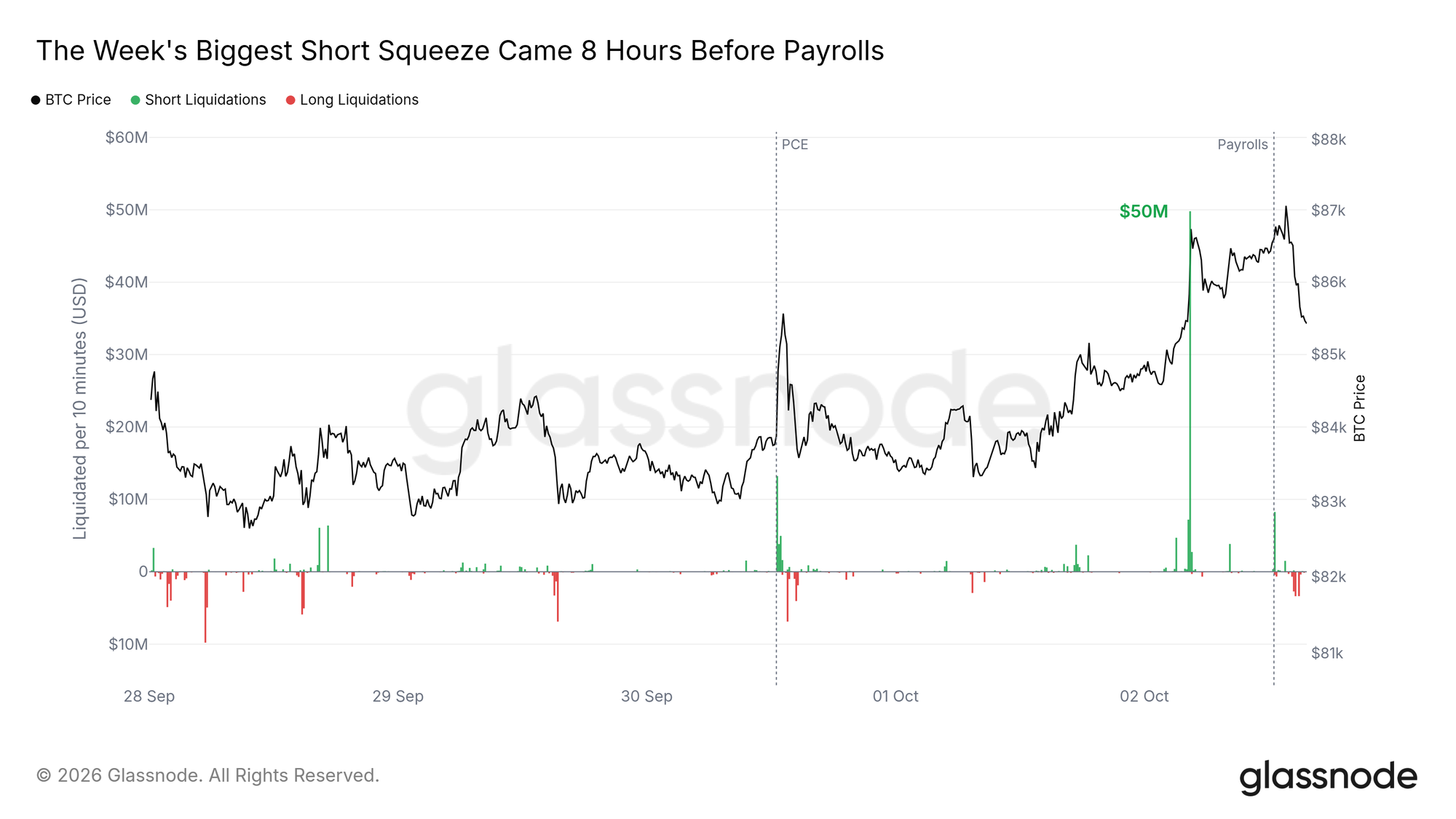
The anatomy of derivatives liquidations over the course of the week highlighted the vulnerability of leveraged traders on both sides of the market, with short positions accounting for roughly 60% of total liquidations. The single most dramatic liquidation event occurred well before the employment report crossed the wires. At 04:20 UTC on Friday—fully eight hours prior to the jobs release and in the absence of any scheduled macroeconomic data catalysts—a sudden volatility spike wiped out $50 million worth of short positions in a compressed ten-minute window. By contrast, the actual release of the employment report triggered a much smaller liquidation wave.
Once the initial release hour passed, market dynamics underwent a complete reversal. As Bitcoin prices trended lower in the aftermath of the data, long positions bore the brunt of the pain. Approximately $11 million in bullish long positions were liquidated as the cryptocurrency slid, compared to just $2 million in short liquidations. By mid-afternoon, Bitcoin was trading more than 1% below the price level it occupied immediately before the jobs report was published.
Options Did Not Price the Jobs Report
While futures traders adjusted their leverage, options markets revealed a distinct lack of anticipation regarding the employment report’s capacity to induce directional volatility. When derivatives traders expect a major macroeconomic catalyst to substantially disrupt asset prices within a matter of days, 1-week implied volatility typically surges above 1-month implied volatility. This phenomenon was clearly observable ahead of the Federal Open Market Committee policy decision on September 16, where short-dated implied volatility remained elevated above the 1-month baseline for a full 48 hours before rapidly evaporating within a day of the rate announcement. A secondary spike occurred on September 21, coinciding with a sudden price expansion that saw Bitcoin rally 2.7% within a single hour.
In stark contrast, leading into the September jobs report, the 1-week implied volatility line remained subdued below the 1-month line for the entire 48-hour window. Options market participants were evidently signaling that they did not expect the payrolls data to generate significant directional movement or outsized volatility for Bitcoin.
Volatility Fades After the Release
An analysis of historical market behavior across 32 employment reports dating back to 2024 demonstrates a consistent pattern in how Bitcoin’s implied volatility reacts to the release. Measuring the percentage change in 1-week implied volatility from the final hourly reading prior to publication reveals a typical post-release trajectory. While the median path remains relatively flat during the day leading up to the print, it drifts downward through the trading sessions immediately following the release. Historical data shows that implied volatility has declined following 23 out of the 32 examined employment reports.
While a portion of this post-release decline can be attributed to a normal Friday afternoon sentiment drift—where volatility typically contracts by roughly half that magnitude heading into the weekend—the additional downward adjustment on employment days has historically been too subtle to serve as a standalone trading signal.
During the latest release, however, this volatility contraction materialized at an accelerated pace. Within three hours of the employment report hitting the market, implied volatility had already dropped by an amount that typically takes a full 24-hour cycle to manifest in median historical data.
October 14 Is the Next Test
Despite the aggressive repricing observed this week, the possibility of an autumn interest rate adjustment remains firmly on the table. Current fed funds futures continue to price in roughly a 22% probability of a rate hike for October alongside approximately 24 basis points of total tightening expected by December, which effectively translates to expectations for at least one quarter-point rate increase before the year concludes.
The next major macroeconomic checkpoint arrives on October 14 with the publication of the September Consumer Price Index (CPI) report. A core inflation reading that exceeds consensus forecasts would likely reignite expectations for an October rate hike, while a print that aligns with or falls below expectations would reinforce the prevailing market view that the Federal Reserve will hold rates steady until the final gathering of the year in December.

Related News