Proton Hosts Comprehensive Flock Surveillance Camera Map Despite Legal Threats Against Creator
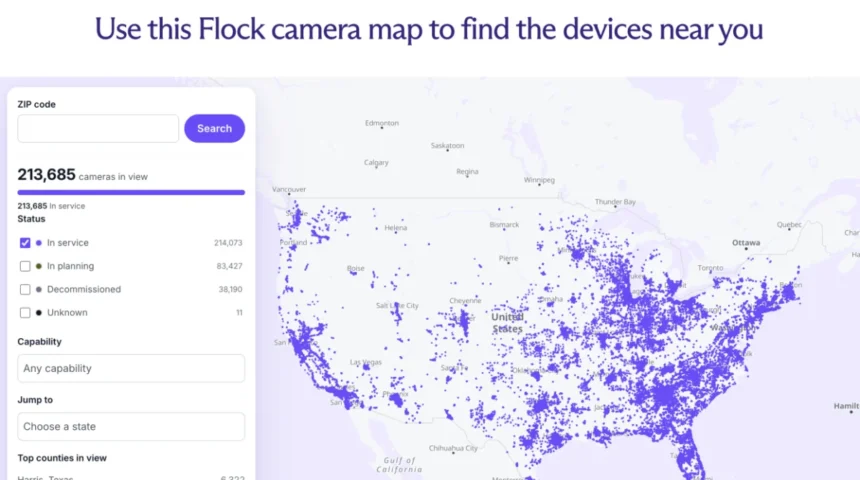
You probably know every coffee shop, gas station, and grocery store layout in your immediate neighborhood. Navigating your daily route is second nature. But keeping track of the automated optical sensors, automated license plate readers, and digital eyes logging your vehicle’s movements as you drive past has become increasingly difficult. These surveillance tools quietly record thousands of commuters every single day, blending into the background of modern infrastructure while accumulating vast troves of location history.
Proton, the Swiss privacy-focused technology company best known for offering encrypted services like Proton Mail and Proton VPN, is working to shed light on this invisible infrastructure. The company is now hosting a free, comprehensive map of Flock surveillance devices directly on its secure servers, allowing anyone to explore the massive footprint of these cameras online. This hosting effort comes in direct defiance of aggressive legal pressure and cease-and-desist letters directed at the independent security researcher who originally mapped the devices.
For those needing a refresher on modern automated surveillance technology, Flock Safety produces automated license plate readers widely utilized by municipal police departments, private businesses, educational campuses, and residential homeowners associations. These specialized cameras capture high-resolution photographs of passing vehicles regardless of whether individual drivers are suspected of any wrongdoing or traffic violations. Flock devices routinely record exact license plate numbers, precise timestamps, geographic coordinates, and distinct vehicle attributes such as make, model, color, and even bumper stickers. According to corporate figures provided by Flock, its expansive network of cameras logs more than 20 billion vehicle sightings every single month across 49 states.
Once captured, these comprehensive records are instantly uploaded to Flock’s centralized cloud infrastructure. Law enforcement agencies can query this database, cross-referencing information and sharing historical vehicle data across city, county, and state boundaries. Motorists do not need to be pulled over or investigated for a crime for their vehicle to become a permanent, searchable entry in a nationwide historical ledger of where they have traveled.
Unfortunately, this sweeping access has already led to documented instances of abuse. A comprehensive investigative report published by The Washington Post revealed that at least 50 police officers across the United States have been accused or formally charged with misusing automated license plate reader networks, frequently employing the technology to stalk, monitor, or track individuals in their personal lives. Flock’s specific system was implicated in 46 of those documented cases, highlighting the severe privacy risks inherent in expansive municipal surveillance sharing.

Citizens interested in checking their own neighborhoods can access Proton’s interactive map by visiting the company’s website. Users can enter a specific ZIP code to inspect recorded devices within their immediate area or freely pan and zoom across a nationwide view of camera placements. However, viewers must keep in mind that the underlying data represents a snapshot captured in December 2025. Any new camera installations or device removals completed after that date are not reflected in the current visualization.
"You Have a Right to Know Who’s Recording You When You Leave Home"
Proton’s newly hosted project is not the first instance of privacy advocates and technologists attempting to map the proliferation of automated surveillance hardware. DeFlock Maps previously emerged as a crowdsourced initiative allowing citizens to identify license plate readers in their communities, incorporating hardware manufactured by Flock, Motorola Solutions, and various other industry competitors. In that project, dedicated volunteers report cameras spotted during their daily routines and contribute verified geographic coordinates directly to OpenStreetMap, an open-source collaborative mapping project.
Mainstream navigation platforms are also beginning to surface this data. MapQuest recently introduced a dedicated "Surveillance Layer" to its application, allowing everyday drivers to toggle on known license plate reader locations, including Flock cameras. When activated through map options, distinct camera markers materialize directly alongside the roads and highways travelers navigate.
The critical distinction with the dataset now hosted by Proton, however, is that the location inventories originated directly from Flock’s own corporate systems rather than purely crowdsourced observations, according to the map’s original creator.
The entire controversy began in November 2025 when security researcher Joshua Michael discovered that Flock’s corporate servers were actively exposing an open access token. This security oversight allowed anyone to retrieve sensitive data without authenticating or logging into an administrative account. Utilizing this exposed token, Michael successfully retrieved a comprehensive inventory detailing exact device locations, promptly reported the vulnerability to Flock, and subsequently published his findings alongside an interactive map in December of that year. That retrieved inventory contained geographic data for more than 170,000 cameras and over 130,000 additional connected Flock hardware devices.

Proton has previously challenged Flock’s corporate leadership directly regarding the societal implications and everyday utilization of its technology. In an exclusive interview published by Proton in August, Flock CEO Garrett Langley defended the company while acknowledging systemic challenges, stating that "any level of abuse greater than zero is unacceptable and makes me sick." Langley pointed to built-in audit logs and an optional monitoring tool engineered to flag potentially abusive activity by law enforcement users. However, when pressed, he declined to disclose the exact number of police department contracts Flock had suspended or terminated due to policy violations, arguing instead that communities should not be penalized for isolated misconduct. "I don’t think you should hold the entire city accountable for just the bad decisions of a few," Langley remarked.
When confronted with Joshua Michael’s security findings, Flock’s corporate response involved severe legal threats, as detailed in reports by The Intercept. While the company quietly patched the exposed-token flaw, it simultaneously maintained a public stance asserting that its systems had never been compromised and that no proprietary data had ever leaked. According to legal documentation published on Michael’s personal website, Flock also issued a formal cease-and-desist letter threatening litigation and notified its extensive customer base that it had alerted law enforcement authorities, characterizing the independent security researcher as a "malicious actor."
Michael noted that this same customer advisory acknowledged Flock had found no evidence of unauthorized external access when it officially closed the security ticket in December. He argues that this contradiction illustrates the exact hazard highlighted by his research: sensitive location data could be silently extracted by unauthorized parties without the corporation ever detecting the breach.
"I’m not backing down," Michael wrote in a public statement shared on social media.
As the dispute continued into September, a brand-protection firm named Doppel filed a formal trademark complaint on Flock’s behalf. The complaint argued that Michael’s informational website could potentially confuse consumers or damage the corporate brand, pointing specifically to the site’s explicit disclaimer stating it was entirely unaffiliated with and unendorsed by Flock Safety. Even amid these trademark challenges, Flock never formally disputed the core geographical accuracy of the published map data.

Choosing to stand by the researcher, Proton formally rejected the trademark arguments and elected to host a verified copy of the map directly on its secure Swiss infrastructure to ensure the information remained accessible to the public.
"This is an attempt to suppress information, not to prevent consumer confusion," said Marc Lėbekken, Proton’s head of legal.
For everyday residents, the availability of this map provides a practical resource for discovering what hardware is actively monitoring public streets, offering a concrete foundation for raising questions with local municipal officials and law enforcement agencies. As Proton emphasizes on the map’s dedicated landing page, citizens possess a fundamental right to understand who is recording them the moment they step outside their homes.

Related News