Rivian Acquires AI Startup Third Dimension to Accelerate Self-Driving Tech Development
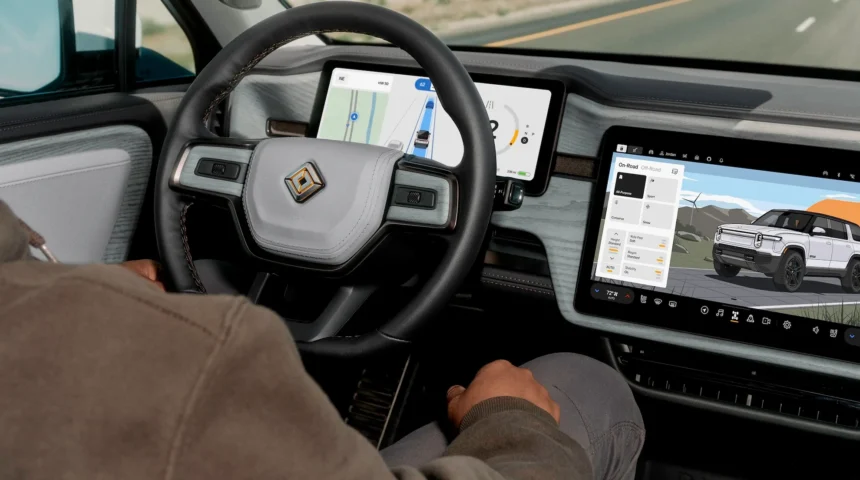
Electric vehicle manufacturer Rivian has acquired Third Dimension, an innovative UK-based startup founded by industry veterans from the gaming and autonomous vehicle sectors. The acquired company specializes in utilizing advanced artificial intelligence to convert ordinary images and videos into lifelike 3D worlds.
While the acquisition does not signal a pivot into the gaming industry for Rivian, the automaker intends to strategically leverage Third Dimension’s proprietary technology. The goal is to ingest real-world data and construct highly accurate 3D environments that can significantly accelerate the development of Rivian’s advanced driver assistance features and the dedicated self-driving system destined for the robotaxis the company plans to supply to Uber.
Financial terms of the transaction were not publicly disclosed. However, confirmation was provided that the entire 15-person team at Third Dimension, the vast majority of whom are based in the United Kingdom, will be fully absorbed into Rivian’s broader autonomy and AI team. This group is led by James Philbin. According to an exclusive interview with Philbin, the acquisition also provides Rivian with a prime opportunity to meaningfully expand its existing artificial intelligence hub located in London.
Third Dimension was established in 2024 by CEO Tolga Kart and co-founder Piotr Sokolski. Prior to the acquisition, the startup successfully raised $7 million in seed funding from a roster of prominent venture capital firms, which included Abstract Ventures, MVP, Soma Capital, and Solari Capital. Although the company’s underlying technology was originally constructed to streamline and speed up video game development, the founders quickly recognized broader, high-value commercial applications across multiple sectors, including defense and autonomous vehicles.
Now, operating under the corporate umbrella of Rivian, the engineering and AI team will shift its full attention and resources toward automated driving.
Reflecting on the acquisition in an interview with TechCrunch, CEO Tolga Kart expressed enthusiasm for the team’s new, singular focus. He noted that as a small startup, having to serve numerous different masters and industries simultaneously presented a significant operational challenge. Kart added that the team is thrilled to transition to working on a problem of immense scale where their core technology can make a tangible, lasting difference.
Simulation has long been recognized as a critical pillar for developers of autonomous vehicles, who rely heavily on virtual testing grounds to train and validate complex self-driving algorithms and software systems. Historically, these virtual simulators were constructed using traditional rendering or standard video game engines and frequently depended heavily on synthetic data. Although these virtual environments can look remarkably similar to the real world, a persistent gap between simulation and reality remains, according to Kart. The standard engineering workaround has typically required feeding these simulators ever-increasing volumes of data in the hope of eventually closing that quality gap.
Third Dimension’s cutting-edge technology leverages AI to accurately mirror the physical world. When this capability is combined with Rivian’s massive repositories of driving data, it has the potential to transform into a remarkably valuable and precise simulator.
Rivian is currently collecting driving data from tens of thousands of R1S trucks, R1S SUVs, commercial delivery vans, and R2 SUVs deployed on public roads. This data collection occurs across any vehicle where the owner has explicitly enabled external camera sharing. Rivian aggregates and anonymizes this incoming data, utilizing it to build sophisticated training models for autonomous driving. According to James Philbin, Rivian currently receives more than 400,000 individual data sequences uploaded from its customer vehicle fleets every single day.
The integration of Third Dimension’s technology will empower Rivian to simulate intricate and complex driving conditions without needing to wait for rare, potentially dangerous real-world edge cases to happen organically on public roadways, Philbin explained.

Related News