Tesla Eyes Rapid Cybercab Expansion Beyond Austin in Bid to Dominate Terrestrial Transportation
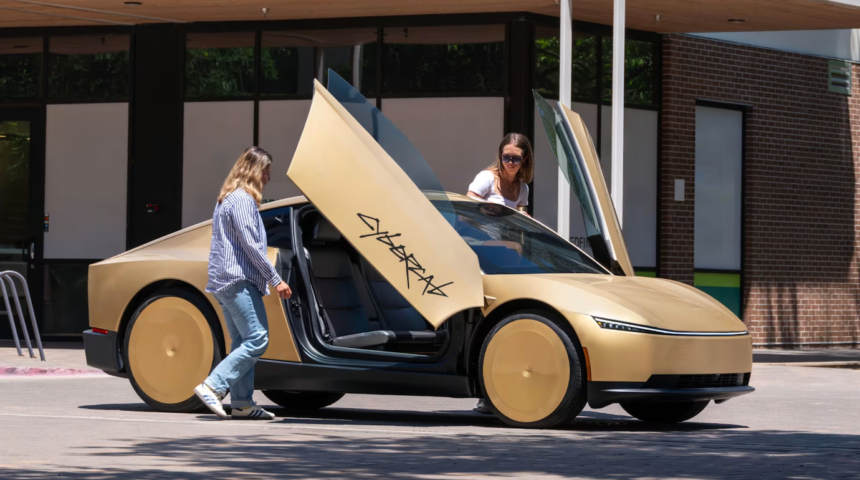
Tesla is actively preparing to scale the rollout of its distinctive, gold-colored Cybercab into new markets outside of its home base in Austin, Texas, as part of an aggressive, long-term strategy to fundamentally reshape and eventually take over every facet of terrestrial transportation on Earth.
During the company’s third-quarter earnings call on Wednesday, Chief Financial Officer Vaibhav Taneja outlined the breadth of this vision, noting that while the initial focus remains on moving people safely from one destination to another, the overarching corporate ambition is to command any kind of transportation on the planet. This bold declaration follows earlier concept unveilings by Tesla, including a multi-passenger vehicle designated as the "Robovan," though executives on the call did not elaborate on whether those additional concepts are currently moving through active development or production pipelines.
More immediately tangible details emerged regarding the commercial rollout of the Cybercab. Company leadership confirmed that the vehicle’s expansion will officially kick off in Dallas next month, with subsequent deployments slated for additional metropolitan areas by the end of the year. Prior to this specific Cybercab push, Tesla has maintained small, localized robotaxi fleets utilizing modified Model Y SUVs across Dallas, Houston, and several Florida cities, including Miami, Orlando, and Tampa. Furthermore, executives announced plans to begin selling Cybercabs directly to external fleet operators before the close of the year, signaling a shift toward a broader commercial model.
This accelerated expansion strategy sets the stage for a high-stakes competitive clash with Waymo, which currently stands as the established market leader in the United States autonomous vehicle sector. Waymo has successfully deployed a fleet exceeding 4,000 robotaxis across more than a dozen cities nationwide. Tesla has repeatedly countered that its custom-built Cybercab possesses structural advantages—specifically that it is significantly cheaper and easier to manufacture—which the company believes will allow it to undercut competitors on pricing. However, industry analysts note that Tesla must successfully achieve true commercial and geographic scale well beyond Austin to validate those claims in practice.
Driving this readiness, according to Tesla, is a dramatic surge in the cumulative mileage logged by its self-driving vehicles over recent weeks. Yet, despite these operational milestones, company leadership remained tight-lipped during the earnings call regarding precise financial metrics or overall revenue generated by the nascent robotaxi business. Chief Executive Officer Elon Musk addressed the financial timeline, cautioning that the new ride-hailing venture will not yet register meaningfully on the company’s broader financial statements until the second quarter of 2027, projecting that it will likely become a major financial driver by the third or fourth quarter of next year.
Simultaneously, subtle adjustments to Tesla’s quarterly shareholder communications have raised questions regarding transparency around the robotaxi program. In the second-quarter shareholder letter, the company published a chart tracking "Cumulative Paid Robotaxi Miles." A closer examination of that data revealed a 36% sequential decline from the first quarter of the year. In the updated letter released on Wednesday, Tesla replaced that specific metric with a chart charting "Cumulative Unsupervised Robotaxi Miles," an indicator measuring total fleet driving distance regardless of whether paying passengers are currently on board.
When questioned about specific paid robotaxi mileage during the conference call, CFO Vaibhav Taneja offered limited clarity, stating generally that the company is observing improvements in fleet utilization without providing concrete data points or volume breakdowns. Instead, Taneja steered the conversation back to manufacturing scalability and production logistics. He praised the dedication and efficiency of Tesla’s engineering and manufacturing teams, reporting that they consider the Cybercab to be one of the most straightforward products the company has ever attempted to scale from a production standpoint. According to Taneja, manufacturing bottlenecks are expected to be minimal, allowing the company to ramp up factory output rapidly.
Instead of manufacturing constraints, Taneja emphasized that the primary gating item for wider deployment is securing the necessary regulatory approvals to allow Tesla to field the vehicles as quickly as they roll off the assembly lines. This sentiment echoes long-standing assertions from CEO Elon Musk, who has consistently argued that government regulatory approval represents the single largest hurdle to Tesla’s autonomous ambitions, far outweighing underlying technical challenges.
While Musk has historically offered few specifics regarding which exact regulatory clearances are required, the company has directly encountered federal oversight hurdles this year. In September, mere hours after Tesla formally debuted the Cybercab in Austin, the National Highway Traffic Safety Administration (NHTSA) opened a formal investigation to determine whether the vehicle’s design complies with existing federal motor vehicle safety standards.
Under current federal frameworks, automakers self-certify that their vehicles conform to established safety baselines, and Tesla has maintained that the Cybercab meets all necessary requirements. However, the vehicle notably lacks physical components traditionally mandated by current standards, such as a physical brake pedal and side mirrors. While the NHTSA has proposed relaxing or eliminating certain brake pedal requirements for autonomous vehicles in a move that would benefit manufacturers like Tesla, that formal rule change remains several months away from final implementation.
Interestingly, not all Tesla executives shared a uniform perspective on the primary obstacles facing the program during Wednesday’s financial call. When asked about the remaining bottlenecks preventing a wider, unrestricted robotaxi rollout, Ashok Elluswamy, Tesla’s vice president overseeing autonomy software, pushed back against the notion that regulatory hurdles are the sole limiting factor.
Elluswamy stated plainly that the remaining challenges are fundamentally technology-driven. He detailed the incremental expansion of the company’s operating hours in Austin—starting initially from 6 a.m. to 9 p.m., expanding later to 10 p.m. and 11 p.m., and soon stretching to 2 a.m.—noting that this gradual extension is dictated entirely by the evolving capabilities of the underlying artificial intelligence software.
This technological gating explains why Tesla’s service continues to avoid highway driving and certain adverse environmental conditions, although the vehicles have frequently been observed operating in heavy rain across Austin—a challenging weather scenario that competitors like Waymo have largely chosen to bypass. Elluswamy confirmed that Tesla intends to tackle increasingly complex driving environments by the end of the year prior to undertaking any wider geographic scaling.
Reinforcing the company’s stated safety philosophy, Elluswamy emphasized that engineering teams are proceeding with extreme caution to protect the brand’s operational integrity. The overarching principle, he explained, is to ensure the complete absence of safety incidents, maintaining that the company refuses to absorb even the slightest potential risk as it refines its autonomous platform for broader public deployment.

Related News