The AI Capex Trap: Why Slowing Growth, Not a Collapse, Could Hurt Corporate Earnings
By Lance Roberts
October 19, 2026
AI capex and earnings are now so tightly tied that spending doesn’t have to fall to hurt profits. It only has to stop accelerating.
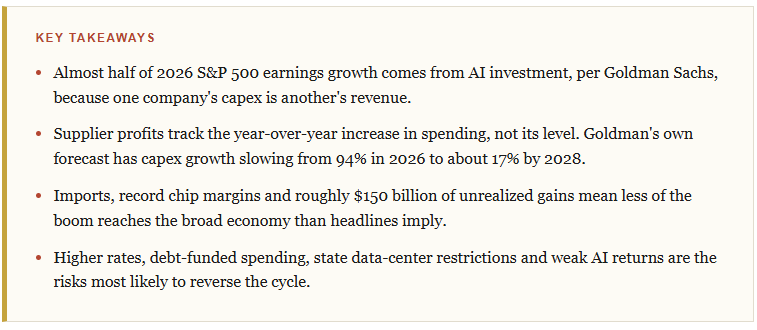
Almost half of the S&P 500’s earnings growth traces back to a single, dominant economic activity: companies aggressively buying advanced chips, servers, power infrastructure, and heavy construction gear to build out artificial intelligence architecture. That is the striking conclusion of an analysis published by Goldman Sachs, highlighting how deeply intertwined corporate capital expenditure and overall market profitability have become.

While most market participants read these figures as a story about the spending power of deep-pocketed tech giants, financial analysts suggest investors are looking at the wrong side of the ledger. Capital expenditure leaves one company’s bank account and immediately lands on another company’s income statement as top-line revenue. Consequently, the ongoing "AI earnings boom" depends less on the absolute volume of money spent and far more on a single metric: whether that spending continues to accelerate year after year.
Every Dollar of Capex Is Someone Else’s Revenue
When a major cloud provider or hyperscaler commits billions of dollars to construct a new generation of data centers, that cash does not simply vanish into concrete and steel. It flows directly to specialized chip designers, high-bandwidth memory manufacturers, electrical transformer producers, cooling system engineers, commercial contractors, and local utilities. Every single entity along that extended supply chain books the transaction as immediate revenue, which in turn trickles down to their own sub-tier suppliers.
The economic mechanics behind this dynamic were mapped out nearly a century ago. Early last century, economic theorists like Jerome Levy, and later Michal Kalecki in the 1930s, formalized frameworks demonstrating that, for the macroeconomy as a whole, aggregate corporate profits fundamentally equal total private investment minus household, government, and foreign savings, adjusted for dividends. Within this foundational equation, corporate capital expenditure sits squarely on the profit-generating side of the ledger.
The operational reality creates a fascinating temporal mismatch between buyer and seller. The seller books the incoming revenue immediately, while the corporate buyer capitalizes the heavy hardware purchase, spreading the expense through depreciation over a standard five-to-six-year window. In the exact calendar year the money is deployed, the broader economy records the supplier’s robust profit without simultaneously registering the buyer’s corresponding heavy expense.
This structural lag is what turns a massive capex cycle into the most earnings-friendly environment imaginable in the short run. However, the lifecycle naturally unfolds across distinct phases. The initial stage features surging spending that lifts supplier revenues, operating margins, and corporate hiring. The second phase arrives when spending stabilizes; supplier revenues freeze while the buyers’ depreciation expenses relentlessly climb, as every dollar of equipment that was treated as "free cash flow" in year one starts hitting the books as a recurring cost. The final stage involves declining spending, which transforms the entire apparatus into a severe economic drag. So far, the market has only experienced the exhilarating first stage.
The Scale of the AI Capex Boom
The scale of the current capital deployment cycle is historic. According to Goldman Sachs projections, hyperscaler capital expenditures are on track to reach approximately $800 billion, representing a staggering 94 percent year-over-year increase compared to the previous year. Looking further ahead, forecasts indicate that spending will climb to $1.2 trillion and eventually push toward $1.4 trillion. Independent tracking from financial data providers like FactSet largely corroborates these staggering multi-billion-dollar trajectories.
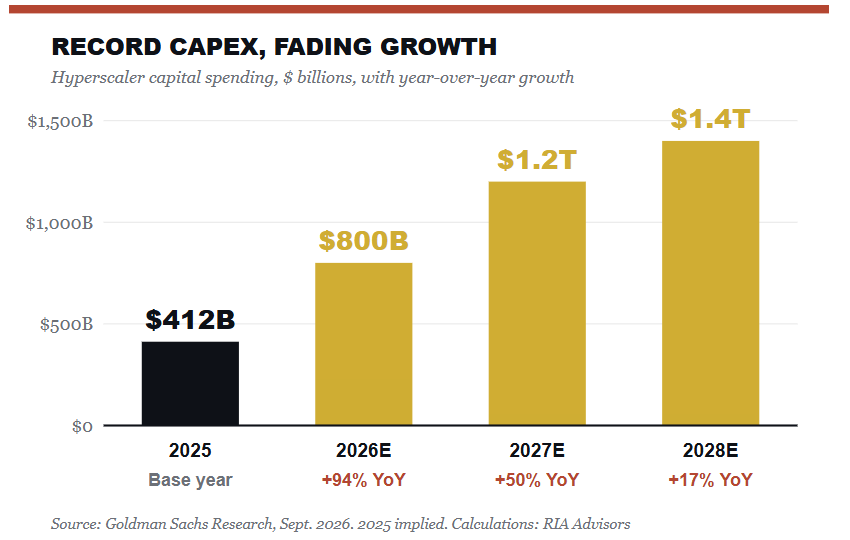
Despite these headline-grabbing, record-shattering absolute numbers, a critical structural shift is already underway beneath the surface. While the total volume of spending continues to set historical records, the rate of growth is actively collapsing. Year-over-year growth rates are projected to decelerate sharply from nearly 100 percent down to much tamer annual increases.
The immediate payoff for the broader equity market has been extraordinary. Consensus forecasts point toward exceptionally robust earnings growth for the broader index, led primarily by the information technology sector. Yet, the underlying math dictates that the health of supplier margins is directly tethered to the magnitude of the annual increase in spending, rather than the sheer height of the spending mountain itself.
Why Earnings Hinge on the Rate of Growth
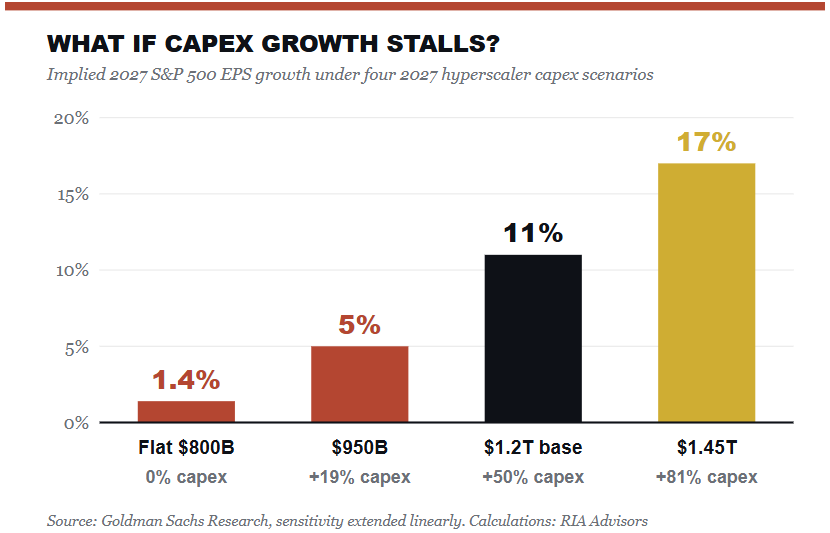
To understand the vulnerability of corporate earnings, financial analysts look closely at sensitivity models. Historical rules of thumb suggest that multi-billion-dollar deviations in forecasted capital expenditures can swing overall index earnings growth by several percentage points in either direction. If future spending merely holds flat at record-high levels rather than continuing its aggressive upward trajectory, the implied earnings growth rate for the broader market faces a dramatic contraction.

The core dilemma is not that spending is dropping—it is that the absolute dollar increment added each year is beginning to plateau. When capital expenditure increases by hundreds of billions of dollars year after year, suppliers rapidly expand their operational capacity. A specialized industrial equipment manufacturer whose orders suddenly double will add manufacturing shifts, hire additional specialized labor, and sign major supply contracts of its own.
This second-round economic activity is precisely why the artificial intelligence boom has felt far broader than the headline figures from a handful of tech giants would suggest. Unfortunately, operating leverage works in reverse with equal ferocity. When growth stalls, these same suppliers are left carrying bloated payrolls, excessive facility capacity, and high-cost inventories built for an acceleration phase that has abruptly ended.
Where the Money Actually Lands and Margin Realities
While the flow of capital is undeniably massive, the actual domestic economic pipe is narrower than many realize. A significant portion of the advanced hardware components is fabricated overseas in specialized international foundries. Federal Reserve and economic analyses frequently note that surging technology imports offset a substantial portion of gross domestic investment during peak quarters, suggesting that the direct domestic gross domestic product impact is more muted than headline figures imply.
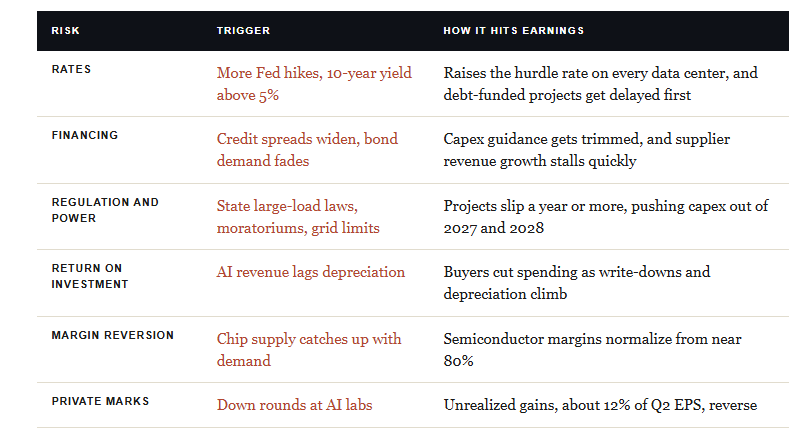
Beyond the macroeconomic leakage, two specific components of current corporate earnings deserve intense scrutiny. First, semiconductor gross margins have expanded to historic extremes, running well above their long-term historical averages. Classic market principles dictate that such cyclical excesses eventually revert toward their long-term means.
Second, a surprising share of recent corporate earnings has been driven not by operational cash flows, but by financial accounting marks. Large technology conglomerates have recorded substantial unrealized investment gains stemming from private company stakes in emerging artificial intelligence labs. This creates a deeply circular ecosystem: hyperscalers invest billions into specialized AI startups, those startups use that exact capital to purchase cloud compute power from the hyperscalers, and the equity stakes are marked up to higher valuations with each successive funding round. If private funding rounds hit a wall, those paper marks can reverse just as quickly as they were written.
Potential Reversals and Historical Precedents
The most formidable threat to the ongoing capital expenditure cycle is not necessarily a sudden evaporation of end-user demand, but rather tightening financial conditions and funding constraints. Free cash flow profiles for several major hyperscalers are narrowing significantly as heavy infrastructure investments outpace immediate cash generation, leaving these corporate giants increasingly reliant on debt markets at a time when interest rates and Treasury yields have drifted steadily higher.

Regulatory scrutiny represents another formidable, slow-burn risk. Across multiple state legislatures, moratorium bills and restrictive zoning proposals targeting heavy-load data centers have been introduced, while federal oversight measures sit in legislative committees. Even if sweeping statewide bans fail to become widespread law, localized permitting delays can easily push multi-billion-dollar infrastructure projects out by a year or more. A single year of operational delay is precisely the kind of unexpected friction in capex acceleration that the delicate earnings math cannot easily absorb.
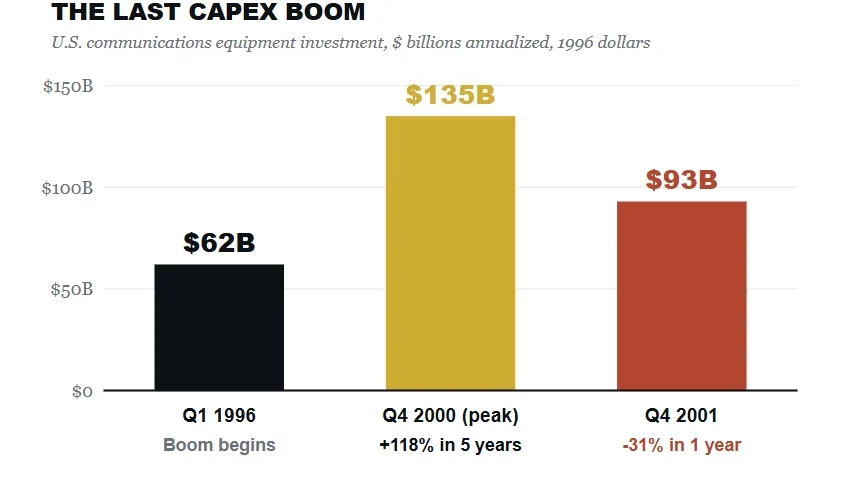
Financial history offers clear cautionary templates for such massive capital deployment cycles. During the late 1990s, U.S. communications equipment investment more than doubled over a four-year span, only to suffer a catastrophic correction of nearly a third within a single year as the telecommunications sector digested overcapacity. While the underlying technological thesis—in that case, the internet—ultimately proved correct and reshaped global commerce, the equity holders of the companies that built the physical infrastructure suffered devastating losses.
Portfolio Implications and Risk Management
For the average investor, navigating this environment requires looking past headline growth figures and focusing closely on the underlying rate of change. Because index funds naturally concentrate capital in the largest technology spenders and suppliers, many passive portfolios have become leveraged bets on the continuation of the artificial intelligence capex cycle.
Rebalancing portfolio allocations and ensuring alignment with established risk tolerances is a standard exercise in prudent asset management rather than an outright bearish market prediction. As the market digests the interplay between record capital spending and shifting earnings growth rates, the central question for investors remains whether the eventual economic returns generated by artificial intelligence infrastructure will comfortably outpace its massive cost of capital. Until that fundamental equation is definitively answered, the market remains acutely sensitive to any deceleration in the pace of corporate spending.

Related News