German Police Detain Suspect After Fire Engulfs Hitler’s Eagle’s Nest Mountain Retreat in Bavaria
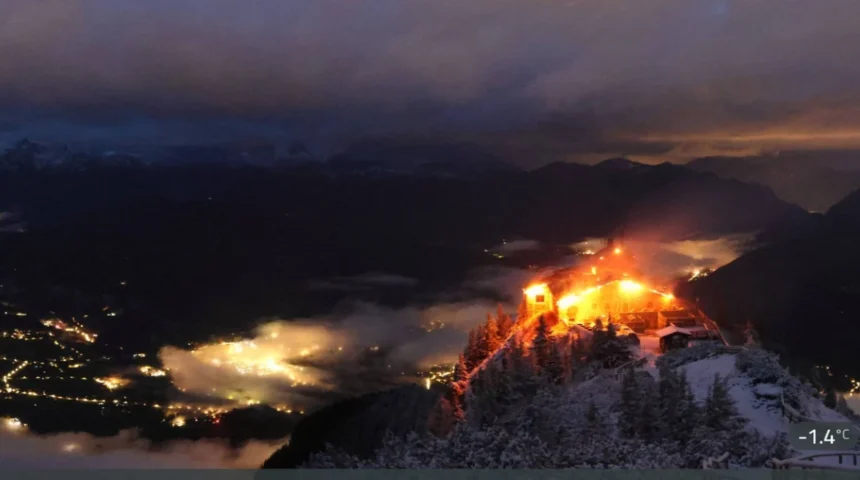
German police have detained a suspect after a major fire engulfed the Eagle’s Nest, Adolf Hitler’s notorious Nazi-era mountain retreat in Bavaria, prompting a massive and challenging overnight emergency operation involving about 200 firefighters who battled the blaze in freezing, high-altitude conditions.
No injuries were reported at the historic building, which is known locally as the Kehlsteinhaus. Authorities confirmed that investigators were examining whether a "suspicious person" taken into temporary custody shortly after the outbreak of the fire was connected to the blaze, which caused significant concern among local emergency services and heritage protection officials alike.
The high-stakes emergency response was triggered late Friday evening when a smoke detector inside the historic structure sounded the alarm at about 9:50 pm local time (19:50 GMT). As emergency crews navigated the steep winding roads leading up the mountain, responding firefighters could immediately see towering flames rising high above the building. Upon arrival at the summit, responders found the historic stone-and-granite structure "completely ablaze," according to statements released by local police officials.
Fighting the intense fire presented extraordinary logistical hurdles for the emergency services. The retreat’s remote Alpine location, situated at a dizzying altitude of more than 1,800 metres (about 6,000 feet) above sea level, severely complicated efforts to extinguish the fire and supply water to the remote peak, according to police spokesperson Lisa Maier. Firefighters had to deploy specialized equipment and coordinate carefully over narrow mountain passes to bring the situation under control during the hours of darkness.
While local authorities have not yet officially announced a definitive cause for the late-night blaze, prominent German media outlets reported that investigators strongly suspected arson given the circumstances of the fire and the subsequent apprehension of a motorist near the scene.
According to reports from the German newspaper Bild, emergency responders battling their way up the mountain encountered a motorcyclist travelling away from the scene and toward them. Following a quick assessment of the situation, the individual was subsequently detained by law enforcement officers. Authorities stated that his possible involvement in setting the fire remained under active investigation as forensic teams prepared to examine the charred remains of the structure.
Police spokesperson Lisa Maier emphasized that inquiries into the incident were continuing at a rapid pace, with local law enforcement planning to hold a formal news conference later on Saturday to update the public and media on the progress of the investigation, the extent of the structural damage, and the status of the detained suspect.
Built between 1937 and 1938 during the height of the Third Reich, the distinctive stone-and-granite retreat stands proudly on the rocky Kehlstein mountain situated directly above Obersalzberg, near the historic town of Berchtesgaden in southeastern Germany, right near the Austrian border. The ambitious construction project was designed primarily as a monument to Adolf Hitler’s absolute rule and served as an exclusive setting for receiving foreign diplomats, dignitaries, and high-ranking members of the Nazi party.
The structure offers sweeping, panoramic views stretching across the dramatic landscape of the Bavarian Alps. Historical records indicate that Hitler himself visited the remote resort on several occasions during the war years, though historians note he reportedly visited less frequently than initially portrayed by Nazi propaganda due to his fear of heights.
Significantly, the site managed to survive the devastation of World War II completely undamaged, escaping Allied bombing runs that heavily targeted the surrounding Obersalzberg complex, which had served as a heavily fortified southern headquarters for the Nazi regime. In the decades following the war, the historic property found new life serving civilian purposes. It has operated continuously as a popular mountainside restaurant since 1952, drawing hundreds of thousands of international tourists, hikers, and history enthusiasts every year. In addition to the hospitality venue, the site also houses a permanent historical exhibition examining its dark Nazi history and the broader context of the region’s wartime past.
As Saturday morning broke over the Bavarian Alps, law enforcement and forensic specialists continued their meticulous sweep of the property, assessing the structural integrity of the landmark and gathering physical evidence to piece together the exact sequence of events that led to the overnight emergency.

Related News