Why Agency Mortgage-Backed Securities Deserve a Fresh Look as Interest Rates Shift

By Michael Lebowitz
October 14, 2026
For fixed-income investors trying to navigate an uncertain interest rate environment, agency mortgage-backed securities (MBS) are emerging as an asset class worthy of serious reconsideration. Whether you believe benchmark interest rates are finally peaking or suspect that borrowing costs still have room to climb, MBS may offer a compelling strategic addition to your portfolio. These securities frequently deliver higher yields than comparable U.S. Treasuries while carrying essentially zero credit risk, making them an attractive alternative for conservative and income-focused investors alike.
Yet, this optimistic outlook comes with a historical caveat. During the sharp rate hikes of 2022 and 2023, investors in mortgage-backed securities learned a painful lesson. As central bank policies pushed borrowing costs higher, refinancing activity ground to a halt, causing MBS durations to extend outward at precisely the worst possible moment for portfolio performance.
Today, however, that macroeconomic dynamic has largely run its course. With 30-year fixed mortgage rates hovering around 7.25% and nearly 80% of American homeowners locked into mortgage rates below 6%, refinancing has virtually disappeared. Consequently, MBS durations have little room left to extend further. The specific structural vulnerability that punished MBS investors a few years ago has exhausted its potential for further harm, fundamentally altering the risk-reward equation for the asset class.

To understand the current opportunity, one must examine the unique mechanics of mortgage-backed securities. Unlike standard corporate or municipal bonds, MBS are backed by pools of residential mortgages whose underlying borrowers hold an embedded option: the right to prepay part or all of their mortgage debt at any time without financial penalty. Investors who purchase MBS are essentially acting as lenders to these homeowners, meaning they are inherently short a prepayment option.
This embedded option accounts for much of the extra yield that MBS offer over standard U.S. Treasuries, as well as their heightened sensitivity to interest rate fluctuations. However, when those specific risks are legally and economically constrained, holders of mortgage-backed securities often find themselves in an advantageous financial position.
Setting The Stage
Mortgage rates and Treasury yields have followed a sharp upward trajectory over the preceding six months. According to data compiled by Freddie Mac, the average rate for a 30-year fixed mortgage reached 7.28% at the start of October, marking the highest level observed since November 2023 and climbing significantly from 6.34% recorded just one year prior.
Market data clearly demonstrates that virtually all mortgages originated from the early 2000s onward carry interest rates well below today’s prevailing market levels. As a direct result, refinancing activity has dried up across the financial sector. The Mortgage Bankers Association (MBA) recently reported that its national refinance index stands more than 50% below its levels from the same period last year. Joel Kan of the MBA noted that mortgage rates jumping to their highest levels in nearly three years have effectively pushed prospective borrowers to the sidelines.
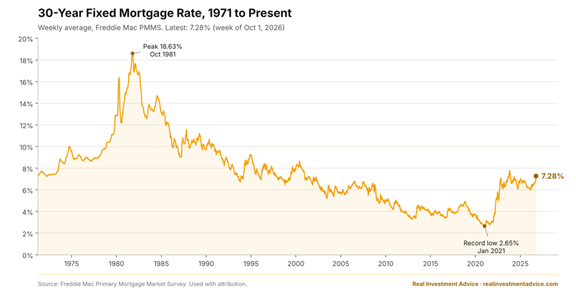
Consider the composition of the iShares MBS ETF (MBB), which serves as a widely accepted proxy for the broader agency MBS index. The fund holds underlying securities with a weighted average coupon of just 3.63%, which is roughly 3.50% below current market mortgage rates. With the vast majority of existing mortgages sitting at least two percentage points below prevailing rates, very few homeowners retain any economic incentive to refinance their loans. In financial terminology, their prepayment options are currently worth very little. To fully grasp why this structural shift matters for modern fixed-income investors, it is essential to look closely at the concept of MBS duration.
Understanding MBS Duration
Duration serves as a standard metric for measuring a bond’s price sensitivity to shifts in interest rates. For example, a traditional bond with a duration of seven years should theoretically lose about 7% of its market value if benchmark yields rise by 1%, and gain approximately 7% if yields fall by an equivalent margin. For traditional fixed-income instruments such as Treasuries, municipals, and corporate bonds, duration remains relatively predictable because their interest and principal cash flows are contractually fixed.
In contrast, the cash flows received by MBS investors depend entirely on when and by how much homeowners choose to pay down their mortgages, a behavior heavily influenced by prevailing interest rates. Consequently, shifts in interest rates exert a much more profound and volatile impact on MBS durations than they do on corporate or government debt. Professional MBS investors rely on effective duration, a sophisticated, model-based estimate designed to account for how anticipated homeowner prepayments evolve as market rates shift.
Historical modeling reveals that MBS rate exposure tends to shift in unfavorable directions during periods of extreme market volatility. When rates decline rapidly, homeowners rush to refinance, returning principal to investors early and forcing them to reinvest those funds in lower-yielding assets. Conversely, when rates spike upward, refinancing drops, locking investors into longer-duration assets at below-market rates. These negative consequences are collectively known in financial markets as negative convexity. This dynamic means that the stated duration of an MBS or an entire portfolio of mortgage-backed securities is never a constant figure; rather, it is a dynamic snapshot that evolves as market rates fluctuate relative to the refinancing threshold of underlying borrowers.

Extension Risk Is Largely Spent
Extension risk—the danger that a bond’s duration will suddenly expand as market rates rise—has plagued MBS investors continuously since the Federal Reserve and broader macroeconomic forces began driving rates upward in late 2021. As borrowing costs climbed, refinancing slowed down dramatically, the expected lifespan of underlying mortgage pools lengthened, and duration expanded precisely when institutional and retail investors least desired additional interest rate sensitivity. Holders of mortgage-backed securities felt the full weight of this negative convexity throughout 2022 and 2023.
Today, despite recent increases in benchmark rates, the vast majority of that duration extension has already taken place. When a mortgage pool is deeply "out of the money"—meaning the underlying loans cannot be economically refinanced—prepayment speeds are driven almost entirely by demographic and life events that have little to do with interest rates. These non-rate factors include residential moves, family changes, job relocations, and property liquidations.
These natural drivers of principal repayment establish a firm baseline floor beneath prepayment speeds. Because prepayments cannot reasonably slow down much further from current depressed levels, any potential future rate increases would fail to extend duration significantly. Stated differently, investors purchasing mortgage-backed securities in the current market environment are absorbing an asset with duration risk that is heavily capped on the upside. Consequently, the fundamental risk-reward proposition for agency MBS appears far more balanced than it did just a few years ago.
The Con: The Double Whammy If Rates Fall
Naturally, every investment strategy carries inherent risks, and the flip side of limited duration extension risk is the vulnerability mortgage-backed securities face if market interest rates experience a sharp decline. If mortgage rates were to fall meaningfully in the future, higher-coupon mortgage pools would face a dual penalty.
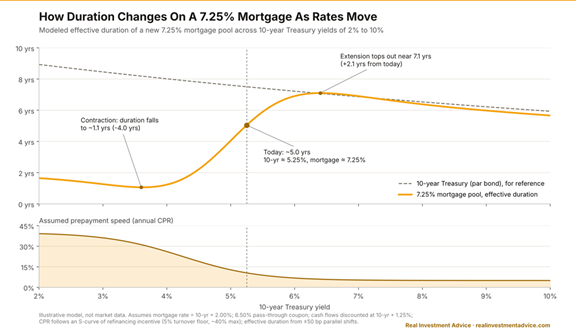
First, homeowners would rush to refinance their high-rate loans, returning principal to investors much earlier than anticipated and eliminating those above-market yield streams. Second, as those cash flows are returned prematurely, investors are forced to reinvest capital into a lower-yielding interest rate environment. This adverse double whammy represents the core cost of the embedded prepayment option that MBS investors effectively sell to homeowners when purchasing the securities. The extra yield that MBS offer over standard U.S. Treasuries serves as the compensation premium collected for bearing this specific structural risk.
The Silver Lining To The Double Whammy
Even within this potential double whammy of negative convexity lies a notable silver lining under current market conditions. If mortgage rates were to decline by a moderate margin toward 5%, market data indicates that over two-thirds of existing American mortgages would still lack any financial incentive to pursue refinancing, as their locked-in rates would remain lower than or competitive with the newly available market rates.
For the vast majority of the modern MBS market, a mild decline in prevailing interest rates would likely prove beneficial rather than disruptive. Beyond the simple math of low coupon comparisons, the practical realities of the mortgage industry serve as a natural friction against sudden refinancing waves.
The refinancing process requires time for borrowers to notice shifting economic conditions, shop around for competitive lenders, and complete extensive underwriting and closing paperwork. Furthermore, given the prolonged slump in recent refinancing activity and existing home sales, institutional lender capacity could easily experience severe operational bottlenecks if mortgage application volumes suddenly surge.

Additionally, a significant percentage of borrowers never refinance their homes regardless of prevailing market conditions. Some individuals lack the requisite credit scores or sufficient home equity to qualify for new financing terms, others carry mortgage balances too small to justify the closing costs associated with a new loan, and many simply fail to act due to inertia. As a result of these behavioral and structural realities, investors would continue collecting above-market coupon payments on the surviving loan pools, demonstrating that falling rates can deliver positive outcomes for MBS holders under the current economic backdrop.
How To Invest In MBS
For large institutional players, the agency mortgage-backed securities market represents one of the deepest, most highly liquid fixed-income sectors anywhere in the global financial system. In theory, owning individual MBS directly is an attractive proposition because it allows portfolio managers to carefully select specific coupons, loan vintages, and prepayment profiles that align with their macroeconomic forecasts. In practice, however, direct ownership remains extraordinarily challenging and impractical for smaller retail investors due to high minimum investment thresholds, complex pricing structures, and the operational difficulties of managing fragmented mortgage pools.
For these reasons, exchange-traded funds (ETFs) and mutual funds provide a much more practical and efficient avenue for individual investors seeking exposure to the asset class. Modern investment funds handle complex cash flow reinvestments, maintain broad diversification across a wide variety of loan vintages and coupons, and leverage professional management teams equipped with institutional prepayment models and lower overall trading costs.
Passive exchange-traded funds, such as the iShares MBS ETF (MBB), offer broad index exposure at minimal cost, boasting a low expense ratio of roughly 0.04%. Alternatively, actively managed MBS funds, including vehicles like JMBS, grant managers the flexibility to tactically adjust their portfolio holdings toward specific coupons and specialized loan pools that offer superior convexity profiles, albeit in exchange for slightly higher management fees.

Investors evaluating these products should carefully review a fund’s coupon distribution, effective duration metrics, and utilization of leverage or financial derivatives. Two distinct funds boasting identical headline durations can behave quite differently during periods of market stress depending on the underlying structure of their holdings.
Summary Investment Thesis
The bullish investment thesis for agency mortgage-backed securities rests upon two foundational pillars. First, it assumes that broader benchmark interest rates will eventually stabilize and begin a gradual descent. Second, it recognizes that even if interest rates manage to climb higher, the associated duration shift is largely constrained, limiting the potential downside price divergence between mortgage-backed securities and comparable maturity U.S. Treasuries, provided that credit spreads remain relatively stable.
Three years ago, severe extension risk provided a compelling justification for investors to steer clear of the mortgage-backed securities market. Today, that exact same dynamic has transformed into a primary reason to consider owning them. With the vast majority of existing American mortgages sitting far below current market borrowing rates, MBS duration retains very little room left to extend or experience aggressive refinancing waves. Consequently, investors are left with an accessible asset class that provides attractive yields, virtually nonexistent credit risk, and a stabilized duration profile.

Related News