Microsoft Teams to Roll Out AI-Powered Phishing Detection to Combat Advanced Social Engineering
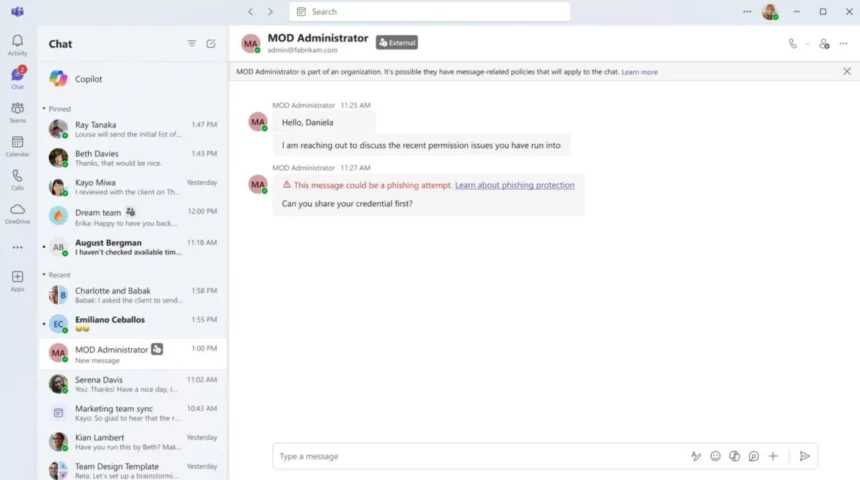
Microsoft has announced that its widely used enterprise communication platform, Microsoft Teams, will soon incorporate advanced, artificial intelligence-powered phishing detection capabilities. Designed to spot malicious behavior, social engineering tactics, and deceptive intent within messages, the new security features are slated to begin rolling out in early November 2026.
The initial deployment will take place through a targeted release phase expected to wrap up by the middle of November. Following this initial rollout, the upgraded security feature is projected to reach general availability for users worldwide between early and mid-December. The enhancement addresses a growing volume of sophisticated cyber threats that target corporate communication networks through collaborative tools.
The upcoming security feature was first disclosed by Microsoft in a Microsoft 365 Roadmap entry published last week. According to the company’s documentation, the AI-driven tool will analyze conversation context to identify phishing indicators and suspicious behavior, particularly in higher-risk communication scenarios such as external first-contact chats. Crucially, the system will evaluate contextual cues without permanently retaining the underlying message content.
In a comprehensive update shared via the Microsoft 365 Message Center, the tech giant elaborated on the mechanics of the new safeguard. The company stated that Microsoft Teams is actively introducing context-aware phishing detection powered by artificial intelligence to help identify complex forms of deception, including phishing schemes, targeted social engineering, and unauthorized impersonation attempts.
The capability is specifically engineered to analyze broader conversation context in order to flag suspicious behavior that may completely lack traditional indicators of compromise, such as malicious hyperlinks or infected file attachments. Because modern attackers frequently rely on psychological manipulation rather than raw payloads to establish initial footholds, this contextual approach represents a shift in how collaboration platforms handle incoming threats.

For most enterprise environments and individual users, the new protective layer will operate seamlessly in the background. Microsoft has confirmed that IT administrators will not need to configure complex policies or take manual action to enable the security protection feature, which will primarily focus on external first-contact chats where the risk of social engineering is significantly elevated.
To address growing enterprise concerns regarding data privacy and regulatory compliance, Microsoft emphasized that the new Teams feature will strictly adhere to data minimization principles. While the tool must analyze conversation context to uncover malicious patterns and suspicious behavior, it will not retain customer message data for further artificial intelligence training or any other secondary uses.
The company reiterated this commitment in its official communications, noting that the capability is utilized exclusively for security protection and is strictly walled off from productivity enhancements, message summarization, advertising, user monitoring, or other non-security purposes. Customer message content is deliberately excluded from being retained by the detection system for model training or secondary business objectives.
This upcoming deployment forms a key component of a much broader, ongoing initiative by Microsoft to harden Teams against persistent cybercrime operations. In a related push last December, the company announced that IT administrators would be granted the ability to lock out external users directly via the Microsoft Defender portal starting in January. That measure was introduced to thwart various cybercrime syndicates, including aggressive ransomware gangs, from abusing legitimate Teams infrastructure to execute social engineering attacks against corporate employees.
Security researchers and incident responders have frequently documented cases where sophisticated threat actors leverage collaboration tools to bypass traditional email perimeters. Ransomware operators and financially motivated hackers have historically impersonated IT support personnel or trusted partners within Teams voice calls and chat interfaces to manipulate employees into granting network access or downloading malicious payloads.
To counter these operational vectors, Microsoft also began rolling out a comprehensive Teams meeting protection policy in August. This policy empowers administrators to automatically block all identified external bots from infiltrating scheduled meetings, thereby closing another common avenue for automated reconnaissance and data harvesting.
The platform enhancements build upon a steady stream of security updates introduced throughout the year. Last month, Microsoft revealed that Teams is scheduled to begin automatically blurring QR codes sent by external senders. This visual safeguard is designed to protect users against emerging fraud and phishing techniques that rely on optical scanning vulnerabilities. Additionally, the platform is introducing functionality that allows users to report suspicious guest invitations directly within the Teams interface, providing security operations centers with vital telemetry to block malicious guest-based attacks.
Earlier in October, the company also outlined plans to introduce native support for third-party deepfake detection solutions alongside advanced impersonation protection for Teams meetings, reflecting the rapid evolution of multimedia fraud techniques utilized by modern threat actors.
These collective enhancements highlight a concerted effort to transform enterprise chat platforms into resilient environments capable of defending against threats ranging from credential harvesting to complex executive impersonations and deepfake-driven fraud.

Related News