Israel Faces Political Gridlock as Election Nears Final Count With No Clear Majority
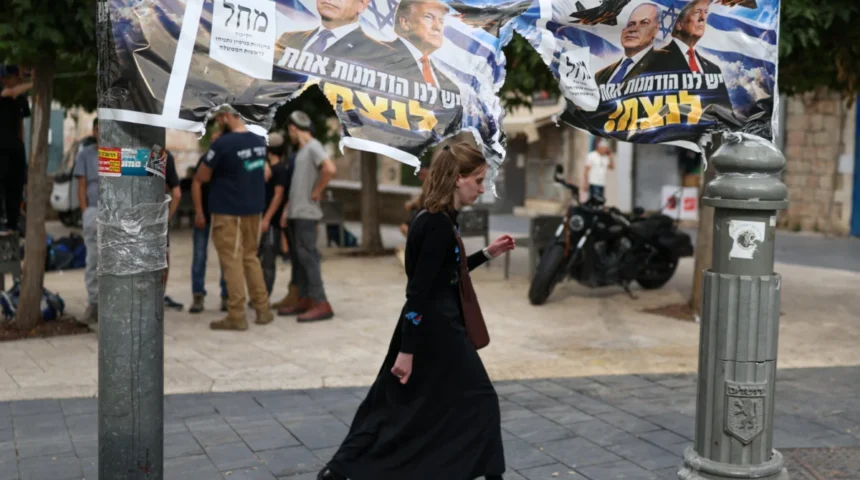
Israel is facing a familiar yet increasingly strained political stalemate following a national election that has left both major political blocs short of the parliamentary majority required to form a government. With nearly 90 percent of all ballots officially counted, the country’s political future remains uncertain as party leaders navigate the complex arithmetic of coalition building.
The Israeli Central Elections Committee reported on Wednesday that more than five million votes had been processed by early evening. The electoral landscape, shaped heavily by the historic events and cascading crises following the October 7, 2023, attacks and the subsequent war in Gaza, has produced a fragmented parliament where absolute majorities remain elusive.
According to the data released by election officials, Prime Minister Benjamin Netanyahu’s right-wing bloc is currently on course to secure 53 seats in the 120-member Knesset. Meanwhile, the primary opposition bloc, spearheaded by Gadi Eisenkot, is projected to win 48 seats. Because a functioning government in Israel requires the backing of at least 61 legislators, both primary factions find themselves compelled to seek additional political partners or explore unprecedented cross-ideological arrangements.
The high-stakes vote, which recorded its highest turnout in fifty years, served as an unmistakable national referendum on Netanyahu’s long-standing premiership. Despite falling short of an outright victory, the 77-year-old incumbent is far from politically sidelined. Netanyahu will maintain his position as caretaker prime minister, steering day-to-day government operations until a new administration is successfully sworn in.
President Isaac Herzog is scheduled to begin formal consultations with leaders from across the political spectrum next week, once the Central Elections Committee certifies and releases the official, final election results. In anticipation of those talks, Herzog has strongly urged all political factions to avoid dragging the country into yet another costly and exhausting election cycle that would further stall governance and state affairs.
Coalition building has long been the bedrock of Israeli politics, and no single party has ever won an outright parliamentary majority in the history of the state. However, the path forward this time is fraught with deep ideological red lines. Ahead of the election, Eisenkot publicly ruled out the possibility of forming a minority government dependent on the external support of Arab-led parties. Netanyahu has similarly rejected any such collaboration, maintaining rigid boundaries around his potential coalition partners.
With Netanyahu’s bloc emerging as the largest single faction in the Knesset, political analysts are speculating about the possibility of a broader unity government. Such an arrangement could theoretically bridge the gap between Netanyahu’s bloc and Eisenkot’s opposition alliance, though political observers caution that reaching such a compromise is far from guaranteed given the intense animosities dividing the current political establishment.
Eisenkot took to social media on Wednesday to outline his alliance’s immediate priorities, writing on the platform X that his political camp is fully focused on the heavy task entrusted to them by the electorate. He emphasized that their goal is to bring tangible change to Israel and establish a mobilization government rooted in Zionist principles.
"This is the will of the people who expressed no confidence in the government of October 7th and the shirking, and in the bloc of shirkers in general," Eisenkot wrote, characterizing his opponents’ bloc as being at its lowest political point in two decades.

Adding a volatile dynamic to the post-election landscape is the surging performance of Arab-led political parties. Projections from Tuesday’s voting indicated that the Joint List and Ra’am alliances could collectively hold a historic 19 seats in the new parliament. This surge was driven by a record-high level of civic participation and voter turnout among Arab citizens.
The potent showing by Arab voters, however, immediately triggered harsh accusations and unprecedented counter-attacks from Netanyahu’s Likud party. In a strongly worded public statement released on Wednesday, Likud alleged that the national elections had been subverted through systemic electoral fraud.
"The elections in the State of Israel were stolen by Arab parties that support terrorism and the elimination of the Jewish state through serious criminal offences of bribery, threats, violence, forgeries, and the use of prohibited software to mobilise voters," the Likud statement claimed.
The party added that it was actively transferring hundreds of testimonies, documents, and other pieces of evidence regarding alleged election theft in numerous Arab-majority polling stations to the Israel Police, the Shin Bet security agency, and the Central Elections Committee for thorough investigation.
The allegations were met with fierce rebukes from Arab political leaders, who defended their communities’ high voter turnout as a legitimate exercise of democratic rights in direct defiance of state policies. Israel’s predominantly Arab Joint List alliance issued its own statement via the Turkish news agency Anadolu, asserting that preliminary figures proved Arab voter participation played a decisive, defensive role in denying Netanyahu and his allies a parliamentary majority.
The Joint List stated that voters courageously answered what it described as relentless incitement and intimidation at the ballot box. The alliance argued that the electorate decisively rejected what it termed a "government of butchers" and its associated policies of home demolitions, systemic racism, and alleged war crimes.
Furthermore, the Joint List emphasized that its strong electoral support reflects a widespread demand for political unity and the establishment of a robust representative force capable of defending the civil and national rights of Arab citizens without making fundamental concessions. The alliance pledged to continue working toward the permanent removal of Netanyahu’s government, stating its readiness to cooperate pragmatically toward an alternative administrative arrangement.
Yousef Jabareen, a prominent leader of the Joint List, indicated that while the alliance would not formally join a Zionist-led government, it could potentially consider backing an anti-Netanyahu coalition from the outside to ensure his administration’s ouster.
The final composition of the Knesset could still shift slightly as election officials work through the backlog of special double-envelope ballots. More than 500,000 of these ballots remain to be counted, including votes cast by active-duty military personnel, Israeli diplomats stationed abroad, hospitalized citizens, and others who voted away from their officially registered neighborhood polling stations.
While these specialized votes have historically altered seat distributions by a margin of one or two mandates, election officials expect that the counting process will conclude, and final certified results will be made public, as early as Thursday evening. Until then, Israel remains suspended in political limbo, awaiting the formal initiation of President Herzog’s consultations and the arduous backroom negotiations that will ultimately determine whether a viable governing coalition can be forged from a deeply fractured parliament.

Related News