Cracks in the Cloud: Neocloud Funding Stresses, Hyperscaler Advantages, and the Transmission of Fed Policy
By RIA Team
October 21, 2026
6 min read
The fault lines running beneath the artificial intelligence infrastructure boom are beginning to widen, exposing a stark divergence in how different players fund the massive expansion of compute capacity. Yesterday on South Korea’s Kosdaq exchange, Elice Group went public and immediately suffered a dramatic plunge of roughly 30%. That sharp market rejection followed closely on the heels of another major casualty in the sector: a week earlier, Nvidia-backed Firmus quietly shelved its planned $5 billion initial public offering.
These developments are part of a broader, mounting distress across the neocloud ecosystem. As previously highlighted in examinations of CoreWeave’s financial positioning, the cost of capital for independent cloud providers has escalated rapidly. CoreWeave’s debt maturing in 2032 has seen its yields spike, trading near 15% compared to below 10 just a week prior. To understand the turbulence currently shaking datacenter stocks and why market participants must differentiate between providers, analysts must examine the starkly contrasting business models of specialized neocloud companies versus the trillion-dollar hyperscalers.

At their core, neoclouds operate a high-stakes spread business. These firms borrow capital from the debt or equity markets, purchase expensive graphics processing units (GPUs), rent out that compute capacity to corporate clients, and pocket the difference—the spread—after covering debt service and equipment depreciation. This business model can be exceptionally lucrative during periods when specialized compute is in hyper-demand and financing is readily available at low interest rates.
However, the macroeconomic environment has shifted dramatically. Financing has become remarkably expensive for independent neocloud firms. Credit default swaps (CDS) for neocloud companies currently hover above 1,000 basis points, creating a yawning chasm when compared to the modest 55 basis points demanded for the large hyperscalers.
In contrast, hyperscalers operate under an entirely different financial architecture. Tech giants like Microsoft, Amazon, Alphabet, and Meta are projected to spend roughly $800 billion this year alone to build out their compute infrastructure. Unlike their neocloud counterparts, these dominant technology conglomerates fund the vast majority of their capital expenditures through robust operating cash flows. They do not need to rely heavily on volatile debt or equity markets to keep their server farms running.
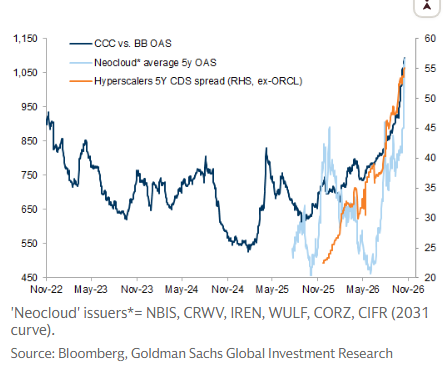
Furthermore, hyperscalers enjoy a built-in structural advantage: they are often their own primary customers. Consequently, a softening in broader datacenter rental rates has virtually no negative impact on their core operations. Their overarching customer bases consist of thousands of diversified enterprise clients spread across global industries rather than a narrow handful of counterparties reliant on speculative tech ventures.
Should neoclouds find themselves cornered into cutting capacity or forced into liquidating GPUs simply to service maturing debt obligations, the balance of power shifts. Hyperscalers stand to gain immense pricing power regarding future GPU purchases and rental terms, alongside a prime opportunity to acquire distressed physical capacity at bargain-basement prices.
At the same time, however, a sudden wave of used or second-hand GPUs flooding the open market could depress the resale value of the hyperscalers’ own hardware assets. It would also signal to the broader market that the era of severe compute scarcity is finally easing. Such a shift would inevitably carry heavy implications for major semiconductor manufacturers, whose current chip pricing remains a key market indicator.
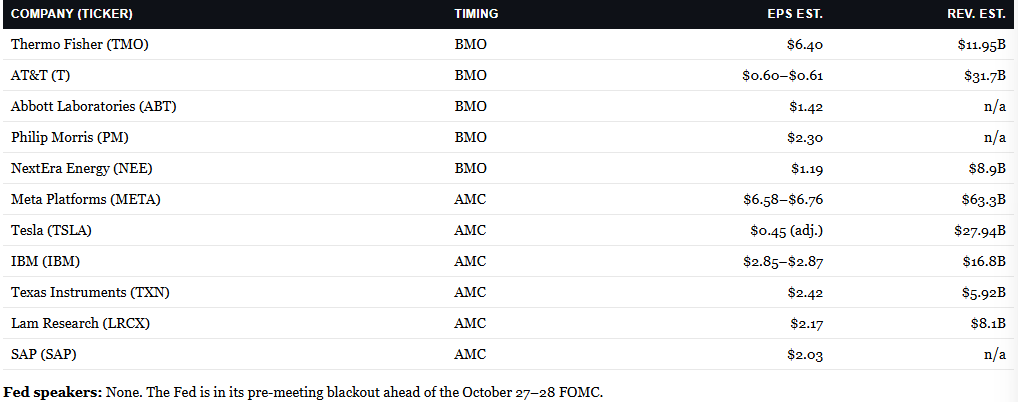
What To Watch Today
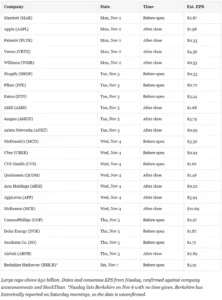
As the financial markets navigate these crosscurrents, investors are turning their attention to a heavy slate of corporate earnings and key economic data releases that will test the resilience of the broader equity rally.
The corporate earnings calendar features high-profile reports from major technology and industrial bellwethers, while the economic calendar provides a snapshot of incoming macro data that could influence sentiment ahead of upcoming central bank decisions.
Market Trading Update
The ongoing market dynamics tie directly into broader discussions regarding market breadth and the behaviour of the largest capitalization stocks. Recent sessions have highlighted how the underlying breadth reversal beneath the ongoing megacap sell-off might ultimately set up a healthier run into the end of the year. However, navigating this transition requires acknowledging the distinct pain felt outside the elite cohort of tech giants.

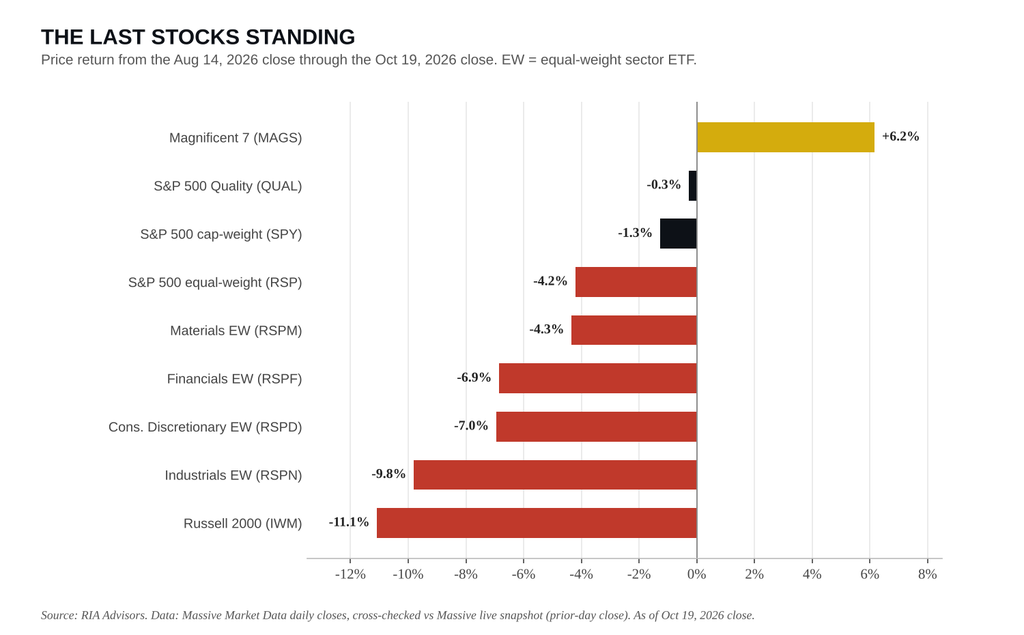
Morgan Stanley’s Michael Wilson has argued that the current market correction will likely not reach its ultimate conclusion until the last stocks standing finally catch down to the valuations of everything else. He is referring, of course, to the "Magnificent 7." For the average stock in the broader market, however, the heavy damage is already done.
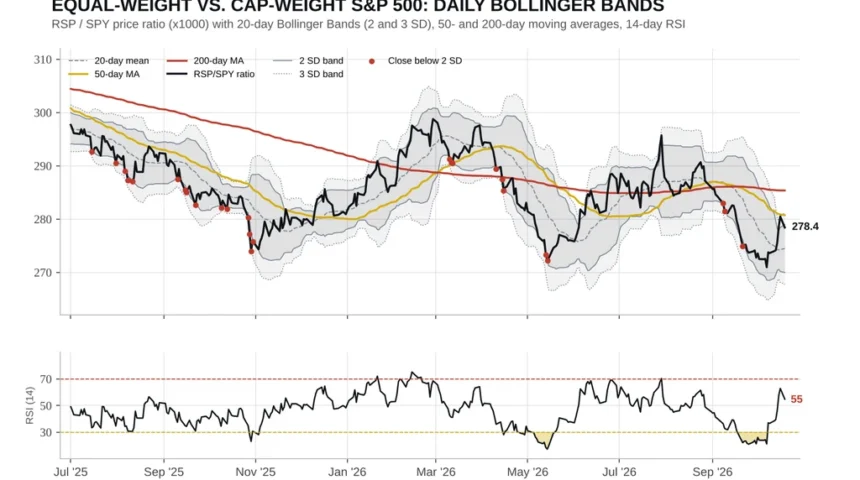
From the market close on August 14 through Monday’s session, the equal-weight S&P 500 index (RSP) fell 4.2%, while the traditional market-cap-weighted S&P 500 (SPY) slipped a mere 1.3%. Digging deeper into sector performance reveals even starker pain: equal-weight industrials lost 9.8%, and the small-cap Russell 2000 dropped 11.1%. Over that exact same stretch, the Magnificent 7 proxy (MAGS) managed a gain of 6.2%. For market strategists, that divergence captures the core tension in the current equity landscape.
Morgan Stanley’s proprietary research underscores this theme, showing that their quality factor has gained roughly 6% since mid-August, recently breaking out to a fresh 52-week high. The earnings revisions gap between high-quality and low-quality companies currently sits near 10 percentage points, marking the second-widest spread recorded since 2010. Meanwhile, the firm’s financial conditions composite—which factors in bond yields, the U.S. dollar, and energy prices—stands at its tightest level since 2022. In essence, the financial markets have already done a significant portion of the Federal Reserve’s tightening work, and the average stock has paid the bill.
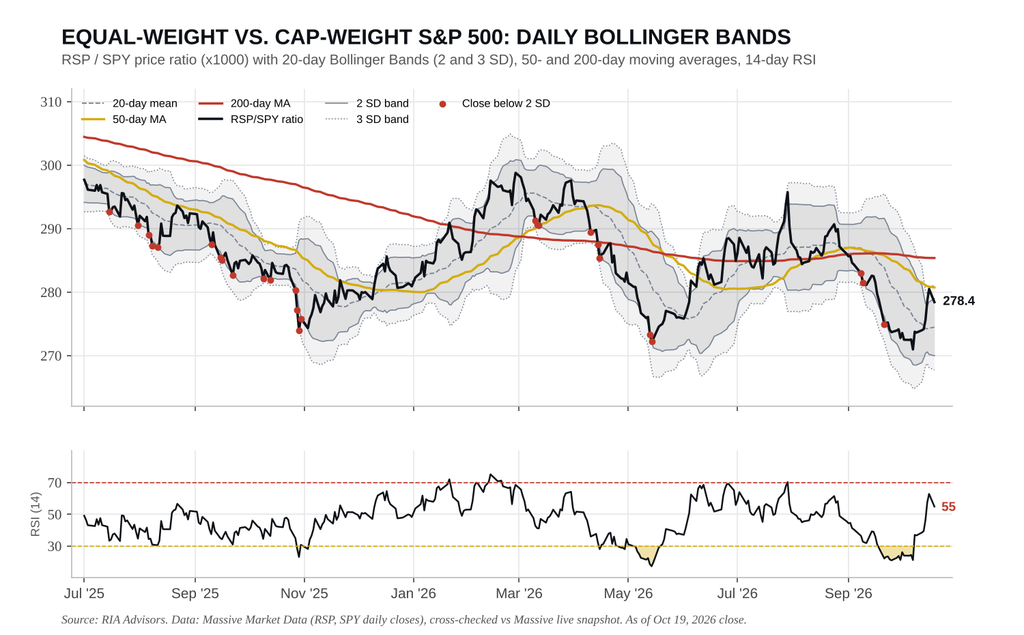
The equal-weight to market-cap-weight ratio (RSP/SPY) hit 270.97 on October 7, registering its weakest reading since mid-2024, with its Relative Strength Index (RSI) deeply oversold below 30. Last week’s relief bounce lifted the ratio by 3.5% to 280.50, but it still lingers below both its 50-day moving average at 280.74 and its 200-day moving average at 285.37. While a single strong week does not constitute a full regime change, it demands close attention from active managers.
Wilson’s core thesis relies on the historical observation that mid-cycle corrections often end when blue-chip leaders finally experience a catch-down correction. The market bottom is rarely in place until the former leaders break. As the old Wall Street axiom dictates, a washout is never truly finished until the selling reaches the holdings nobody wanted to sell.
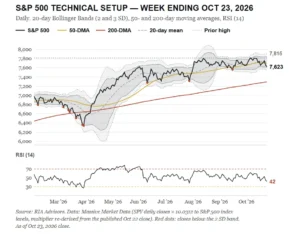
That premise faces a rigorous test as heavyweights including Meta, Tesla, IBM, Texas Instruments, and Lam Research report their quarterly financial results after the closing bell. With the S&P 500 hovering near 7,682—approximately 1.8% below its record high set on October 6—the market setup is delicate. If the market leaders finally crack while the rest of the broader market holds its ground, this convergence could represent a final, cleansing flush rather than the inception of a deeper downturn.
Portfolio positioning remains disciplined. Technology holdings are being maintained at target weights heading into the earnings releases without adding fresh capital. Megacap strength is being utilized as an opportunity to rebalance toward sectors that have already absorbed their share of losses, while building a selective watch list of equal-weight industrials and financials for when the valuation gap eventually closes. As outlined in prior commentary, a decisive close below 7,567 would necessitate raising cash levels and implementing protective hedges. The last stocks standing rarely relinquish their leadership quietly.
CoreWeave And The Fed: Not As Distant A Relationship As You May Think
Recent commentary from financial analysts highlights a compelling macroeconomic argument regarding corporate credit, described by some observers as monetary policy’s sleeping giant. For roughly four years, the corporate credit market largely failed to transmit the full force of the Federal Reserve’s aggressive monetary tightening directly to the real economy. The emerging distress surrounding CoreWeave and the broader neocloud bond rout may signal that this disconnect is finally coming to an end.
The underlying mechanism is straightforward. Many corporations locked in ultra-low borrowing costs during the pandemic era. When the Federal Reserve began its rate-hiking cycle in 2022, the immediate impact on established corporations was surprisingly muted. The returns on corporate cash balances repriced upward almost immediately to capture higher yields, whereas corporate liabilities repriced at a sluggish pace only as existing bonds gradually matured.

Data compiled by the Bureau of Economic Analysis illustrates this dynamic, showing that corporate net interest paid rose by roughly $86 billion over a five-year window, while nonfinancial corporate profits expanded by approximately $1.2 trillion.
As that low-cost pandemic-era debt inexorably reaches maturity, the delayed transmission of Federal Reserve policy through higher interest rates is finally taking hold, reconnecting monetary policy directly to prevailing financial conditions. High-yield junk bond yields have climbed to their highest levels since 2025, while investment-grade yields sit at peaks not seen since 2023. Roughly a quarter of the Bloomberg U.S. High Yield index consists of debt obligations maturing over the next one to three years.
The policy implications for the broader economy are significant. Analysts distinguish between a healthy tightening cycle that cools speculative artificial intelligence capital spending while physical component supply catches up—ultimately helping return consumer inflation toward central bank targets—versus a disorderly widening of credit spreads. The latter risk threatens to transform the upcoming wave of corporate debt refinancing from a manageable corporate hurdle into a full-blown funding crisis.
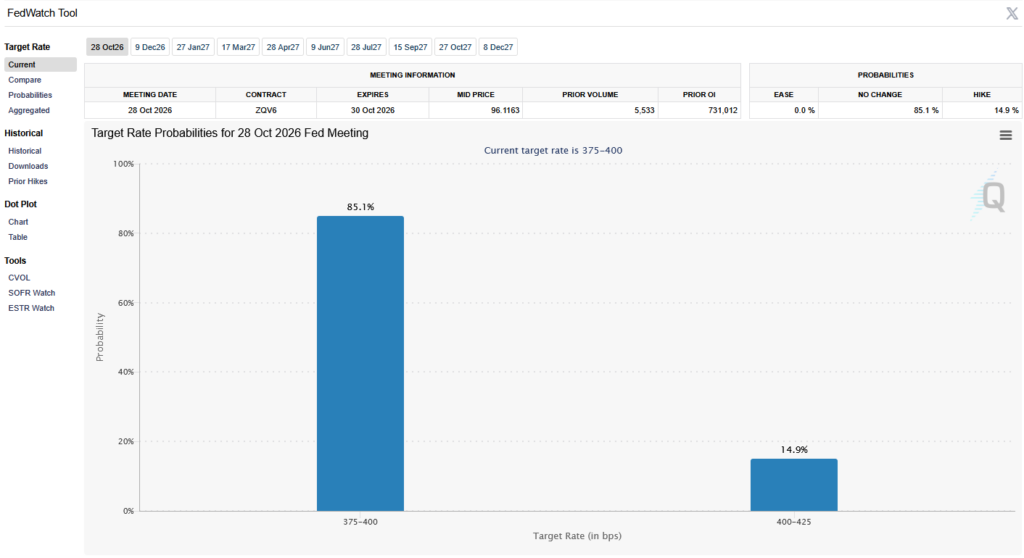
Against this backdrop of financial tightening and market realignment, interest rate futures indicate that the market is assigning roughly 85% odds that the Federal Reserve will hold benchmark interest rates steady at its upcoming policy meeting.

Related News