French Bank Crédit Mutuel Arkéa Hit by Cyberattack Enabling Up to $133 Million in Fraudulent Transfers

French cooperative banking giant Crédit Mutuel Arkéa has fallen victim to a sophisticated cyberattack that allowed malicious actors to initiate fraudulent transactions amounting to as much as $133 million. The incident, which forced the financial institution to temporarily suspend certain core systems to contain the threat, highlights the ongoing vulnerabilities that major financial institutions face when dealing with third-party service providers and interconnected digital infrastructures.
Despite the staggering sums involved, Crédit Mutuel Arkéa has moved swiftly to reassure its massive customer base. The bank confirmed that while its own corporate accounts were utilized by the attackers to siphon funds, everyday retail customer assets remain completely untouched and secure. However, the breach has triggered immediate security clampdowns, localized delays in transfer execution, and heightened warnings regarding secondary threats such as targeted phishing campaigns.
The breach at Crédit Mutuel Arkéa is one of the most notable financial cybersecurity incidents of the season, drawing intense scrutiny from blockchain investigators, European law enforcement agencies, and industry observers alike. As investigations continue, authorities are attempting to map out the exact vector used by the perpetrators and track the rapid movement of funds across international cryptocurrency networks.
Unraveling the Attack: From Third-Party Access to Crypto Laundering
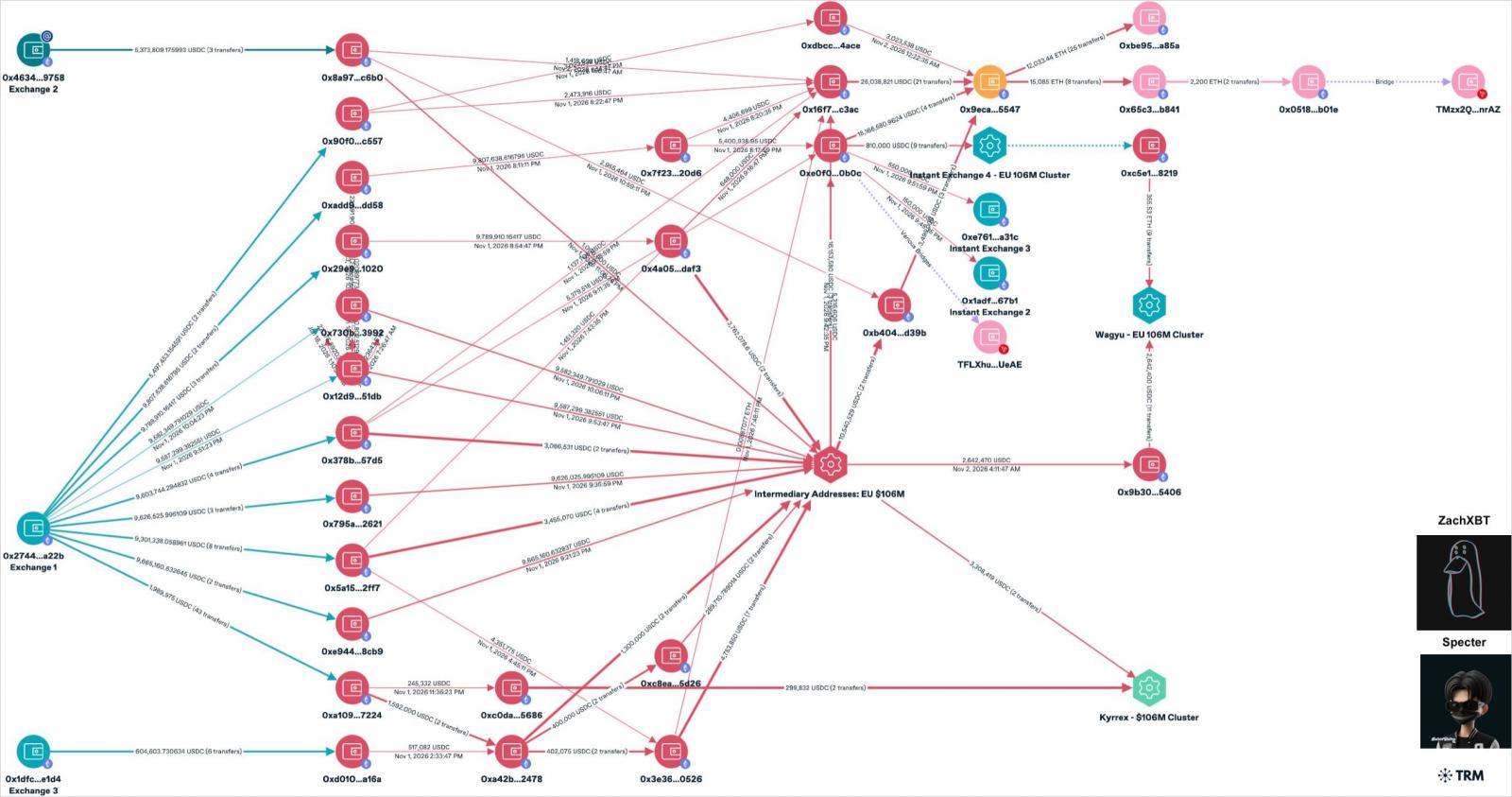
Public awareness of the security breach first materialized on November 2, when blockchain fraud investigator ZachXBT published a series of warnings detailing a large-scale, unauthorized withdrawal scheme affecting centralized exchange accounts. According to the on-chain investigator, the attacker had managed to successfully siphon up to 118 million euros—equivalent to approximately $133 million—before rapidly converting the stolen fiat and institutional capital into stablecoins, specifically USDC and USDT, to obscure the trail.

At the time of the initial blockchain alerts, the identity of the impacted financial institution was not yet publicly disclosed. ZachXBT noted that this lack of immediate public attribution inadvertently granted the attackers a critical window of opportunity, allowing them to launder an estimated $30 million by November 3. Had the victim entity been named and disclosed sooner, European Union law enforcement agencies might have been positioned to freeze a significantly larger portion of the illicitly transferred digital assets before they could be fully obfuscated through decentralized protocols and exchange hops.
Crédit Mutuel Arkéa officially acknowledged the cyberattack on November 4, formally announcing that the situation was already "closed and under control" while operational procedures began a phased return to normalcy. As a major cooperative banking group spanning numerous federations and subsidiaries, Arkéa serves over 5.8 million members and manages an asset portfolio valued at approximately 211.5 billion euros, making its robust digital framework a high-profile target for advanced threat actors.
Bank Response and Customer Impact
In its official communications, which included translated corporate statements and detailed frequently asked questions, Crédit Mutuel Arkéa sought to quell mounting public concern over the security of individual accounts. The institution emphasized that the cybercriminals bypassed standard operational perimeters by leveraging a vulnerability or access point directly through a third-party service provider’s platform, while explicitly ruling out Fortuneo as the entry vector.
Crucially, the bank reiterated that the attackers manipulated Arkéa’s internal institutional accounts rather than dipping into individual customer deposit accounts. "Crédit Mutuel Arkéa wishes to reassure all its clients—across its federations and subsidiaries—that this incident has no impact on their assets; it has merely resulted in a delay in the execution of certain transfer transactions," the bank stated in its official release.

While the bank stopped short of fully endorsing ZachXBT’s specific financial estimates, management acknowledged that the sheer scale of the attempted theft was substantial, confirming that the order of magnitude reported by independent analysts was accurate and that a portion of the funds had successfully been blocked or intercepted.
When discussing the nature of the breach, Arkéa categorically ruled out human error on the part of its internal staff, categorizing the event instead as a highly "sophisticated attack" orchestrated by actors with advanced technical capabilities. The organization is now collaborating closely with judicial authorities, police forces, and specialized cybersecurity investigators to reconstruct the exact modus operandi and trace the origin of the digital intrusion.
Heightened Vigilance and Phishing Warnings
In the wake of the cyberattack, Crédit Mutuel Arkéa has pivoted toward proactive defense measures, warning its massive customer network to remain exceptionally vigilant against opportunistic threat actors. Security experts note that major high-profile bank breaches are frequently followed by secondary social engineering waves, where opportunistic scammers impersonate financial institutions to exploit public anxiety.
The bank has urged all clients to exercise extreme caution when dealing with unsolicited communications, phone calls, or emails purporting to originate from Arkéa or its subsidiaries. Customers have been expressly advised never to share sensitive personal information, account credentials, or authentication codes over digital channels or telephone conversations.
To combat potential fraud, Arkéa has instructed account holders to independently verify the legitimacy of any suspicious messages by reaching out directly to their designated bank advisers through established, official communication channels rather than relying on links or contact numbers provided in questionable messages.
As judicial authorities and police continue their joint investigation into the origin and mechanics of the breach, Crédit Mutuel Arkéa maintains that its primary defenses have held firm against direct customer asset loss. However, the incident serves as a stark reminder of the systemic risks introduced by third-party service integrations within modern, highly digitized banking environments.

Related News