Bitcoin Miner Replaces Traditional Furnace in Innovative European Home Heating Project
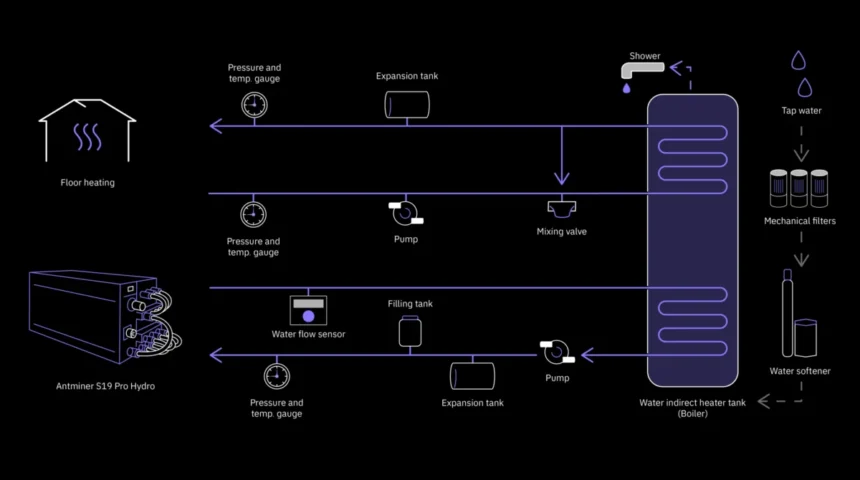
A QA engineer at mining software firm Braiins has successfully heated a modern 140-square-meter home and supplied domestic hot water for an entire year using a single hydro-cooled Antminer. The residential heating project, dubbed the "Bitcoin Shower Project" or "Hashpunk Citadel" by online observers, relies on a 6-kilowatt hydro-mining setup integrated into the home’s low-temperature radiant floor heating and water boiler system.
Backed by twelve months of real-world operational data, the project demonstrates how residential bitcoin mining can transition from an experimental hobby into a practical, economically viable alternative to traditional gas, oil, or standard electric heating systems. As mining margins tighten across the industry, the reuse of ASIC-generated heat offers a sustainable model that aligns domestic comfort with cryptographic validation.
The Engineering Behind the Hashrate Heating Citadel
The project began during the planning and construction phase of a modern timber-frame home featuring high-performance insulation, including a wall assembly of gypsum fiberboard, a vapor barrier, mineral wool insulation, and an external layer of expanded polystyrene. Working alongside a project engineer, the homeowner designed the house specifically to incorporate mining heat reuse into the primary thermal architecture.
The core infrastructure relies on a low-temperature water loop designed similarly to modern heat pump setups. While a certified professional plumber installed the domestic tap water loop and the radiant floor heating infrastructure, the homeowner personally designed and constructed the dedicated miner cooling loop.
The system is organized into three distinct fluid loops operating across different temperature ranges. The primary miner loop, which reaches the highest temperatures, extracts thermal energy directly from the bitcoin miner and transfers it into an accumulation boiler tank. Because Bitmain hardware documentation specifies a maximum water inlet temperature of 45 degrees Celsius, the system utilizes Dynamic Power Scaling via Braiins OS. This firmware automatically throttles the miner’s power consumption when temperatures spike, protecting the hardware, maintaining uptime, and enabling safe operation at higher water inlet temperatures.
The secondary loop handles city and tap water, sitting between the miner and the domestic hot water supply. The third and lowest temperature loop supplies the radiant floor heating system that regulates ambient indoor temperatures throughout the 1500-square-foot living space. The entire setup functions largely through self-regulation, utilizing smart circulation pumps, thermostatic actuators, and automated firmware controls to match
mining output with real-time heating demands.
Financial Realities: Upfront Costs Versus Long-Term Operating Expenses
Evaluating the financial viability of the system requires comparing initial capital expenditures and ongoing operational costs against traditional alternatives such as standard heat pumps and electric boilers. The home features a calculated thermal loss of 3.5 kilowatts at an ambient outdoor temperature of minus 10 degrees Celsius, over a standard heating season lasting four and a half months.
Upfront equipment costs for a traditional heat pump system typically range between 10,000 and 15,000 dollars. In contrast, an electric boiler setup requires a much lower initial investment, usually around 1,000 to 2,000 dollars. The bitcoin mining heating setup falls into a similar capital expenditure bracket as the electric boiler, requiring standard plumbing components, fittings, and an accumulation boiler tank costing approximately 1,000 dollars, alongside the cost of the ASIC hardware itself.
While heat pumps offer high efficiency, their Coefficient of Performance drops significantly when shifting from low-temperature floor heating to the higher temperatures required for domestic showers, which must reach around 65 degrees Celsius to prevent bacterial growth. Furthermore, a traditional heat pump requires an exceptionally long payback period of roughly 24 years due to its steep initial purchase price.
By contrast, the hashrate heating system operates at a consistent efficiency regardless of outside weather conditions. More importantly, the electricity consumed to heat the home simultaneously generates bitcoin rewards. Factoring in the value of the mined cryptocurrency during the heating season significantly offsets operational expenditures, reducing net electricity costs compared to standard electric resistance heating or even traditional heat pumps depending on local utility rates and grid dynamics.
Maintenance and the Future of Residential Hashrate Reuse
After a full year of continuous operation, the system has proven remarkably low-maintenance. Utilizing propylene glycol within the closed miner loop eliminates the need for frequent fluid changes, while lower overall operating temperatures minimize calcium buildup inside the boiler tank. Day-to-day operation requires minimal human intervention, as the software stack—consisting of Braiins OS, Home Assistant, and specialized miner integrations—manages thermal regulation and power scaling automatically.
Building on the success of the initial residential installation, future developments are already underway. The homeowner plans to upgrade the system to newer generation S21-series miners, which offer greater energy efficiency and advanced chip-level temperature monitoring. This enhanced hardware safety profile will enable the design of a hash-heated sauna, utilizing the higher air output temperatures generated by the newer ASIC units.
As hashprices fluctuate and industry margins contract, proponents believe that integrating heat reuse into residential and commercial architecture will become an increasingly important strategy. By combining grid-balancing capabilities with domestic utility, projects like the Hashpunk Citadel illustrate how bitcoin mining can embed itself directly into everyday infrastructure while decentralizing the network’s global footprint.

Related News