Braiins Manager Pro Introduces Automated Balancing Rules and Shareable Custom Filters for Bitcoin Mining Fleets
Bitcoin mining operations are constantly dancing on a razor-thin margin between maximizing hashrate and respecting strict power constraints. Traditionally, maintaining that delicate balance has required intensive manual oversight. Facility operators or site engineers have had to manually monitor total electrical load, pausing miners by hand when consumption threatened to spike past capacity limits, and manually bringing them back online as conditions stabilized, equipment dropped off the network, or grid supply shifted.
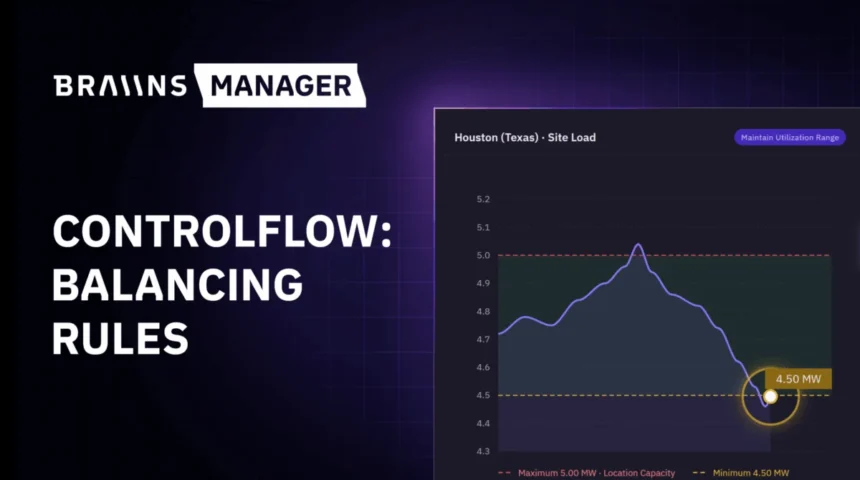
Addressing this operational bottleneck, Braiins has rolled out a major update to Braiins Manager Pro, introducing automated Balancing Rules within its Controlflow automation engine. Designed to take the guesswork and human latency out of power management, the new feature allows operators to set precise maximum, minimum, or dual boundaries for energy consumption. Once configured, Controlflow dynamically pauses or resumes only the exact number of miners required to keep the site safely within its designated electrical operating range, operating entirely autonomously around the clock.
The introduction of Balancing Rules marks a significant evolution for large-scale mining infrastructure management, providing operators with a seamless tool to handle power fluctuations without constant human intervention. Alongside this core automation release, Braiins has also updated the platform with a powerful new Filter Builder, enabling teams to create, save, and share custom worker filters across entire organizations to streamline fleet monitoring.
How Balancing Rules Work in Controlflow
At the core of the new functionality is a continuous monitoring mechanism. A Balancing Rule periodically polls the total power consumption of its designated target group—which can encompass an entire geographical location, specific sub-groups within a facility, or individual rack setups. During each automated check cycle, the system evaluates the real-time aggregate power usage against the user-defined limits, executing adjustments to the fleet only when thresholds are crossed.
The configuration of these limits offers substantial flexibility. The maximum threshold can be established as a fixed megawatt value or dynamically tied directly to the location’s changing capacity. When linked to the site’s total capacity, the rule reads the current metric during every operational check, meaning any structural adjustments to site capacity are factored in from the very next execution run.
Because Balancing Rules achieve their targets by pausing and resuming machines, the system is engineered for broad compatibility. It functions seamlessly not only on specialized mining firmware like Braiins OS but also on stock firmware environments, lowering the barrier to entry for diverse hardware fleets.
Intelligent Prioritization: Pausing the Least Efficient Miners First
One of the nuanced challenges of automated power scaling is determining which specific machines to target. Left unguided, automated systems might distribute shutdowns indiscriminately, potentially creating logistical imbalances across a facility’s physical electrical architecture. For instance, if an operation houses older generation Application-Specific Integrated Circuit (ASIC) rigs and newer flagship units in separate containers serviced by distinct transformers, a random shutdown approach could disproportionately starve one transformer while leaving another running at maximum thermal and electrical capacity.
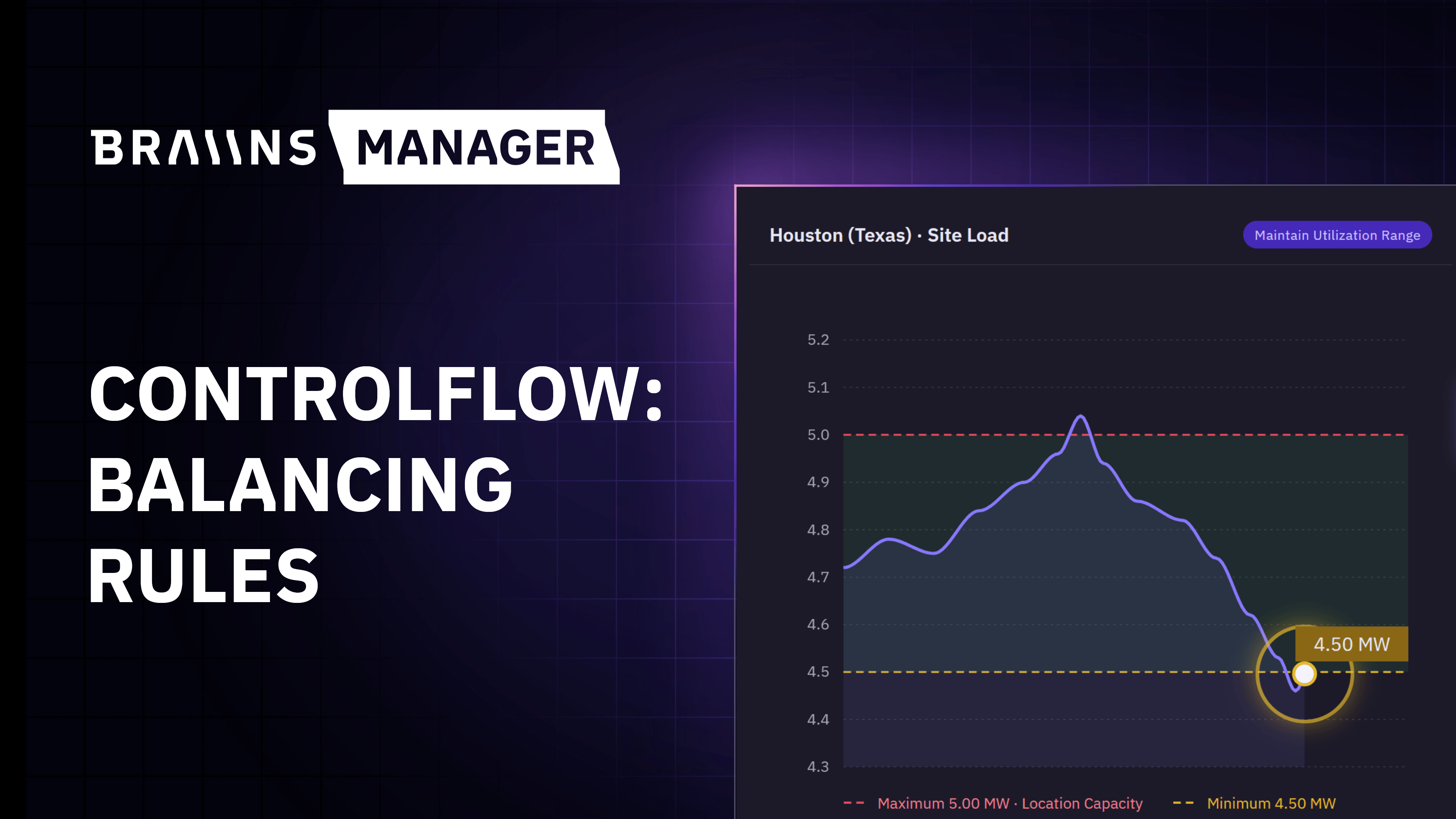
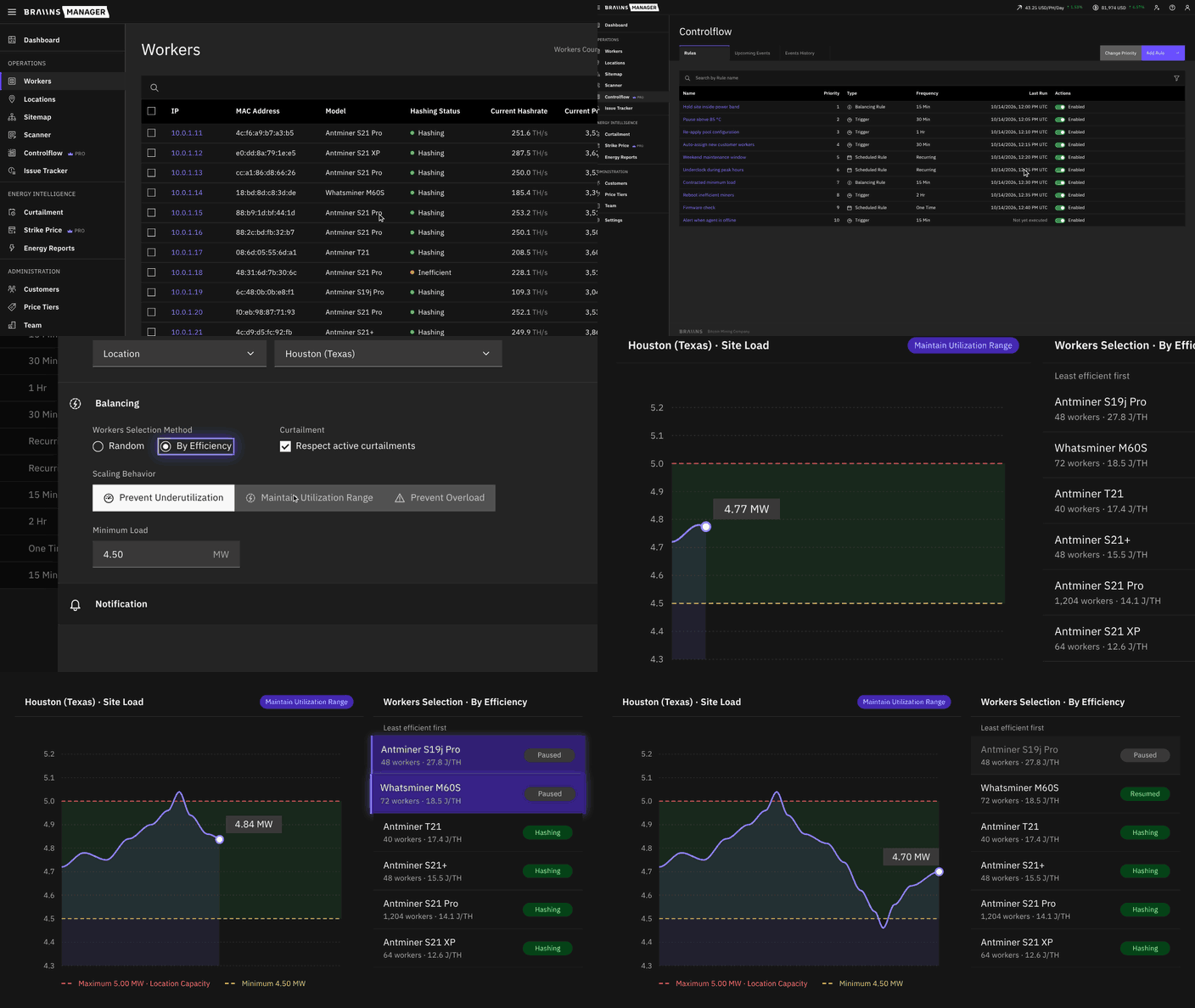
To counteract this, Controlflow offers configurable selection behaviors. While the default setting relies on a random distribution to spread pause events evenly across a site, operators can alternatively select the "By Efficiency" option. Under this intelligent routing method, the system evaluates every individual miner based on its measured joules per terahash (J/TH).
When a site must shed load to stay beneath its cap, the least efficient machines are automatically paused first. Conversely, when power availability expands and the site has room to ramp back up, the most efficient units are resumed ahead of older models. In mixed-hardware fleets, this ensures that legacy equipment absorbs curtailment measures before top-tier machines go offline, allowing operators to maximize total active hashrate while strictly adhering to their power boundaries.
Seamless Integration with Active Curtailment
Power management protocols within modern mining facilities rarely operate in a vacuum. Demand response programs, utility curtailment notices, and energy price spikes frequently require sudden, targeted shutdowns that override routine site balancing.
To prevent operational conflicts, Balancing Rules are designed to respect active curtailment orders by default. If any miner falling within a rule’s target parameters is already subject to an active curtailment event, the system skips that specific check cycle and refrains from making conflicting adjustments.
This safeguard stops automation tools from working against one another. Without this protective logic, a balancing rule might evaluate power readings captured just before a curtailment event initiated, erroneously triggering secondary pauses on machines that were already being taken offline. By integrating curtailment awareness, Controlflow waits for conditions to settle before evaluating accurate, post-curtailment power numbers, executing a single, clean adjustment when necessary.
Comprehensive Tracking and System Transparency
Operational visibility is vital when automation is handling critical infrastructure. To ensure site managers maintain complete oversight, every evaluation executed by a Balancing Rule is permanently logged within Controlflow History. This audit trail captures every check instance—even those where system parameters were already within range and no adjustments were required.
Operators can inspect any historical run to verify precisely which miners were paused or resumed during that specific cycle, alongside the exact configuration settings active at that moment. Additionally, upcoming check schedules are integrated into the Upcoming Events calendar, sitting directly alongside existing Trigger and Scheduled rules.
Balancing Rules seamlessly adopt the established priority hierarchy used throughout Controlflow. If a higher-priority automation rule has already interacted with a specific miner during a given evaluation cycle, lower-priority rules are instructed to leave that machine untouched for the duration of that cycle, preventing competing control signals from disrupting the fleet.
New Shareable Custom Filters Enhance Fleet Visibility
Complementing the power management updates, Braiins Manager has also introduced a robust new Filter Builder for the Workers list. Moving beyond basic categorical filtering, the updated tool allows operations teams to filter fleets based on precise, measured operational values.
Users can define specific parameters, assign a name, and save the custom filter directly to their account, making the configuration accessible across any browser or connected device. Furthermore, these filters can be shared with specific locations or across an entire corporate organization. This capability ensures that engineering, management, and support teams all rely on an identical definition of operational edge cases, such as identifying units "running hot" or showing signs of underperformance.
To maintain security and operational boundaries, shared custom filters dynamically respect user permissions, ensuring that each team member only views the specific miners and infrastructure they are authorized to access. While these advanced saved filters reside within a new dedicated tab, the familiar one-click category selections remain readily available for rapid navigation.
Balancing Rules and the updated Filter Builder are available immediately within Controlflow for Braiins Manager Pro. Operators looking to evaluate the automated power management features can initiate a free Pro trial or consult the technical documentation provided via Braiins Academy, with community discussions and user feedback ongoing through the official Braiins Telegram channel.

Related News