Foundation Devices Releases KeyOS 1.4.1 for Passport Prime, Bringing Major Reliability and Performance Upgrades
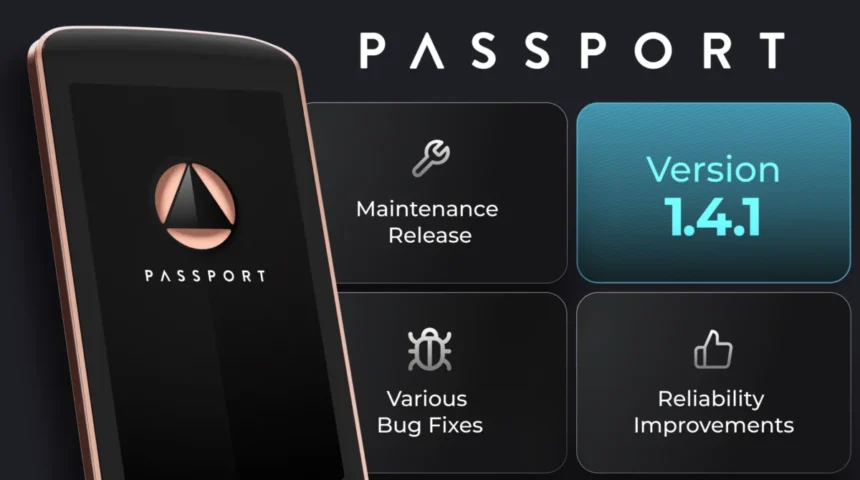
Foundation Devices has officially announced the launch of KeyOS version 1.4.1 for its flagship hardware wallet, the Passport Prime. The latest firmware update, which is now live and ready for deployment, focuses heavily on enhancing overall device reliability, optimizing battery care protocols, and significantly accelerating the firmware update process. Alongside the software rollout, the company has issued an urgent and explicit security warning to users, cautioning them to remain vigilant against a wave of sophisticated phishing attempts involving fake passport recalls and compromised device alerts.
The release of KeyOS 1.4.1 represents an important milestone for the Passport Prime ecosystem. According to the development team, the update can be initiated seamlessly through the Envoy companion application, which guides users step-by-step through the installation procedure. As hardware wallets continue to serve as the critical last line of defense for self-sovereign Bitcoin holders, maintaining robust, efficient, and thoroughly audited firmware is essential to safeguarding user assets against evolving digital threats.
Critical Security Alert Issued Amid Phishing Campaigns
Before detailing the technical specifications of the new firmware, Foundation Devices felt compelled to address a troubling surge in malicious activity targeting the broader crypto community. The company published a prominent security alert warning users that unsolicited calls and emails claiming a passport recall or asserting that a device has been compromised are fraudulent scams.
Bad actors frequently leverage fear and urgency to manipulate cryptocurrency holders into revealing sensitive data. To combat this, Foundation Devices reiterated a foundational security rule that all hardware wallet owners must memorize: the company will never, under any circumstances, call or email a user to ask for their recovery phrase. The recovery phrase—the sequence of twelve to twenty-four words generated during device setup—is meant solely for the user’s eyes and physical backup. Handing over this information to anyone, regardless of how official their communication may appear, grants them total access to the underlying funds. Users who receive suspicious communications are advised to immediately block the senders, ignore their demands, and report the incidents to official support channels.
What Has Changed in KeyOS 1.4.1
Shifting to the technical improvements contained within the new software package, the KeyOS 1.4.1 release centers its improvements on three primary pillars: system reliability, power management, and operational speed. Hardware wallet users frequently interact with complex cryptographic signing operations, multi-signature arrangements, and secure communication channels like USB and the device’s optical data transfer interface, known as Airlock. Ensuring that these components interact smoothly without crashing or stalling is paramount for a frictionless user experience.
One of the most notable bug fixes included in this release resolves a specific Bitcoin application crash that previously occurred when users were reviewing multi-signature signers. Multi-signature setups, which require multiple independent keys to authorize a single transaction, add an advanced layer of security for institutional investors, family offices, and privacy-conscious individuals. By smoothing out the review process for multisig signers, the updated firmware ensures that complex collaborative custody arrangements can be managed reliably and without unexpected software interruptions.
In addition to resolving the multisig review bug, KeyOS 1.4.1 addresses a targeted set of operational issues associated with both the Airlock optical scanning system and USB connectivity. These fixes ensure that data transmission between the Passport Prime and companion devices, such as software wallets running on desktop or mobile platforms, remains stable and secure. Whether users are importing transactions via QR codes through the camera or connecting physically via cable, the underlying communication layer has been refined to eliminate handshake failures and connection drops.
Performance Enhancements and Battery Management
Beyond bug fixes and connectivity stabilization, the development team focused heavily on streamlining the user experience during routine maintenance. Updating hardware wallet firmware can occasionally be a tense procedure for users concerned about device bricks or prolonged downtime. KeyOS 1.4.1 makes firmware updates substantially faster, reducing the time required to apply new software and minimizing the window during which the device is actively processing the update.
Furthermore, power management has received a major overhaul. The new software improves how the Passport Prime handles charging cycles and protects the long-term health of its internal battery. Because hardware wallets are often stored for long periods between uses, optimizing battery longevity and charging safety is vital for ensuring that the device remains fully operational and dependable whenever a transaction needs to be signed. Proper thermal and electrical management during charging cycles helps prevent premature degradation of the hardware components, protecting the user’s investment over years of long-term storage.
Transparency and rigorous code evaluation continue to be central tenets of the Foundation Devices development philosophy. To ensure the highest standards of safety, the KeyOS 1.4.1 codebase underwent comprehensive automated security evaluations prior to its public release. Independent AI-driven security reviews conducted by Claude Opus 5.5 Max running on Ultracode, alongside GPT 6.1 Sol operating on Ultra, thoroughly analyzed the firmware. Both evaluation systems returned definitive findings confirming that no critical security issues were identified within the release candidate.
Users wishing to adopt the latest improvements can access the software release notes directly via GitHub for a granular look at the technical modifications. The update process itself is designed to be user-friendly, requiring individuals to open the Envoy application on their paired smartphone or computer and follow the on-screen prompts to download and install KeyOS 1.4.1 onto their Passport Prime hardware. As the digital asset landscape continues to mature, timely updates like this one ensure that physical security devices remain resilient against both software bugs and physical operational challenges.

Related News