Understanding the Mechanics of Modern Banking: Fractional Reserves, Financial Crises, and the Future of Money
The modern banking system operates in ways that remain largely unintuitive to the general public. Yet, grasping the mechanics of how banks function is an essential tool for investors. Understanding this architecture helps market participants determine whether to anticipate monetary inflation or disinflation, as well as assess whether the underlying risks of a widespread financial crisis are running high or low.
For years, many investors have maintained a deep-seated fear of participating in markets, haunted by the persistent ghosts of the 2008 banking crisis. Simultaneously, others continue to purchase bonds, chronically underperforming most other asset classes due to misguided theories regarding how the financial sector truly operates. On the opposite end of the spectrum, some commentators frequently call for hyperinflation or systemic collapse based on a misplaced sense of probabilities and timeframes.
While financial dynamics have been analyzed extensively across various economic literature, a specific area deserves closer scrutiny: the fundamental divide between fractional reserve banking and full reserve banking, and the profound implications these practices hold for money itself.

Custodians Versus Lenders
At the foundation of the financial sector lies a distinct separation between pure custodians and lenders. A pure custodian is an entity that holds items of value on behalf of its customers, typically charging a fee for that safekeeping service. Safe deposit boxes, gold vaulting facilities, and exchange-traded funds holding portfolios of equities are all prime examples of custodial operations. They hold and manage assets, while clients pay for the security and convenience.
Certain stored items are non-fungible, meaning they are entirely unique and interchangeable. The contents of an individual safe deposit box, for instance, differ entirely from another, requiring the institution to keep them strictly separated. However, when customers own standardized commodities—such as identical one-kilogram gold bars stored at a precious metals custodian—individual tracking becomes unnecessary because the assets are entirely fungible. The custodian simply maintains a sufficient overall inventory of gold to cover total customer ownership, utilizing a single large vault to bypass the logistical overhead of individual item storage.
When custodians hold fungible assets that function as money or money-like instruments, a new commercial opportunity emerges: lending. Because most depositors do not intend to redeem their stored gold immediately, and because a returned gold bar does not need to be the exact physical bar deposited as long as it is functionally identical, custodians realize they can put a portion of that idle capital to work.

By analyzing historical statistics, a custodian might determine that only 10% of its customers redeem their gold in a given year, or perhaps up to 20% during an unusual period. Recognizing this stable baseline, the institution can lend out a portion of the gold while keeping a safe reserve margin—such as 30%—to cover normal redemptions. This lending activity generates interest income for the custodian, allowing it to boost profits while simultaneously lowering storage fees for depositors, attracting a larger customer base in a seemingly win-win scenario.
At this juncture, the custodian has transitioned into a lender, functioning essentially as a commercial bank. As long as appropriate reserves are maintained to meet typical redemption demands, the operation appears secure. Historically, when gold served as legal tender or backed circulating banknotes and deposits through redemption processes, banks operated as fractionally reserved claims on that underlying metal.
A solvent lender technically possesses enough assets to meet its liabilities. However, unlike a pure custodian, a significant percentage of a lender’s assets are tied up in illiquid loans rather than the actual underlying asset owed to depositors. This fundamental reality introduces institution-specific risk and, more importantly, systemic vulnerability across the entire financial sector.

How Financial Crises Happen
Terms like financial crisis, bank run, and financial panic describe situations where a single isolated banking problem rapidly cascades into a widespread systemic failure. Much like discovering a single pest in a commercial kitchen implies a broader infestation, the failure of one major financial institution often triggers a domino effect. In 2023, for instance, the collapse of Silicon Valley Bank ignited a chain reaction that ultimately engulfed institutions halfway across the globe, including the 167-year-old Credit Suisse in Switzerland.
Unlike other commercial industries—where the operational failure of a single train line, car manufacturer, or chemical facility rarely triggers a global cascade of similar corporate failures—banks are structurally intertwined. This instability stems directly from the fractional reserve framework, which relies heavily on interconnectedness and mutual trust.
Whether examining gold, fiat dollars, or digital assets, any fractional reserve lending model involves a distinction between base money and broad money. Base money represents the actual physical or digital currency that exists, whether determined by mining and physics for gold, central bank policy for fiat dollars, or decentralized network rules for Bitcoin.

Broad money, by contrast, accounts for the total volume of liquid claims circulating across all commercial banks. These bank deposits differ fundamentally from bonds because they represent a promise of immediate withdrawal. At any given time, the total volume of claims for base money vastly exceeds the actual physical supply of base money in existence.
Within modern central banking systems, the ratio of broad money to base money illustrates this leverage. In the United States, there are currently approximately four broad dollars for every one base dollar, down from a peak of nearly 12-to-1 in 1985. Zooming in specifically on commercial banks, there are more than six bank deposit claims for every base dollar held directly by a bank as cash reserves. Right before the 2008 global financial crisis, that specific ratio reached an extreme of 23-to-1, driven by the fact that a large portion of base dollars circulate outside the banking system as physical currency held by the public, leaving the bank-held reserves heavily leveraged.
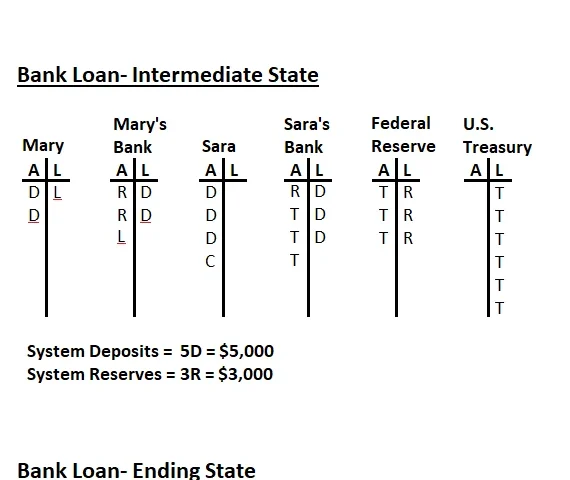
When a fractional reserve bank issues a loan, it effectively creates new broad money and new financial liabilities. For example, when a consumer takes out a bank loan to purchase a vehicle, the commercial bank creates a new deposit for the borrower and a corresponding loan asset on its balance sheet. No physical reserves leave the system initially, but a new deposit is successfully brought into existence. When that borrower writes a check to the seller, and the funds are deposited into a second bank, the underlying cash reserves move between institutions at the central bank level. The total volume of base money in the system remains unchanged, but the total volume of broad money expands, raising the leverage ratio of the financial system.

In a strictly regulated market, authorities typically mandate minimum capital ratios or require banks to hold a specific percentage of assets in defined risk-free instruments, such as government bonds or cash reserves. Yet, even without strict regulatory reserve floors, commercial banks must maintain a functional percentage of cash on hand to handle routine daily withdrawals. In the aggregate leading up to 2008, U.S. banks held less than 5% of their total deposits backed by cash on hand.
This dynamic operates as a recursive series of lending. When a bank makes a loan, it becomes a deposit in another bank, empowering that second institution to issue a new loan, which in turn becomes a deposit in a third. Each base dollar is effectively double-counted and multi-counted as it is leveraged throughout the economy.
Under normal operating conditions, individual banks remain solvent. They may hold only a fraction of customer deposits in liquid cash, but the remainder is theoretically covered by performing loans, ensuring total assets exceed total liabilities. Occasionally, however, a wave of borrower defaults can cause a bank’s total assets to fall below its liabilities, resulting in outright insolvency.

Yet, even a fully solvent bank with zero bad loans can experience a liquidity crisis. If an institution holds 10% of its deposits in cash reserves, but 15% of its depositors suddenly demand immediate withdrawals, the bank faces a severe mismatch. While it possesses sufficient long-term assets to cover liabilities, 90% of those assets are illiquid loans that cannot be instantly converted to cash.
Historically, solvent banks facing localized liquidity drains survive by turning to the interbank lending market. Institutions with excess liquidity lend cash to the troubled bank in exchange for high-quality collateral, or purchase performing loans at market rates. Liquid reserves thus flow temporarily from institutions with a surplus to those facing a deficit.
The systemic danger materializes when the entire banking sector becomes overleveraged simultaneously, and a macroeconomic shock shatters interbank trust. In 2008, financial institutions grew so heavily leveraged that very few held excess liquidity to rescue peers, and banks lost faith in each other’s underlying solvency. Solvent banks failed because they could neither satisfy customer withdrawals nor secure emergency loans from other commercial institutions.

This vulnerability is the inherent trade-off of fractional reserve banking. Even an institution executing responsible lending practices is ultimately dependent on statistical probabilities, depositor behavior, and the willingness of external entities—such as commercial peers or the central bank—to provide emergency liquidity. When the system as a whole creates a volume of monetary claims that vastly exceeds the underlying base money, the entire structure becomes vulnerable to a sudden loss of confidence.
Fractional Reserve Versus Full Reserve Lending
Discussions surrounding full reserve banking often prompt the misconception that such institutions are merely passive custodians that refuse to engage in lending. However, economic theorists distinguish between different classifications of credit. Full reserve banks are fully capable of lending, provided they utilize duration-matched liabilities rather than relying on short-term deposits to fund long-term commitments.
Bank liabilities generally fall into two categories: demand deposits and time deposits. Demand deposits, such as standard checking accounts, can be withdrawn at any moment during banking hours. Consumers and businesses rely on these accounts for immediate liquidity, payroll, and essential bill payments, operating under the assumption that the funds are instantly accessible. Time deposits, or certificates of deposit, require capital to be locked up for a specified duration, serving as vehicles for longer-term savings rather than immediate transactional needs.

Fractional reserve banking inherently bridges this gap by funding illiquid, long-term loans with liquid, short-term demand deposits. Institutions gamble on statistical probability, assuming that demand depositors will not all request their funds simultaneously, or relying on the safety net of central bank intervention if a run occurs.
Full reserve banking, by contrast, dictates that demand deposits must be backed 100% by liquid cash reserves, ensuring every client can withdraw funds concurrently without threatening the institution. Any lending conducted by a full reserve bank must be funded strictly through duration-matched time deposits or investor capital agreements where risks and withdrawal limitations are explicitly outlined. While a full reserve bank can still suffer a solvency loss if a time-deposit loan defaults, that loss impacts only investors who willingly locked up capital for yield, leaving immediate transactional demand deposits entirely untouched.
The practice of funding illiquid loans with liquid deposits—creating a structural liquidity mismatch—is the primary engine of broad money creation. It enables commercial banks to issue a vast volume of monetary claims backed by non-monetary assets. While central banks manage base money, commercial banks create broad money through fractional reserve expansion.

Historically, different monetary eras have managed these pressures in contrasting ways. During the classical gold standard, the sluggish physical transport and authentication of gold meant the monetary base moved slowly, while financial claims moved rapidly via telegraph and clearinghouses. Economist William Stanley Jevons warned as early as 1875 that the British banking system had grown dangerously leveraged, relying on the statistical improbability that depositors would ever simultaneously demand even a small fraction of the gold backing their claims. That leveraged structure ultimately fractured during World War I, leading to formal defaults on gold pegs and the inflationary devaluation of circulating claims.
In the modern fiat era, central banks manage these structural breakdowns through continuous policy adjustments. When systemic shocks occur, central authorities expand the monetary base to supply emergency liquidity, converting troubled credit claims into solvent currency. While this prevents immediate deflationary collapses, it drives steady long-term currency debasement, penalizing holders of cash while rewarding those with access to cheap credit and scarce assets.
Productive Versus Arbitrage Lending
Questions regarding economic growth often center on the necessity of lending. Credit has existed for millennia and remains an invaluable tool for enhancing commercial efficiency and market flexibility. However, the prevailing monetary technology heavily influences how lending is utilized across an economy.

During the 19th-century gold standard, capital deployment focused primarily on productive infrastructure, such as financing railroad development. Borrowing scarce gold required high-return economic justifications. In contrast, modern fiat environments heavily incentivize financial arbitrage. Because reasonably scarce assets consistently outperform soft currency, corporate and institutional borrowers frequently utilize long-term debt not for direct productive investment, but to structurally short the currency.
Major blue-chip corporations routinely issue multi-decade bonds at low interest rates, deploying the proceeds to repurchase equity or execute corporate acquisitions. Similarly, real estate investors utilize low-rate mortgages as a form of long-term arbitrage, maintaining low-cost debt while allocating capital toward appreciating assets.
Economists point to a lending bell curve to explain this behavior. When a currency is exceptionally weak, lenders refuse to commit to long-term debt agreements denominated in that unit. When a currency is exceptionally strong and scarce, borrowers are disincentivized from taking on long-term debt for speculative arbitrage or consumption. It is precisely when a currency possesses middling strength—exhibiting a steady, moderate rate of broad money supply growth outpacing goods and services—that debt-driven arbitrage peaks, fueling the expansion of highly leveraged societies.

Ultimately, understanding the mechanics of banking returns to the core principle of duration matching. When institutions issue loans funded by redeemable demand deposits, they rely not solely on their own underwriting soundness, but on statistical trends and systemic backstops. This practice expands the broad money supply and underpins the structural fragility that characterizes modern financial architecture.

Related News