Why You Should Immediately Distrust Every Number in the News: World-Renowned Statistician Sir David Spiegelhalter Breaks Down the Art of Uncertainty
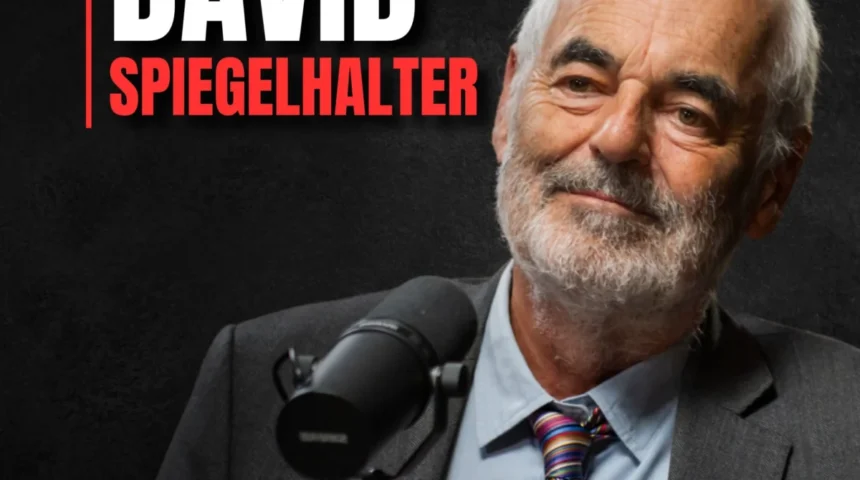
In an era defined by relentless information streams, breaking news alerts, and endless data dashboards, the public is constantly asked to make sense of numbers. From public health metrics and economic forecasts to risk assessments and political polling, statistics have become the universal language of modern authority. Yet, according to one of the world’s leading statisticians, the public should approach these figures with a heavy dose of skepticism.
Sir David Spiegelhalter, Chair of the Winton Centre for Risk and Evidence Communication at Cambridge University and author of The Art of Uncertainty, pulls back the curtain on how data is gathered, interpreted, and frequently manipulated in the public sphere. Having spent decades serving on high-profile public inquiries—including investigations into systemic healthcare failures and the horrific crimes of British mass murderer Harold Shipman—Spiegelhalter has an insider’s perspective on how numbers function in society. In a comprehensive interview, he breaks down the mechanics of numerical manipulation in the media, explores the illusion of objective truth, and offers crucial mental frameworks to help individuals protect themselves against confirmation bias.

The Mechanics of Numerical Manipulation
The modern news ecosystem thrives on urgency, and nothing drives engagement quite like alarming statistics. Spiegelhalter argues that it is remarkably easy to make any number look frightening or reassuring simply by altering how it is framed, without changing the underlying mathematical reality. Through careful linguistic choices, identical datasets can be presented in ways that induce panic or offer false comfort.
This manipulation of perception often preys on human psychology. Rather than forcing a false narrative from scratch, media presentations and institutional communications often rely on the audience’s preexisting cognitive biases to do the heavy lifting. When people encounter numbers that align with what they already fear or hope to be true, they tend to accept them uncritically. Spiegelhalter notes that this dynamic severely undermines public trust, transforming numbers from tools of clarity into weapons of persuasion.

This friction between data communication and public trust was laid bare during the COVID-19 pandemic. Reflecting on his time sitting in the middle of intense scientific and political arguments, Spiegelhalter discusses where public messaging went wrong. He points out that the ubiquitous institutional mantra of vaccines being "safe and effective," while rooted in medical reality, proved to be an overly simplistic and ultimately flawed communication strategy. When complex biomedical realities are boiled down into absolute slogans, any nuance lost in translation inevitably damages long-term institutional credibility.
Furthermore, Spiegelhalter addresses the broader policy measures of that era, including the data surrounding lockdowns. He expresses deep concern over the level of fear-mongering deployed by authorities during the crisis, arguing that the government frequently threw its institutional weight around in ways that exaggerated threats and ignored broader contextual risks—particularly regarding children, who have historically never been safer. For Spiegelhalter, the standard for public communication must shift from merely trying to make the public compliant and "trusted" to genuinely becoming "trustworthy" through transparent, unvarnished communication of uncertainty.

Beyond the Headlines: From Serial Killers to Productivity Flaws
Statistical analysis extends far beyond macroeconomic indicators and pandemic response; it is a critical tool in uncovering hidden truths and tracking down dangerous criminals. Spiegelhalter discusses how mathematical algorithms and statistical pattern recognition played a pivotal role in helping authorities catch Britain’s most prolific serial killer, Harold Shipman. By analyzing the mortality rates and practice patterns of the trusted general practitioner, statistical anomalies emerged that ultimately exposed a horrific pattern of criminality that had gone unnoticed for years by conventional oversight.
However, when data collection and statistical frameworks go wrong, the societal fallout can be widespread. Spiegelhalter highlights how national productivity figures have occasionally gone awry due to flawed methodologies, leading economists and policymakers to operate on faulty foundations. Whether predicting crowd sizes at local sporting events like Real Bedford or evaluating massive national infrastructure projects, the accuracy of a forecast depends entirely on the humility of the forecaster.

To differentiate between terrible forecasters and elite practitioners, Spiegelhalter highlights the psychological framework of "Hedgehogs vs. Foxes"—a distinction that separates those who view the world through a single, rigid theoretical lens from those who draw on a wide variety of perspectives, acknowledge nuance, and readily adapt when new evidence emerges.
The Rise of Artificial Intelligence and "Black Boxes"
As society transitions further into the digital age, the challenge of interpreting data is increasingly being outsourced to artificial intelligence and automated systems. Spiegelhalter examines the rapid rise of AI "black boxes" across critical sectors, including healthcare, weather forecasting, and corporate business modeling. Algorithms are now deployed to predict everything from routine economic shifts to deeply personal outcomes, such as complex models that attempt to predict when an individual might pass away.

This technological shift has fundamentally altered the role of mathematicians and statisticians. While algorithms can process vast quantities of data at unprecedented speeds, they also introduce new layers of opacity. When Elon Musk floats specific probabilities—such as a 20% chance of a given catastrophic outcome—it highlights the way high-profile figures use speculative forecasting to capture public attention. Spiegelhalter warns that as society becomes more reliant on automated black-box predictions, maintaining human oversight, rigorous skepticism, and a profound respect for uncertainty remains more essential than ever.

Related News