Foundation Devices Releases Envoy 2.3.1 with Crucial Privacy and Connectivity Fixes
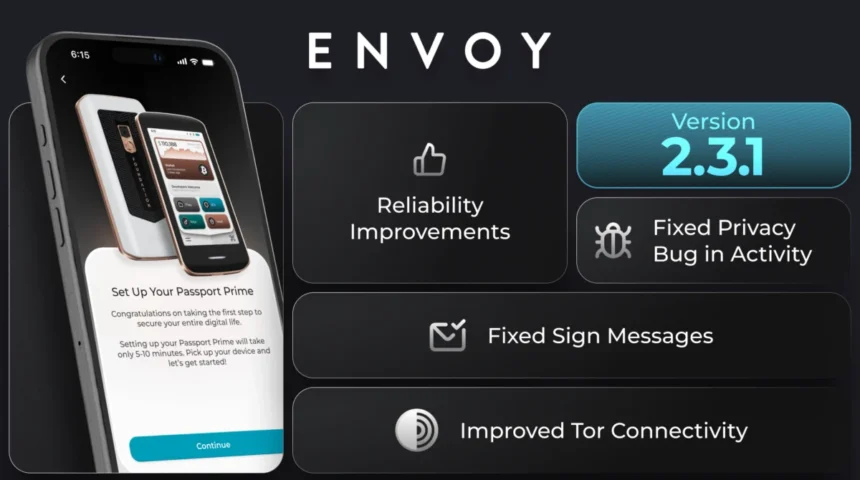
Foundation Devices has officially announced the rollout of Envoy version 2.3.1, a significant maintenance update designed to enhance the reliability, security, and overall performance of its companion mobile application. The latest version of the software has been published across all major mobile platforms, giving users an immediate opportunity to upgrade their systems and benefit from a targeted series of bug fixes and infrastructure improvements.
For users eager to secure the latest software, the update can be downloaded directly by visiting the official Foundation download page or by checking for manual updates through their preferred mobile platform’s application store. However, the development team has reminded the community that a brief waiting period may occur before the update becomes universally visible. Due to the routine review policies, security checks, and platform-specific deployment schedules enforced by the Apple App Store and the Google Play Store, there can occasionally be a noticeable lag between the initial publishing phase and general availability across all regions and devices.
Serving as a direct follow-up to the recent 2.3.0 release, Envoy 2.3.1 hones in on resolving specific operational friction points reported by the user base. Rather than introducing sweeping new features, this iteration prioritizes the refinement of existing capabilities, ensuring that privacy safeguards, hardware wallet integrations, and network connectivity protocols operate with maximum dependability.
What’s Changed
The core objective behind the deployment of Envoy 2.3.1 is the remediation of several distinct issues affecting data privacy, device compatibility, and network resilience. Among the most critical items addressed in this release is a privacy-related bug that previously allowed passphrase-account transactions to inadvertently appear within the global Activity feed. By correcting this oversight, the update ensures that sensitive account information remains properly isolated and private, maintaining the strict confidentiality standards expected by self-sovereign wallet users.
In addition to privacy enhancements, the update restores seamless message signing capabilities from non-zero accounts when utilizing the Passport Prime hardware device. This fix resolves a functional limitation that had temporarily impacted advanced users managing multiple accounts or derived address paths. Furthermore, the software corrects an interface discrepancy on the Devices tile, where the application previously displayed an inaccurate version status regarding the "latest" available firmware for Passport Prime.
Network connectivity has also received vital attention in this release, particularly for users operating in challenging online environments. Envoy 2.3.1 improves Tor connectivity performance specifically within regional network topologies where Internet service providers or local filtering mechanisms actively block Tor exit nodes. By optimizing how the application handles these network constraints, the update resolves a frustrating repeated Tor restart loop that previously hindered background synchronization and communication stability for certain users.
Connectivity enhancements extend to hardware pairing protocols as well. The release successfully restores QuantumLink Bluetooth pairing functionality for users operating devices powered by Android 10 and Android 11. This fix reestablishes reliable wireless communication channels between the mobile application and compatible hardware, ensuring a smooth pairing and management experience regardless of older operating system dependencies.
Beyond functional fixes, the development team has addressed underlying software architecture by shipping crucial security updates to various internal wallet dependencies. These proactive maintenance measures protect the broader application framework against potential vulnerabilities, reinforcing the overall security posture of the software ecosystem.
Verifying Envoy on Android
For advanced users and privacy-conscious individuals who wish to take an optional, additional step to independently confirm the authenticity of the software they are running, Foundation Devices maintains protocols for verifying Envoy binaries on the Android operating system. Users interested in cryptographic verification can consult the dedicated step-by-step documentation provided on the official Foundation website, which outlines the necessary procedures for checking digital signatures and confirming that the installed application package has not been tampered with since its official compilation and release.

Related News