Sony WH-1000XM4C vs. Bose QuietComfort (2nd Gen): The Ultimate Mid-Range Headphone Showdown
As great as flagship headphones can be, paying $450 or more isn’t always in the cards for the average consumer. That financial reality leaves a massive gap in the audio market, one that is expertly filled by the humble mid-range headphone. These devices allow budget-conscious audiophiles and everyday commuters to enjoy many of the features characteristic of a premium, top-tier experience without absorbing a punishing price tag.
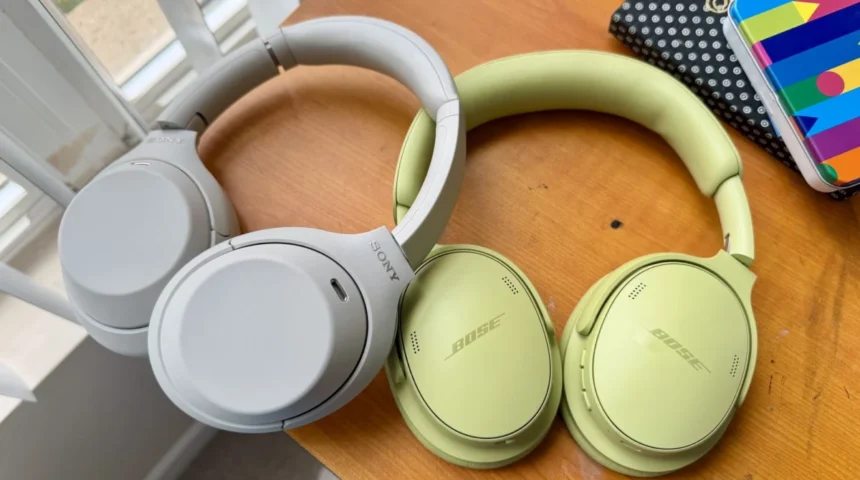
Recognizing this critical market segment, both Sony and Bose have recently refreshed their offerings. Bose introduced the second generation of its popular QuietComfort headphones, while Sony has rolled out a fresh iteration of a previous flagship model—the iconic Sony XM4s. This newly branded revision arrives under the moniker of the Sony WH-1000XM4C headphones.

Having thoroughly tested both pairs side by side, it becomes clear that these two tech giants are duking it out for supremacy in the mid-range category. Each pair brings distinct strengths to the table, but determining which one reigns supreme depends heavily on what a listener values most: absolute sound clarity, superior active noise cancellation, long-term comfort, or overall value.
Sound Quality: Nuance and Customization Face Off
Sony headphones have long enjoyed a stellar reputation for superior audio fidelity, and that industry trend holds true in this head-to-head comparison. Without making any manual adjustments to the sound profile right out of the box, the XM4C headphones consistently produce a more nuanced, detailed soundstage with noticeably greater clarity across frequencies.

For instance, listening to the piano and delicate vocals in Fiona Apple’s rendition of "Why Try to Change Me Now" evokes the cozy atmosphere of an intimate jazz club on the Sony units. By contrast, listeners may find themselves instinctively bumping up the volume on the Bose QuietComfort headphones just to capture that same level of immersive detail.
When it comes to spatial audio, however, Bose holds a distinct advantage. The company implements its proprietary Immersive Audio mode, which—while not the absolute best spatial audio on the market—does help live performances and soaring vocal arrangements truly shine. Tracks like Billy Joel’s "New York State of Mind" sound especially pleasing when this spatial mode is engaged.

Sony does offer a spatial audio format called 360 Reality Audio, but its utility is severely limited because it only functions with select, niche applications and fails to integrate with any of the major music streaming services. Fortunately, Sony easily makes up for this shortcoming through its exceptionally robust companion app.
The Sony companion app features an impressive equalizer that offers six distinct presets alongside three fully customizable settings. Furthermore, users can fine-tune their listening experience using a comprehensive 10-band equalizer. This stands in stark contrast to Bose’s more modest offering, which limits users to a three-band equalizer and four presets. Ultimately, Sony provides a much more dynamic and customizable listening experience for audio purists.

Active Noise Cancellation: Bose Retains Its Crown
While Sony generally takes the cake when it comes to raw sound fidelity, Bose has historically been recognized as the undisputed master of active noise cancellation (ANC). Although Sony’s most recent flagship XM6 headphones have started to challenge that dominance at the very top of the market, Bose comfortably reclaims the crown in this mid-range matchup.
The Sony WH-1000XM4C headphones rely on an adaptive sound control system paired with a four-microphone array. Bose, on the other hand, utilizes a manually adjustable ANC framework backed by a six-microphone system. The practical result of this hardware difference is slightly superior active noise cancellation on the Bose headphones, giving users much finer flexibility regarding how much external sound is allowed to filter through.

That said, Sony does feature an effective ambient reduction sound mode. For everyday commuters or frequent flyers staring down a long-haul flight, the performance gap in ANC is narrow enough that most users would be well-satisfied with either pair in a noisy environment.
Design, Comfort, and Travel Portability
True to their name, the Bose QuietComfort headphones place a heavy emphasis on ergonomics, and they easily live up to the high expectations they set. They feature a slightly looser, more forgiving fit than the Sony counterparts and boast noticeably plusher ear cushions. An added bonus for long-term ownership is that these ear cushions are fully replaceable, making the Bose headphones a more sustainable, future-proof purchase.

This is not to suggest the Sony XM4Cs are uncomfortable—they remain plenty comfortable for extended listening sessions—but individuals who wear over-all-day headphones for work or study may find that the Bose design better suits their daily physical needs.
From a travel perspective, both pairs of headphones fold up into a similarly compact position, allowing them to be easily slipped into a backpack or tote bag without taking up excessive space. The most significant divergence in physical design comes down to control preferences. The Bose QuietComfort rely entirely on tactile controls, utilizing physical buttons and a traditional power switch. Meanwhile, the Sony headphones lean heavily into touch controls for media playback, supplemented by physical buttons dedicated to power and ANC toggling.

Companion App and Ecosystem Experience
While no consumer should ever base a major headphone purchase solely on a companion app, evaluating the software experience is important given the financial investment required for mid-range audio gear. The Bose companion app layout leans toward a more minimalist, elegant aesthetic, neatly displaying all available customization options on a single screen. Conversely, navigating the Sony application requires some scrolling to access the full menu of features.
Functionally, the two applications are relatively equal in terms of overall customization depth. However, their primary focus areas mirror the hardware philosophies of their respective brands: Sony prioritizes extensive audio adjustments, while Bose focuses heavily on granular noise-cancellation controls.

Battery Life: Sony Edges Ahead
Battery endurance remains a critical metric for wireless headphone users. Interestingly, Sony actually reduced the battery life from the impressive 30-hour benchmark found on the original XM4s down to 27 hours on the newly minted XM4C model. Even with this slight regression, Sony’s 27-hour capacity still outperforms the 24-hour battery life offered by the second-generation Bose QuietComfort headphones.
While 24 hours is certainly a respectable amount of playback time for daily use, that extra three-hour cushion provided by the Sony headphones can make all the difference during the final, exhausting leg of an international flight or a particularly busy work week without access to a charger.

Value and Final Verdict
This comparison would present a much tighter dilemma if not for the significant price differential separating the two models. The Sony XM4C headphones command a retail price of $299.99 and have already seen promotional price drops dipping as low as $248. By comparison, the Bose QuietComfort 2 headphones enter the market at a higher price point of $359, with sales occasionally pushing them down to around $290.
Given the remarkably similar day-to-day user experience offered by both devices, the Sony headphones emerge as the undeniably superior value proposition.

For consumers who struggle specifically to find over-ear headphones that can be worn comfortably for hours on end without fatigue, the Bose QuietComfort headphones remain the sensible choice. For everyone else, however, the minor trade-off in slightly less aggressive active noise cancellation is easily offset by the lower price point, superior sound quality, and longer battery life delivered by the Sony XM4C headphones.

Related News