Gaza International Women’s Film Festival Opens Amid Rubble, Showcasing Voices of Resilience
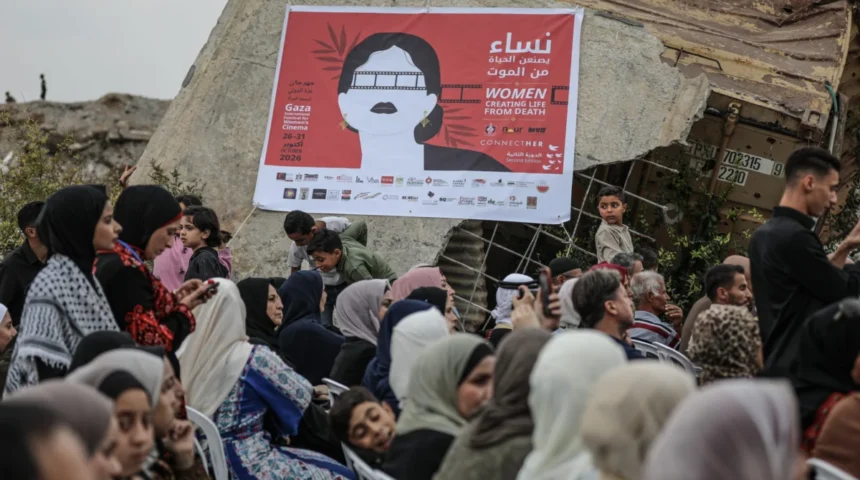
AL-BUREIJ, Gaza Strip — Amid the concrete skeletons of a destroyed events hall in central Gaza, the second Gaza International Women’s Film Festival opened on Monday, offering a powerful platform for a new generation of Palestinian filmmakers determined to document survival, loss, and endurance.
Held under the defiant slogan “Women Creating Life from Death,” the festival’s opening ceremony marked not only the screening of five poignant new short documentaries by emerging Palestinian women directors, but also the official launch of the newly established Gaza Cinema Academy. The venue itself—the shell of the former al-Nakheel Hall in al-Bureij—stands as a stark reminder of the devastating human and structural toll of the ongoing war, which has claimed more than 74,000 Palestinian lives over three years of intensive bombardment and siege.
The centerpiece of the opening night was a collection of five short documentary films produced through an intensive filmmaking diploma programme launched in March, which brought together 25 young Palestinian women determined to preserve their narratives despite the staggering obstacles of daily life in a conflict zone.
Among them is A Sack of Flour, an 11-minute documentary by emerging filmmaker Mona Abu Qass. Drawing directly on her own harrowing personal experiences, the film examines the deliberate use of starvation as a weapon against Palestinians in Gaza. The documentary captures the exhausting, perilous daily struggle to secure food, the extreme dangers associated with navigating chaotic aid distribution points, and the tragic loss of lives for a basic necessity.
Through her personal narrative, Abu Qass explores how the deep psychological trauma of hunger continues to haunt families even after provisions are temporarily restored. Her film carries profound, renewed relevance today, as ongoing Israeli restrictions on the entry of vital goods and subsequent cuts to food assistance have triggered severe shortages and renewed fears of a returning famine across the enclave.
“The idea for the film stems from a personal experience and a true story,” Abu Qass told Al Jazeera, describing the grim backdrop against which the project was brought to life. “It documents daily life in Gaza, weighed down by bombardment, destruction, siege, hunger, and loss.”

“I want to capture details that reveal suffering and people’s determination to hold on to their life,” she added. “I seek to show reality as people experience it and help viewers understand what the war has done to their relationships, dreams, and hopes.”
Highlighting Struggles of the Disabled
Another compelling work featured on the opening night was Beyond Silence, which marks the directorial debut of emerging filmmaker and journalist Raghda al-Buhaisi. The documentary turns its lens toward the often-overlooked wartime struggles of people with disabilities in Gaza.
The film centers on the harrowing journey of a deaf artist who never learned to read, write, or communicate through sign language. His life was upended when his art studio in Rafah, southern Gaza, was destroyed by Israeli strikes, an attack that also claimed the lives of his parents and several other family members. Following his subsequent displacement to Deir el-Balah in central Gaza, another family took him in, helping him set up a modest, makeshift studio by the roadside. Today, his paintings serve as a visceral visual language, reflecting profound loss and displacement, and expressing through color and line what spoken words cannot.
“I want to highlight the additional challenges people with disabilities face during war, including displacement, family loss, and the destruction of livelihoods,” al-Buhaisi told Al Jazeera. “Art can cross barriers of language and silence, turning an individual experience of pain into a visual message that conveys Gaza’s suffering to the world.”
The opening programme also showcased three other remarkable works by emerging Palestinian women filmmakers: Soso: The Lifeline, Remnants of Light, and Dandana. Each film captures a different facet of human resilience amid devastation. Soso: The Lifeline follows an orphaned child and his donkey as they labor to help community members survive. Remnants of Light chronicles a filmmaker’s intimate struggle to cope with the profound loss of her family and home. Meanwhile, Dandana tells the heartrending story of a mother whose eight children were killed, and who turns to traditional Palestinian songs alongside her surviving family members as a collective mechanism to process and endure her grief.
Preserving Gaza’s Stories
Festival Director Ezzedine Shallah emphasized that the featured documentaries draw directly from the lived experiences of women and girls throughout the war. By translating these raw realities into visual testimonies, the films provide women with an essential space to articulate their stories in their own authentic voices.

“Though their subjects differ, the films turn individual pain into broader human stories, revealing war’s psychological and social scars,” Shallah told Al Jazeera. “They preserve stories that might otherwise never reach the screen, transforming suffering into cinematic testimony and bringing Gaza’s stories to audiences beyond its borders.”
The festival, scheduled to run through October 31, features a diverse international lineup of 73 films hailing from 24 countries, creating a robust cultural bridge between filmmakers inside Gaza and the wider global community.
Yet, organizing and producing cinema under current conditions remains an extraordinary challenge. The widespread destruction of cultural infrastructure, an acute scarcity of professional equipment, severe funding limitations, chronic power and internet outages, and the constant psychological and physical pressures of war and displacement have choked opportunities for local film production. For women filmmakers specifically, accessing adequate training, production grants, and international festival circuits presents steep, structural hurdles.
Filmmaker Rima Mahmoud, a co-founder of the festival, noted that the protracted blockade and successive military offensives—predating even the current escalation—have historically hindered young women from entering the field, forcing many to rely on basic equipment, self-funding, and sheer perseverance to document Gaza’s reality against all odds.
“Despite limited resources, these films deserve international exposure,” Mahmoud said. “Their makers need technical and financial support, translation, and partnerships with festivals and platforms.”
Resisting Attempts at Erasure
For co-founder and prominent Palestinian filmmaker Mai Masri, based in Lebanon, these cinematic projects represent a vital instrument for young women to narrate their own histories, actively resist ongoing attempts at cultural and physical erasure, and preserve collective memory while developing professional skills that can secure employment locally or across digital platforms.

To formalize and sustain this momentum, the newly established Gaza Cinema Academy has developed an accredited filmmaking diploma in cooperation with al-Quds Open University, endorsed officially by the Palestinian Ministry of Education. Masri noted that the academy is now actively working to bridge the gap between local creators and international film circuits.
“We are seeking agreements with distributors to screen these films in educational and cultural institutions outside Palestine, and through international platforms and festivals focused on women’s and human rights,” she said.
“This would bring the voices of Palestinian women to a global audience, shed light on their human experiences and artistic creativity, strengthen the presence of Palestinian cinema internationally, and open new horizons for young female directors to reach global screening platforms and film festivals,” Masri added.

Related News