Anthropic Files for Nasdaq IPO as Market Weighs AI Concentration Risk and Upcoming Fed Decision
By RIA Team | October 28, 2026 | 7 min read
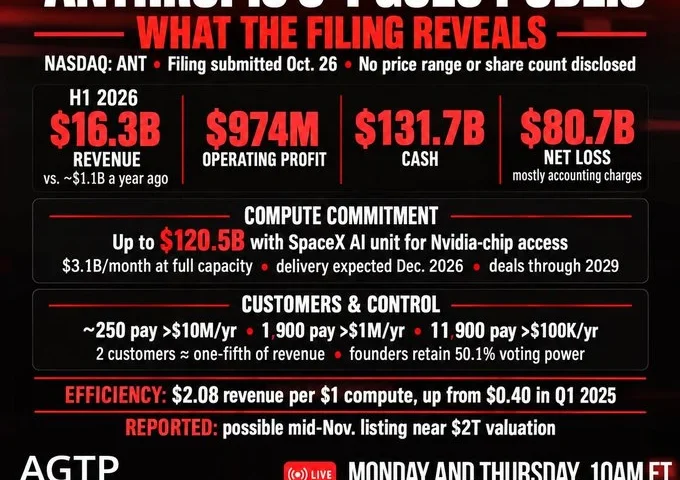
Artificial intelligence pioneer Anthropic officially stepped into the public spotlight on Monday morning, filing an SEC S-1 form to initiate a public listing on the Nasdaq exchange under the ticker symbol ANT. The long-anticipated move highlights the staggering financial realities of the generative AI boom, offering investors an unprecedented look inside the balance sheet of one of the industry’s foundational heavyweights. While Wall Street digests the massive capital expenditures and unique governance structures defining the modern tech landscape, investors are simultaneously bracing for a consequential Federal Reserve rate decision and high-stakes corporate earnings from major market anchors.

Anthropic Bares All: What the S-1 Filing Reveals
Anthropic’s public debut filing immediately commanded attention across financial circles, offering several critical takeaways concerning its financial performance, future infrastructure commitments, and corporate governance.
A surface-level glance at the headlines might startle casual observers, as the company reported a massive net loss of $80.7 billion. However, a deeper dive into the financials reveals a fundamentally different picture. The vast majority of that headline figure—specifically $72.4 billion—stems from a non-cash accounting charge driven by the revaluation of convertible notes and similar financial instruments. This massive paper charge is primarily a reflection of the company’s skyrocketing private valuation over the past year. On an operational basis, Anthropic actually posted an operating profit of $974 million, supported by a robust revenue surge. For the first half of 2026, revenue reached $16.3 billion, representing an astronomical leap from the $1.2 billion reported during the same period a year earlier. Furthermore, the company closed out June with $131.7 billion in cash and short-term investments.
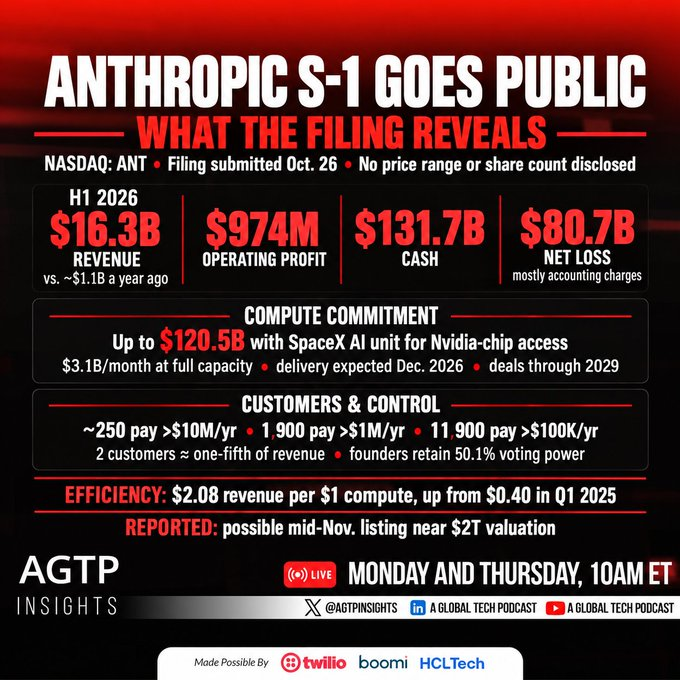
Despite this substantial cash cushion, the filing underscores the insatiable capital appetite required to remain competitive in the frontier AI race. Anthropic reported spending $8.9 billion on compute and infrastructure in the first half of 2026 alone, already eclipsing the $7.3 billion spent across the entirety of 2025. Looking further ahead, the company disclosed purchase commitments and long-term lease obligations extending through 2045. While a portion of these liabilities is due before 2030, the remainder spans the 2031 to 2045 window. Credible industry estimates place total projected commitments above $500 billion. Anthropic explicitly noted its intention to secure even greater computing power beyond these existing commitments and construct proprietary data centers, signaling to investors that massive future financing will remain a necessity despite its current cash reserves.
Governance-wise, the filing reveals a voting structure heavily reminiscent of the Meta playbook, designed to separate capital financing from managerial control. Seven co-founders will collectively hold a single share of Class F common stock that grants them 50.1% of total voting power, completely devoid of economic rights. Additionally, a separate trust will elect a majority of the board through another nonvoting share class. The S-1 explicitly warns prospective investors that this dual-class configuration may effectively eliminate the ability of Class A common shareholders to influence critical corporate decisions, including any potential change in control.
Who Will Survive the AI Buildout?
The broader market debate surrounding artificial intelligence frequently revolves around whether the sector represents an unsustainable bubble. Industry analysts emphasize that AI is far from a traditional bubble; the underlying technology is entirely real and is fundamentally reshaping global business operations and daily life. Nevertheless, economic history suggests that major technological revolutions inevitably produce corporate casualties, echoing the railroad booms of the nineteenth century.
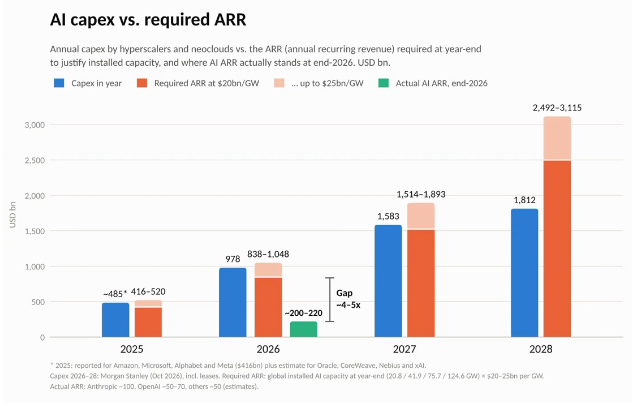
An examination of capital expenditure versus annual recurring revenue (ARR) among hyperscalers and neocloud providers highlights a critical timing challenge. Current spending on AI infrastructure dramatically outweighs near-term revenue generation across many emerging players. While major hyperscalers such as Amazon, Alphabet, and Meta possess diversified revenue streams and deep capital reserves to weather the deployment phase, smaller neocloud providers face tightening financial conditions. With borrowing rates hovering near 15% for some specialized operators, smaller players depend heavily on rapid revenue growth to service their debt. Market observers note that potential distress or defaults among smaller cloud providers could ultimately create consolidation opportunities for well-capitalized tech giants seeking to acquire data centers and advanced graphics processing units at a significant discount.
Market Context and Trading Outlook
As Anthropic prepares for its public debut, equity markets are navigating a delicate tug-of-war between institutional caution and retail enthusiasm. Recent data indicates that hedge funds have trimmed their technology exposure at the fastest pace since 2016, while retail investors have continued to pour capital into semiconductor and hardware equities.
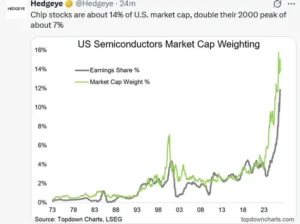
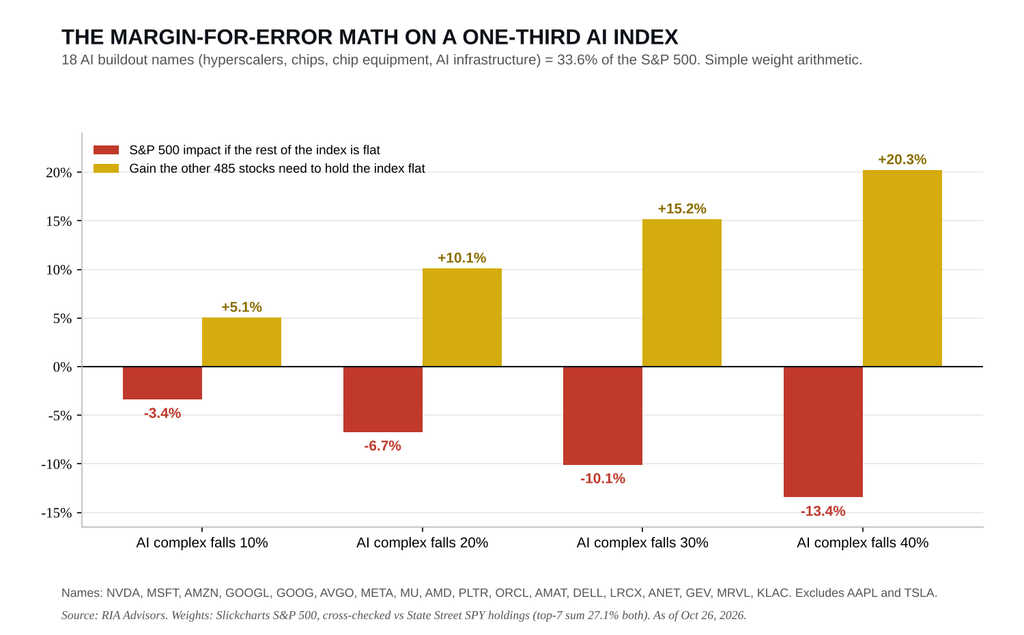
This dynamic has created a market environment characterized by narrow margins of error, with AI infrastructure leaders commanding unprecedented index weights. Approximately 18 core AI buildout companies—spanning hyperscalers, semiconductor designers, equipment manufacturers, and power providers—account for over a third of the S&P 500. A handful of mega-cap entities, including Nvidia, Microsoft, Amazon, Alphabet, Broadcom, and Meta, represent more than a quarter of the entire benchmark index. This concentration means that a modest correction in the AI complex exerts an outsized drag on headline indices, requiring extraordinary rallies from the remaining hundreds of constituent stocks simply to maintain equilibrium.

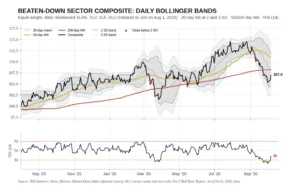
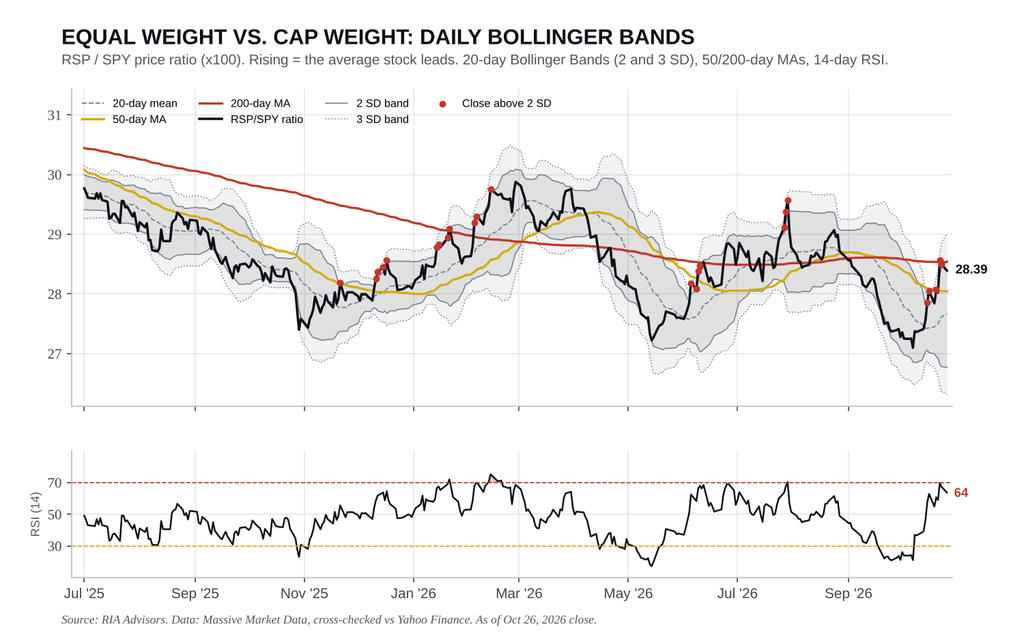
Despite this concentration risk, broader market participation has shown signs of broadening. The equal-weight S&P 500 has outperformed its market-cap-weighted counterpart over recent weeks, reflecting a healthy rotation into neglected sectors. However, because mega-cap technology names dominate index calculations, the broader market’s gains have largely served to tread water while index-level averages remain constrained just below key moving averages.
Market participants are closely monitoring upcoming corporate earnings reports and macroeconomic catalysts to determine the next directional trend. Investors are digesting third-quarter results from market-moving corporations alongside the Federal Reserve’s rate decision and subsequent policy statements. With capital expenditure pressures mounting across the hyperscale ecosystem—exemplified by Meta’s recent quarterly spending figures outpacing operating cash flow—the sustainability of aggressive AI infrastructure investments remains a central focus for portfolio managers.
In light of these narrow margins of safety, financial advisors continue to advocate disciplined risk management. Maintaining target allocations rather than excessive overweights in high-beta artificial intelligence exposure allows investors to participate in structural growth while insulating portfolios against potential volatility. Rebalancing capital into broader market sectors and adhering to strict stop-loss disciplines below key long-term moving averages remain critical strategies for navigating an evolving macroeconomic and technological landscape.

Related News