Federal Reserve Chair Kevin Warsh Answers Questions in Washington
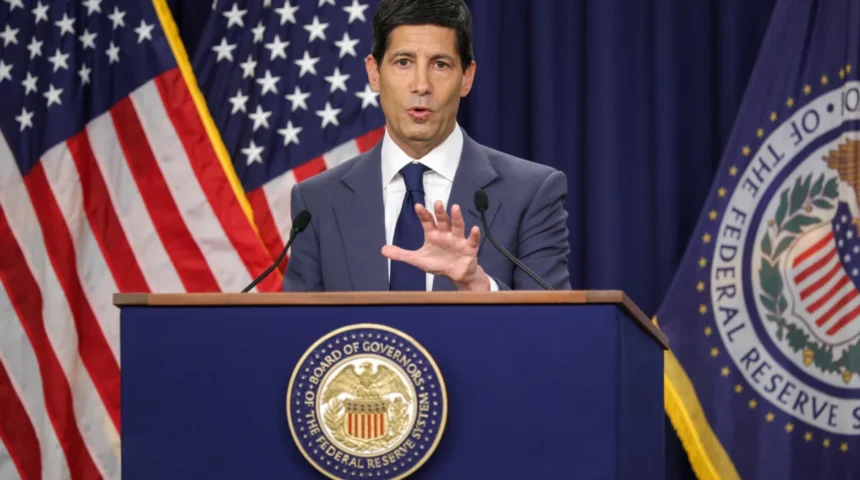
Kevin Warsh is done proving himself.
The Federal Reserve chairman’s press conference Wednesday in Washington, D.C., was sharply different from his early appearances in the job, when he often seemed backed into a corner. He has shown he is willing to let the markets guess where he is going—at least to a point—and he has started using his newfound authority to reshape the central banking institution in fundamental ways.
Warsh was originally appointed by a president who made it clear that cutting interest rates was a primary litmus test for his choice of Fed chair. When the Federal Open Market Committee opted to hold interest rates flat in both June and July, even with inflation remaining well above the Fed’s stated 2% target, a swarm of market commentators and financial analysts openly questioned the new chairman’s credibility and independence. The FOMC’s subsequent decision in September to raise rates came accompanied by such a hawkish reading of the economy by Warsh that financial markets swung sharply in the opposite direction. Investors suddenly thought the central bank might be locked into another rate hike during the October meetings, right up until a pair of top Fed officials came out and appeared to deliberately temper those market expectations through public remarks.
This week, Warsh put all of that early turbulence behind him. He firmly disavowed any public expectation that the Federal Reserve is currently on a set, predetermined course for monetary policy.
"If we had a firm conclusion about the conduct of monetary policy, we’d announce it to much fanfare today," Warsh told reporters during his Wednesday news conference at Federal Reserve Headquarters.
At the same time, however, Warsh also delivered a strong signal that his current personal and professional lean is toward higher interest rates if economic conditions demand it. While noting that overall financial conditions have grown progressively tighter across the broader economy, he added a critical caveat that left observers parsing his exact phrasing.
"While overall financial conditions are tighter, I’m unwilling and unable to call them tight," Warsh said.
Through these carefully chosen remarks, the chairman was effectively preserving his policy options while simultaneously laying the intellectual groundwork for a potential rate hike in December, should consumer price inflation remain stubborn and persistent heading into the final stretch of the year.
During the press conference, Warsh declined to confirm the widespread assumption among market participants that the central bank officials who had recently talked down rate expectations had done so at his direct command. However, traditional Fed insiders have long noted that the central bank’s vice chairs usually coordinate their public messaging closely with the sitting chair.
"To suggest somehow that I am some kind of all-knowing person sending messages out, that’s not the committee of the FOMC that I know," Warsh said.
And yet, despite his denial, Wall Street successfully got the clear message that the Federal Reserve would not be hiking interest rates at this particular meeting. By utilizing his lieutenants to deliver otherwise taboo forward guidance while maintaining plausible deniability, Warsh demonstrated his characteristic modus operandi: he remains intellectually flexible, highly strategic, and intensely focused on achieving his ultimate policy goals.
For instance, one of the primary long-term goals of the specialized task forces he has assembled to kick-start internal policy changes is to completely alter the way the Federal Reserve measures inflation. However, pursuing such a structural shift was virtually impossible while his personal commitment to aggressively fighting inflation remained an open question in the minds of investors. September’s rate hike went a long way toward answering the skeptics who previously argued he wasn’t serious about slowing price increases, and his recent comments suggest he remains entirely willing to deliver further interest rate increases if economic conditions require it.
"If you think that we’re tolerating some inflation target somewhere in the twos, let us disabuse you of it," Warsh said Wednesday, making it clear that the official target remains strictly at 2% flat. His uncompromising remarks serve as an explicit recipe for higher interest rates for as long as the broader American economy continues to demonstrate underlying strength.
Warsh and the members of the FOMC will have a raft of new economic data to digest before their next scheduled meeting in December to make their ultimate case. That forthcoming incoming data could alternatively help him make the argument that overall productivity is rising sufficiently, which might allow for continued economic growth without triggering a resurgence of inflation.
Meanwhile, the broader organizational and procedural changes that Warsh has initiated at the Federal Reserve are already starting to take effect. He announced a significant plan Wednesday to reduce the total number of times the FOMC is officially scheduled to vote on interest rates over the next two years. While the Fed will continue holding its regular policy meetings eight times a year, the committee will deliberately skip a formal vote on whether to change interest rates at one designated meeting in 2027 and two designated meetings in 2028.
This procedural move has the immediate effect of devaluing a good chunk of routine Fedspeak. Financial markets will no longer pay as much mind to commentary from a marginal regional Federal Reserve bank president when those remarks come as much as three months ahead of an actual, scheduled rate decision. Furthermore, regional bank presidents will also receive one fewer scheduled vote during their standard year-long rotations as active decision-makers on the FOMC. Despite these structural adjustments, the Fed chairman retains the absolute authority to call an impromptu, emergency meeting at any time should he see an urgent need to alter interest rates outside the normal calendar.
Yet, despite the strategic advantages of Warsh’s calculated approach, professional economists note that there are inherent risks to doing business this way, especially as the chairman recedes further behind the institutional curtain. Staunch advocates for central bank transparency have long argued that bright sunlight and open debate add essential rigor to policymakers’ arguments and prevent market miscalculations.
That lack of explicit transparency could already be causing friction, according to Robert Sockin, chief U.S. economist at asset manager PGIM. Sockin belongs to the camp of analysts who believe that underlying inflation is currently running far too hot to justify the Fed’s recent decision to keep interest rates unchanged.
"While more data is always better, Warsh did not sufficiently explain why this backdrop did not justify a rate increase, particularly given his comment that while he thinks financial conditions have tightened, he would not say they are tight," Sockin said.
Sockin characterized the decision to hold rates flat as a potential policy mistake, warning that a cautious and gradual Federal Reserve approach likely means a central bank that will eventually have to hike interest rates even higher later on, which mechanically raises the long-term risk of triggering an economic recession.
The full consequences of Warsh’s distinct leadership style and operational approach may not become entirely clear for many months. That temporary ambiguity gives him valuable room to maneuver as he continues to aggressively reshape the Federal Reserve. However, it also means that the negative consequences of waiting to tighten monetary policy further may not become fully apparent until it is too late to easily reverse course.

Related News