Oracle’s $20 Billion Capital Raise Highlights Hyperscaler AI Cash Crunch and Shifting Market Dynamics
By RIA Team | November 4, 2026
Oracle’s recent announcement to seek $20 billion through a combined offering of common stock and debt has sent ripples through the financial markets, casting a spotlight on the staggering capital requirements of the artificial intelligence boom. On Monday, Oracle filed to sell $10 billion of common stock and $10 billion of debt. In the immediate wake of the disclosure, the company’s stock tumbled roughly 8% after it revealed plans to offer the new shares at an 11% discount to its prevailing market price.

The massive capital raise underscores a growing financial reality for major technology companies: the immense costs associated with building out AI data centers have outpaced organic revenue generation. Oracle’s free cash flow plummeted to negative $23.7 billion in fiscal 2026, forcing the tech giant to look outside its operations to fund ongoing infrastructure projects.
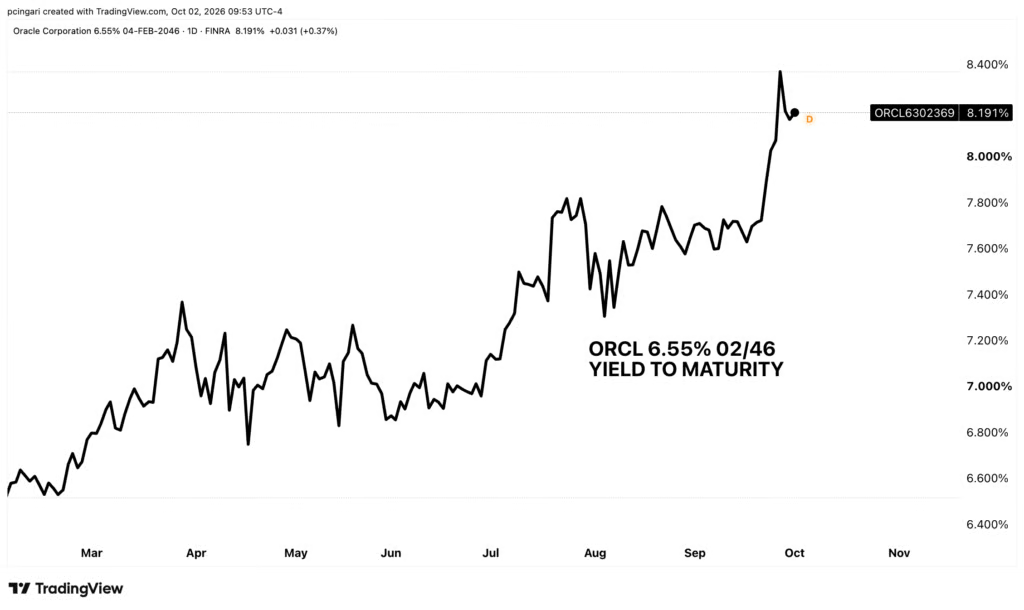
The company’s decision to split its funding requirements evenly between debt and equity points to limited remaining room in its traditional borrowing capacity. Oracle’s total debt burden, inclusive of lease obligations, climbed to $169.1 billion by August, a sharp increase from $84.5 billion in August 2021. Credit rating agencies have already signaled concern; S&P Global Ratings downgraded Oracle to BBB- in July, placing it just one notch above speculative grade, commonly known as junk status. Market pricing for Oracle’s existing debt reflects these concerns, trading at levels typical of high-yield bonds. Piling another $10 billion in debt onto the balance sheet risked triggering a full downgrade to junk status, which would have significantly elevated its borrowing costs.

Faced with looming rating downgrades and elevated yields, Oracle had little choice but to issue equity. However, the timing of the stock sale presents its own strategic paradox. The equity issuance is priced at approximately 15 times forward earnings, well below its five-year historical average near 21 times forward earnings. In corporate finance, issuing stock while valuations are depressed runs counter to traditional principles, which dictate that companies should repurchase shares when they are cheap rather than dilute existing shareholders.
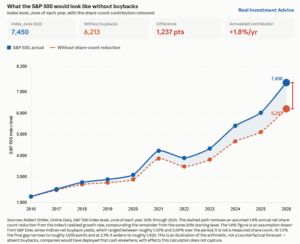
This capital-raising pivot aligns with broader trends unfolding across the technology sector. As noted in recent commentary, a growing list of hyperscalers find that existing revenues can no longer fully fund the massive infrastructure required for the AI buildout. Furthermore, corporate share buybacks—long the bedrock of equity market support—are shifting into reverse. Over the past decade, S&P 500 companies have acted as the marginal buyer of U.S. stocks, contributing roughly 1.8% a year to index returns through shrinking share counts.
When negative free cash flow forces capital-intensive companies into the open market, high interest rates and stretched balance sheets tilt the scale toward equity rather than debt. Together, these conditions bring buybacks to a halt, effectively turning some of the market’s most reliable buyers into active sellers.
Market Trading Update and the Midterm Technology Sell-Off
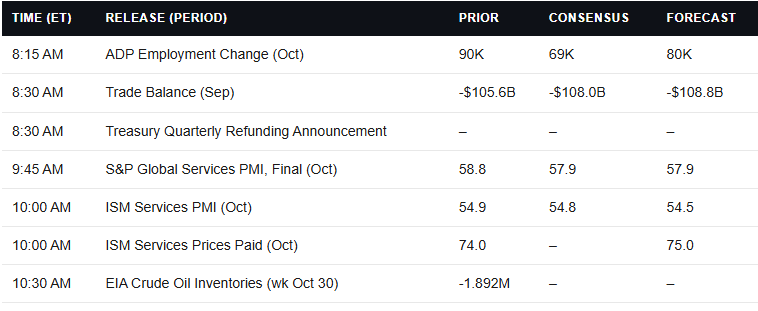
Against the backdrop of corporate capital restructuring, investors are grappling with a sharp pullback in technology equities. The immediate question facing traders is whether the technology sell-off tied to midterm election uncertainty serves as a warning sign or a buying opportunity.
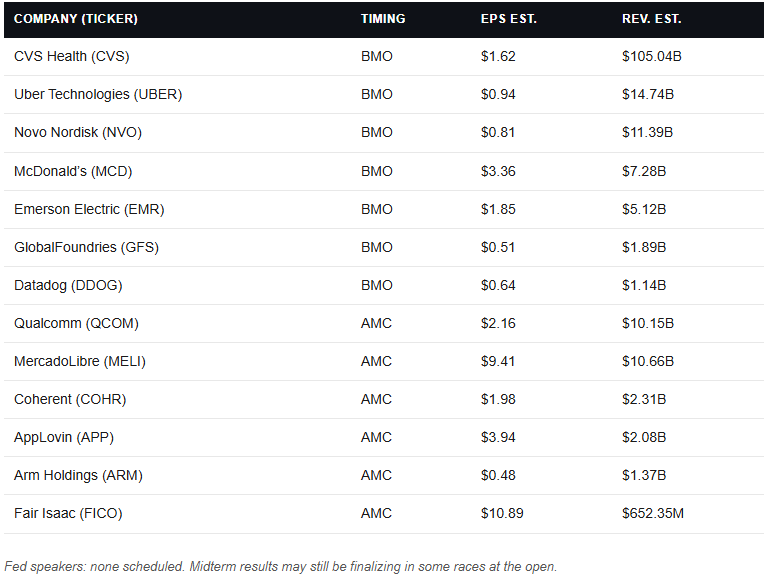
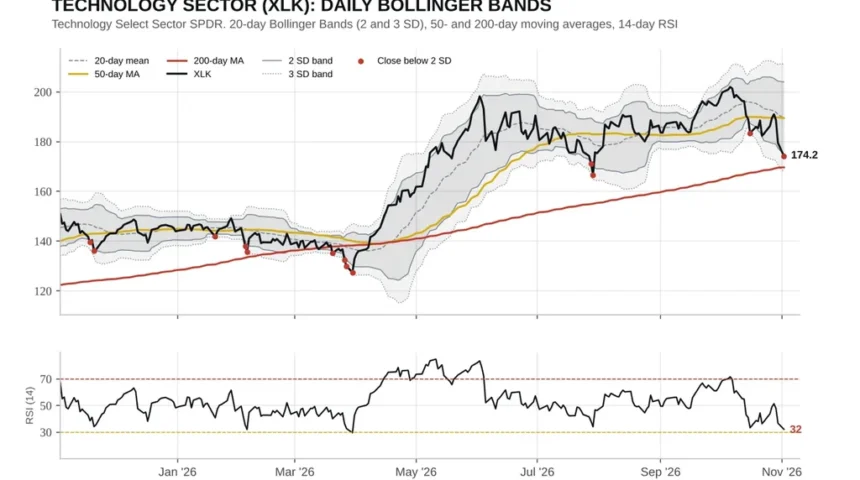
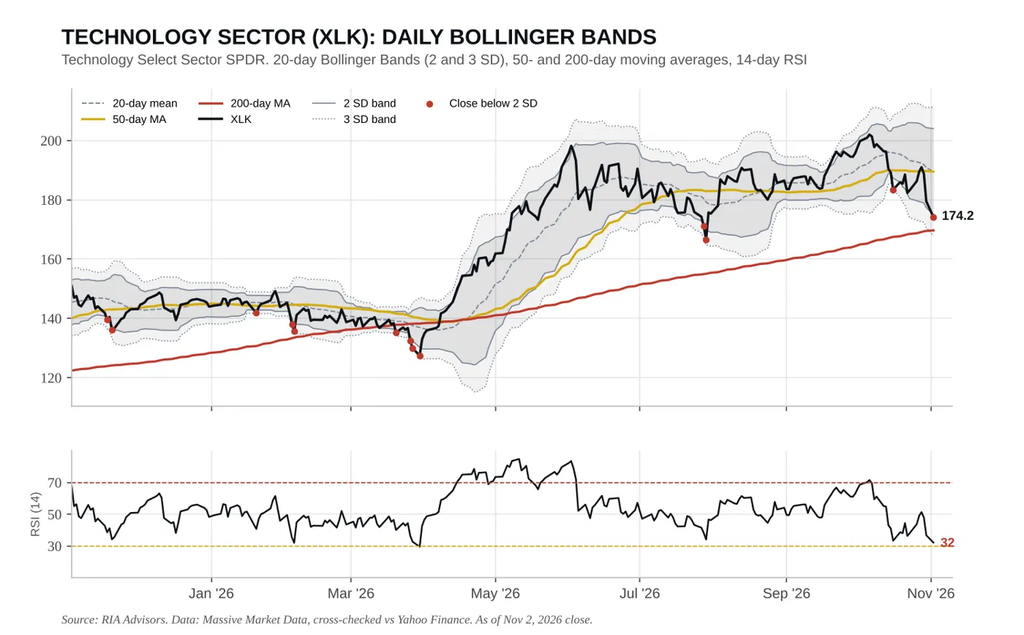
The recent market correction has inflicted notable damage across major indices. The Nasdaq Composite closed Monday at 25,164, marking an 8.8% decline from its October 6 record high of 27,600. The Technology Select Sector SPDR (XLK) experienced an even steeper pullback, dropping 13.8% from $202.00 to $174.22. Investor anxiety has centered heavily on regulatory concerns, with market participants fearing potential policy shifts surrounding artificial intelligence, antitrust enforcement, and chip export restrictions should control of Congress change.
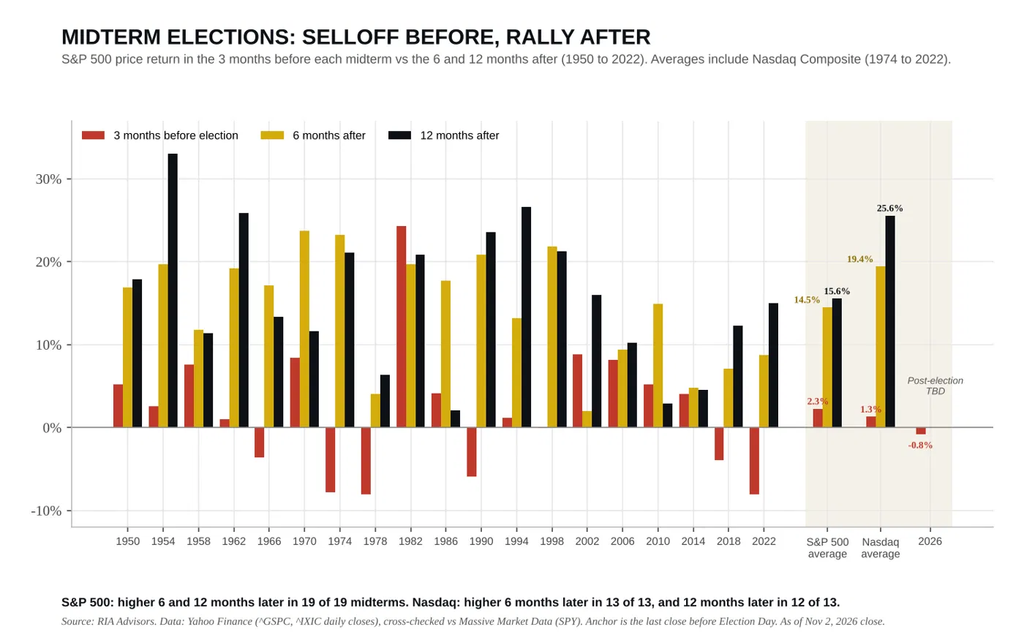
While such regulatory fears are tangible, historical market patterns suggest that pre-election anxieties rarely dictate long-term trajectories. An examination of midterm election cycles since 1950 reveals that the S&P 500 has traded higher six and twelve months after all 19 midterm elections. Similarly, the Nasdaq—with data stretching back to 1974—has posted gains six months after all 13 midterm cycles and twelve months later in 12 out of 13 instances.
Crucially, pre-election weakness in the technology sector is far from unprecedented. In seven of those 13 historical cycles, the Nasdaq declined during the three months leading up to the vote, including substantial drops of 14.8% in 1990 and 16.5% in 2022. Following those pre-election declines, the Nasdaq demonstrated remarkable resilience, averaging a 23.8% gain over the subsequent six months and a 27.6% surge over the following year. This historical outperformance relative to cycles that entered Election Day on strong footing highlights the nature of an uncertainty discount, where investors price in political risks before the vote and unwind them afterward.
Technical indicators suggest that the current technology sell-off, while sharp, remains well within normal historical parameters and is considerably milder than the drawdowns witnessed in 1990 or 2022. Just four weeks prior, the 14-day relative strength index (RSI) for the XLK sector fund sat in overbought territory above 70. By Monday, the RSI closed at 32, with prices dipping below the lower two-standard-deviation Bollinger Band. The fund currently trades roughly 8% below its 50-day moving average near $189.50, yet remains 2.7% above its rising 200-day moving average near $169.70.
As long as the 200-day moving average holds, the pullback constitutes a routine correction within a broader structural uptrend. However, a decisive break below that critical threshold would alter the technical landscape. Portfolio management strategies must balance seasonality and historical odds against prevailing risks, ensuring that any dip-buying strategy is executed with strict risk parameters and defined price levels.
Examining the Tech Momentum Factor and Earnings Fundamentals
Adding another layer of complexity to the current market environment is the unprecedented behavior of quantitative momentum strategies. Recent commentary highlighted a striking divergence noted in Morgan Stanley’s U.S. TMT momentum factor, which sits approximately 62% below its 12-month high. This drawdown exceeds the magnitude of the collapse witnessed during the dot-com bust, occurring paradoxically while underlying corporate earnings continue to accelerate.
A momentum factor is not a direct index of technology share prices; rather, it represents a quantitative long/short model designed to purchase recent market winners and short recent losers. The steep 62% decline does not mean that leading technology stocks fell by that amount. Instead, it signals that the broader momentum strategy of riding prior winners and dumping laggards temporarily broke down.
This factor compression contrasts sharply with fundamental business performance. Approximately 80% of companies have beaten earnings expectations during the current reporting cycle, with S&P 500 earnings growth tracking near 27%. Analysts attribute the sharp unwinding to the concentrated liquidation of crowded positions rather than a deterioration in underlying business fundamentals.

During the dot-com bust in the year 2000, the long legs of momentum portfolios consisted largely of speculative companies devoid of earnings, causing the factor to collapse alongside failing fundamentals and unfulfilled revenue promises. In contrast, today’s momentum leaders rank among the most profitable enterprises in corporate history. The rapid decline of the factor—falling 40% from its peak in just 17 trading days compared to a historical median pullback of 22% over 33 days—points primarily to a structural unwinding of leverage and crowded positioning rather than a systemic failure of corporate business models.

Related News