European Cities Gripped by Violent Clashes as Protests Over Living Costs and Spending Cuts Intensify
NewsFeed
Published On 25 Oct 2026
Major cities across Western and Southern Europe have once again become the epicenter of intense civil unrest, as widespread demonstrations against soaring living costs, reductions in public services, and escalating military budgets boiled over into violent street clashes. Law enforcement agencies in France, Italy, and Spain found themselves confronting large, angry crowds of demonstrators, deploying tear gas, batons, and riot control tactics in attempts to disperse the gatherings as the situation deteriorated into chaos.
The wave of demonstrations reflects deep-seated and mounting public frustration over economic pressures that have strained households across the continent for extended periods. Citizens in multiple countries have grown increasingly vocal in their condemnation of government fiscal policies, arguing that ordinary people are being forced to bear the brunt of economic instability. At the same time, protesters have directed their anger toward dwindling investments in essential public infrastructure and healthcare systems, contrasting these cuts with what they view as misplaced government priorities, particularly regarding increased allocations for defense and military spending.
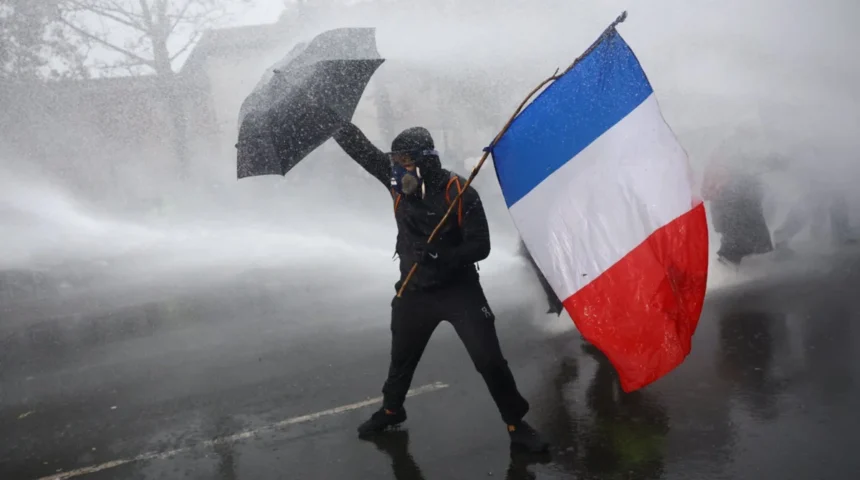
In France, the atmosphere in several urban centers quickly turned volatile as marchers took to the avenues to voice their grievances. What began as organized labor and civic demonstrations transformed into chaotic confrontations with police forces. Demonstrators erected improvised barricades across thoroughfares, setting fires to debris, rubbish bins, and wooden pallets to obstruct the movement of law enforcement vehicles. Thick plumes of black smoke filled the air above parts of the city as firefighters struggled to reach blazes amidst the ongoing skirmishes. Police units equipped with full riot gear responded by charging groups of agitators and deploying volley after volley of tear gas to clear the streets, leading to scattered running battles through narrow side streets and transit hubs.
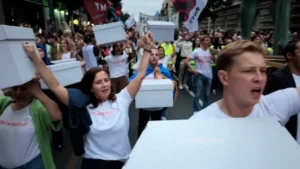
Similar scenes unfolded concurrently across Italy, where students, workers, and community activists converged on major public squares to protest the compounding pressures of inflation and reduced state support for public welfare. The demonstrations, which drew participants from various demographic backgrounds united by economic hardship, quickly escalated as tensions flared between aggressive groups of protesters and cordons of riot police. Authorities in Italian cities utilized batons and physical force to push back crowds attempting to breach restricted zones near government buildings. The use of tear gas became widespread in downtown areas as police sought to regain control over major thoroughfares that had been blocked by angry demonstrators chanting slogans against the current economic trajectory of the nation.
Meanwhile, in Spain, the public outcry over the cost-of-living crisis manifested in large-scale rallies that similarly ruptured into violent confrontations. Protesters marched through prominent commercial and governmental districts, demanding immediate intervention from policymakers to curb rising prices for basic necessities, housing, and energy. As the marches progressed, pockets of demonstrators engaged in direct clashes with police officers, throwing stones, bottles, and other projectiles at law enforcement lines. Officers responded with decisive crowd-control measures, including baton charges and tear gas deployment, to disperse the crowds and prevent further damage to public and private property. The unrest severely disrupted local commerce, public transportation networks, and daily routines for residents caught in the affected zones.
The synchronized nature of the unrest highlights a broader, transnational discontent sweeping through parts of Europe, where citizens feel increasingly alienated by economic policies that fail to address their immediate daily struggles. The combination of rampant inflation, which has steadily eroded purchasing power, and the perceived neglect of public services has created a volatile social climate. Furthermore, the allocation of state funds toward military capabilities—driven by shifting geopolitical tensions and defense commitments—has provided a focal point for anti-establishment sentiment, with protesters questioning the ethics and priorities of increased military expenditures while domestic social safety nets continue to fray.
As law enforcement agencies work to restore order and municipal workers begin the task of clearing debris from the affected streets, the underlying socio-economic grievances that fueled the violence remain largely unaddressed. Governments across France, Italy, and Spain face mounting pressure to respond to the demands of the populace, even as they navigate complex fiscal constraints and international obligations. The events of recent days underscore a deepening chasm between state policy and public expectation, leaving authorities searching for effective strategies to quell civil unrest while managing the persistent crises of economic hardship and public spending allocations.

Related News