Full Steam Ahead: The Rise of Fiscal Dominance and Its Impact on Global Economies
As global financial markets navigate a complex web of shifting economic paradigms, structural fiscal deficits have officially surpassed private sector lending and traditional monetary policy as the primary drivers of economic activity and inflation. This fundamental shift marks the dawn of an era defined by fiscal dominance—a landscape where government spending and massive public debt burdens dictate liquidity dynamics, rendering conventional central bank strategies increasingly obsolete.

Originally compiled and written by market analyst Sam Callahan and commissioned and advised by macroeconomic researcher Lyn Alden, recent insights into the United States economy and global markets reveal that the current economic trajectory is less dramatic than what alarmists predict, yet far more persistent and intractable than optimists hope. The structural deficit problem shows no signs of resolution within the current decade, pointing instead toward a prolonged period of steady nominal growth, elevated borrowing costs, and ongoing currency debasement.

The Global Fiscal Backdrop and the UK Gilt Crisis
To understand how fiscal dominance constrains monetary policy, economists frequently point to the events of September 2022, when the United Kingdom gilt market suffered a severe crash that nearly toppled the nation’s pension system. The crisis was triggered by former Prime Minister Liz Truss’s controversial "mini-budget," a fiscal package consisting of unfunded tax cuts and increased government spending introduced at a time when UK consumer price inflation was running above 10% year-over-year and debt-to-GDP ratios sat at levels unseen since the 1960s.

Investors viewed the fiscal agenda as reckless, sparking a massive sell-off in the gilt market. Because UK pension funds were deeply intertwined with the gilt market through leveraged strategies, the plummeting bond prices triggered a wave of margin calls that threatened their solvency. The crisis forced the Bank of England to temporarily abandon its quantitative tightening and inflation-fighting mandate, stepping in to purchase long-dated gilts to stabilize the financial system.

This episode provided a textbook example of fiscal dominance, demonstrating how overwhelming government debt obligations can strip a central bank of its independence. The Bank of England was forced to prioritize financial stability over price stability, a dilemma that continues to echo globally as governments run massive fiscal deficits despite historical highs in public debt. In the United States, debt-to-GDP ratios remain elevated at levels not seen since World War II. However, unlike the preceding four decades—a period characterized by structurally falling interest rates that made debt management relatively straightforward—today’s environment features persistent, higher-for-longer interest rates. Over the past four years, the federal funds rate has multiplied significantly while public debt has expanded by more than 30%.

As interest rates spiked, the U.S. Treasury’s net interest expense surged. Net interest represents the federal government’s out-of-pocket cost of servicing its debt to external creditors after subtracting offsets like trust fund income and Federal Reserve remittances. By the last fiscal year, net interest had become the second-largest government expenditure, trailing only Social Security and surpassing both Medicare and defense spending for the first time in history.

Defining Fiscal Dominance and the Mechanics of Money Creation
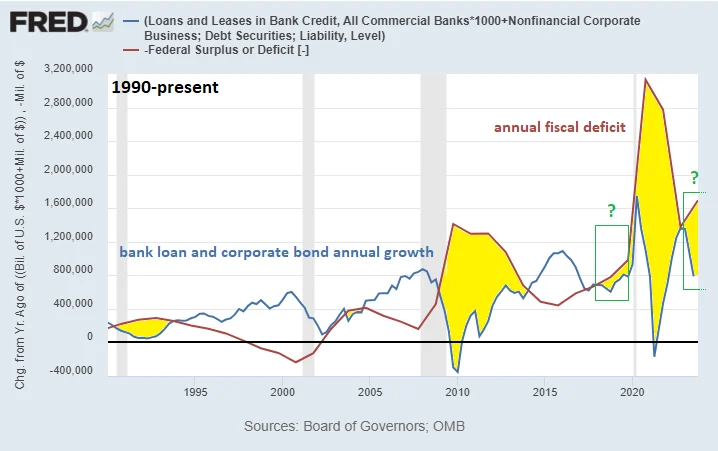
Economic analysts define fiscal dominance as a condition where a country’s debt and deficit levels are so high that monetary policy ceases to be an effective tool for controlling inflation. In such an environment, persistently high interest rates paired with perpetually large deficits risk exacerbating rather than cooling inflation. A complementary definition suggests that fiscal dominance occurs when government deficits become equal to or more influential than private sector lending and traditional monetary policy in driving economic activity.

To grasp this dynamic, one must examine how money is created. Traditionally, money creation has been driven by private sector lending, where commercial banks and private credit institutions issue loans and credit borrower accounts out of thin air, backed by the promise of repayment. Alternatively, governments finance budget deficits by issuing debt. When central banks purchase this debt—either directly through direct monetization, as seen historically in nations like Argentina and Venezuela, or indirectly through secondary market asset purchases like quantitative easing—they expand the money supply and inject liquidity.

Over the last fifteen years, however, the balance has shifted dramatically. Government spending has persistently outpaced revenue collection, and fiscal deficits have grown far more influential than organic private sector credit creation. With over $36 trillion in outstanding public debt and an increasing reliance on short-duration borrowing, higher interest rates rapidly amplify the government’s interest expenses.

These interest payments flow from the Treasury to bondholders across the private sector—including households, money market funds, banks, and pension funds—acting effectively as an economic stimulus. Even as the Federal Reserve raises interest rates to constrain private borrowing, these interest payouts inject liquidity into the economy, sustaining demand and counteracting the central bank’s tightening efforts. This creates an inflationary feedback loop: rising rates increase government interest payments, which widen deficits, stimulate economic activity, and keep inflation elevated.

Why Traditional Monetary Policy Is the Wrong Tool for the Job
In an era of fiscal dominance, the Federal Reserve relies on the wrong tool—interest rate policy—to combat consumer price inflation. Historical precedents, such as former Fed Chairman Paul Volcker raising interest rates to nearly 20% in the early 1980s, successfully cooled inflation because the economic pressures of that era were primarily driven by private sector credit creation.

Today, the structural drivers of inflation are perpetually large fiscal deficits. Because private borrowing has been crowded out by government borrowing and spending, making private credit more expensive through rate hikes fails to cool the broader economy. Furthermore, historical data confirms that fiscal deficits have transitioned from a countercyclical tool used during economic downturns into structural fixtures of the budget. Governments continue to run massive deficits even during periods of multi-decade lows in unemployment, driven by systemic obligations such as an aging population, rising healthcare costs, and compounding interest on accumulated debt.

This structural liquidity injection does not always manifest solely in consumer price indices. In the absence of acute supply constraints in commodities and energy, excess liquidity often flows into financial assets. Since consumer price inflation peaked in mid-2022, prices for equities, real estate, gold, and bitcoin have soared. This asset price inflation erodes purchasing power for households, widens wealth inequality, and favors high-income earners who already hold significant assets, while traditional rate hikes remain powerless to address the root fiscal cause.

Projecting Public Debt and the Challenge of Buyers
Assessing the trajectory of the national debt requires a close look at its composition. Total public debt exceeds $36.2 trillion, divided into marketable debt, which trades on secondary markets and imposes direct costs on taxpayers, and non-marketable debt, which consists of internal trust fund obligations like Social Security and Medicare.

Focusing on debt held by the public, the government faces a heavy refinancing schedule due to a short-term maturity profile skewed heavily toward Treasury bills and notes. Billions in debt must be rolled over annually at prevailing higher interest rates. Economic modeling across various fixed interest rate scenarios demonstrates the compounding impact of borrowing costs. Under a fixed 5% rate over the next decade, debt-to-GDP pushes past 108%, whereas a fixed 2% rate sees the ratio decline below 95%.

However, debt-to-GDP metrics can be misleading. Nominal GDP growth driven by deficit spending and inflation can artificially stabilize or reduce debt-to-GDP ratios while masking severe underlying currency debasement and nominal debt accumulation, a phenomenon observed in extreme cases like Turkey.

As the U.S. government continues to issue debt to cover structural deficits, the crucial question remains: who will buy it? Historically, domestic institutions, banks, insurance companies, and pension funds have absorbed Treasury issuance. Yet, post-financial crisis banking regulations cap bank demand, and rising interest rate volatility makes long-term bonds less attractive to institutional investors seeking shorter durations to manage risk. Meanwhile, foreign ownership of U.S. debt has steadily declined over the past 15 years, dropping from 47% to 30% amid geopolitical tensions and international diversification into neutral reserve assets like gold.

While emerging buyers such as stablecoin issuers have drastically increased their holdings of short-term Treasury bills, they do not solve the government’s need to finance long-duration debt. Stablecoin operators maintain that immediate liquidity is paramount, leaving them unwilling to absorb long-term bonds. Consequently, if foreign and domestic private demand wanes further, the Federal Reserve risks being forced back into the role of buyer of last resort through quantitative easing—undermining its inflation-fighting mandate to stabilize the bond market.

Can Private Credit or Government Efficiency Reforms Save the Day?
To escape fiscal dominance, policymakers face two fundamental paths: either the private sector expands to reclaim its role as the primary engine of economic activity, or fiscal deficits are meaningfully reduced. While private credit markets have grown significantly over the past two decades, they still comprise a mere 2% of the total non-financial debt market, rendering them too small to alter systemic liquidity dynamics.

Attention has frequently turned toward the Department of Government Efficiency (DOGE), an advisory commission aiming to target federal spending cuts. However, achieving substantial reductions is constrained by the structure of the federal budget. Mandatory spending—comprising entitlement programs like Social Security, Medicare, and Medicaid—accounts for roughly 61% of total spending and is legally mandated. With both incoming administration leadership and party platforms explicitly vowing to protect Social Security and Medicare, these programs remain off-limits without congressional legislative overhauls.

Defense spending accounts for nearly half of all discretionary expenditures, and ongoing geopolitical tensions point toward modernization rather than contraction. This leaves non-defense discretionary spending—roughly 14% of the total budget—as the primary target for potential cuts. Even if the entirety of non-defense discretionary spending were eliminated, it would fall short of aggressive deficit-reduction targets. Furthermore, mandatory spending components tied to an aging population and interest expenses are projected to drive 87% of nominal spending growth over the coming decade, easily eclipsing potential discretionary savings.

Compounding the challenge, federal tax receipts are heavily correlated with equity market performance rather than labor markets alone. Because capital gains and dividend taxes form a major portion of federal revenue, spending cuts that trigger a contraction in asset prices could paradoxically cause tax receipts to fall faster than expenditures, widening the deficit further.

Navigating an Era of Fiscal Dominance
The global economy has entered a persistent era where fiscal policy dictates economic activity and inflation. While central banks grapple with the tension between lowering rates to ease sovereign debt servicing costs and raising rates to fight inflation, structural deficits continue unabated.

Despite these profound challenges, several stabilizing factors suggest the era of fiscal dominance will unfold gradually rather than resulting in an immediate crisis. The global demand for U.S. dollars, reinforced by trillions of dollars in foreign debt denominated in the U.S. currency, provides a robust buffer. Additionally, because U.S. debt is denominated in its own currency, and the domestic economy possesses deep capital markets, the nation retains flexibility unavailable to smaller sovereign debtors.

Rather than culminating in a sudden financial collapse, fiscal dominance will likely manifest as a persistent, structurally hot economic environment characterized by steady nominal growth and ongoing currency debasement. In response to this enduring landscape, market participants increasingly turn to scarce, hard assets—including real estate, equities, gold, and bitcoin—as pragmatic hedges to preserve purchasing power against the gradual erosion of the fiat currency.

Related News